
Reprint

Not enough hours in the day
The Sunday Times, December 11 1994
Culture Essay
By Brian Deer
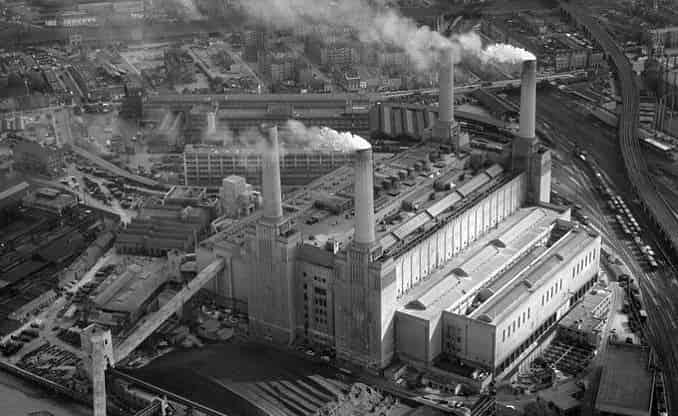
When each morning’s swarms of 747s arrive from North America, form into line and drop their wheels over London, window-seat passengers may read a telling message from the country that lies below. As the aircraft turn away from the sun to descend westward into Heathrow, they pass four giant cream-coloured chimneys that rise from a crumbling cathedral of bricks. On the south bank of the Thames, by a big patch of grass and trees, the ruined power station at Battersea signals. A beacon on the flight path of time.
For two generations this building was a wonder of the industrial age. When gantry cranes first dragged its 31-ton switches from off to on in 1933, the London Power Company which owned it was hailed as a miracle of enterprise. At its peak in the 1950s, Battersea burnt a million tons of coal a year and sucked 340 million gallons of water daily from the river. Even after it shut, in 1983, its fluted 337-foot chimneys remained as icons of a golden era. They spoke of battleships and ocean liners, of steam trains, mines and mills.
In the depths of the inter-war depression, the construction of this colossus gave the finger to pessimism. When, in June 1935, the third of its eventual six turbo-alternators was synchronised – a massive 140,000 horsepower Metropolitan Vickers – the empire listened to the station’s roar by wireless around the world. This one piece of machinery, 120 feet long and with an 85-ton rotor spinning 25 times a second, generated 105,000 kilowatts per hour at 11,000 volts. It was a spider in the newly formed National Grid – juicing the soaring labour-saving inventory of employed people’s consumer goods.
 But from the air today you might easily decipher Battersea as a vast signpost pleading “Help!” Although classified as a grade 2 historic building, its central roof, once 100 feet above the ground, has gone, along with most of one exterior wall. The inside, much of which was an art deco masterpiece, has been gutted, and all of its machinery scrapped. Outbuildings have been demolished and the 15-acre site is a now rat-infested waste. Of what calamity could this be a remnant? A firestorm? A civil war?
On cursory inspection, the fate of this building is a peculiarly 1980s tale. After a competition to decide Battersea’s future, a syndicate led by one John Broome was given the go-ahead to turn it into a leisure centre and entertainment park. Among the novel features they proposed were electronic golf, a dance floor and gym. There would be a swimming pool, jogging track, weights room and health spa. There were to be cinemas, shops, restaurants and tea rooms. There would be an oceanarium, carousels and Disney-style rides. An all-in ticket, priced #3.50, would admit you to everything.
Not least among this plan’s supporters was the prime minister, Margaret Thatcher, who praised Broome, a leisure entrepreneur, for what she called his “vision”. She particularly warmed to his intended “theming” of Battersea, which was meant to turn the great Deco hall of turbo-alternator No 3 into “The World of Dickens” and give a similar adjacent industrial cavern a new “Tudor look”. Between the buildings and the river, where once 85,000 tons of coal had been piled, a “Tivoli-style gardens” would be laid out, while the entrance to the station was to get a “Victorian” glass canopy.
It was a ludicrous scheme, which appeared to have been drafted on folded and gummed manila. Although the developers boasted that by 1990 Battersea would be entertaining “a quarter of the moving population of this country for six hours at a time”, a street-corner market researcher could have told them that this would never be so. Fun park families know all about London’s traffic. And the clientele of leisure centres, whether private or municipal, is heavily skewed towards the young middle class – who would hardly come from Chelsea with their Turbos and towels to some hideous house of schlock.
But for all its obvious absurdity, the plan was at one with the times. The enthusiasm with which Thatcher ploughed up the landscape of work required, at least in partial justification, some renewed aspirations for leisure. The return of 1930s-style mass unemployment was the stick to a sceptical nation, but among the carrots was the notion that life would be better for some. Not only would people have more leisure for themselves, it was posited, but slumped manufacturing businesses would be replaced by burgeoning new activities on this allegedly fertile terrain.
“There is much industry to be had from people’s pleasures,” was how Thatcher explained it to The Director magazine in the year that Battersea closed. It was one of her more endearingly candid interviews with her own people’s publications. “We must expect that a lot more of our jobs will come from the service industries – from the McDonalds and Wimpys, which employ a lot of people – and from the kind of Disneyland they are starting in Corby. Leisure is a big industry.”
What better proof, in the heart of the capital, than the coal-burning citadel of power? Notwithstanding the taste, this building revamped would have become the epitome of the Thatcherite transformation. What, indeed, could be more appropriate to greet foreign visitors flying into Britain than a relic of the passing industrial age turned into a leisure centre? The prime minister herself fired a laser beam launching Broome’s ingenious conversion, switching her gaze from the hell of the jobless to the heavens of frolics and fun.
That the building is derelict speaks for itself, but Thatcher, as was her habit, was stabbing a hot but neglected button. In the same way that she realised that most people agree, when prompted, that their taxes ought to be lower, but do not otherwise think much about it, she was also aware of a strong unstated instinct that leisure is a primary goal. And since it was clear that British industries would need replacing with potent money-spinners in the imminent “information age”, many pundits and politicians joined her efforts to steer the public mood.
Most eloquent among them was Peter Walker, her energy secretary, who in 1983 took time out from plotting coal’s closure to write a polemic on leisure. “With care and thought we can now have a better lifestyle,” he gushed in a newspaper article. “And possibilities for time for far more pleasure, for travel, for reading and for those activities that bring genuine happiness and enjoyment to the individual. It is a whole new concept of life that the information society is going to provide. We have the opportunity of creating Athens without the slaves, where the slaves will be the computer and the microchip and the human race can obtain a new sense of enjoyment, leisure and fulfilment.”
Battersea’s role in Athens without the slaves has yet to be decided, but, as a power house, a pleasure palace or a plain old ruin, its message is as much about the future as its structure is a voice from the past. Will the replacement of manufacturing industry by the global infobahn liberate the masses from toil? After more than a decade of the revolution that Thatcher began, are there long-term trends behind the fickle business cycle that promise you and me a better life? Or is bold talk of leisure a confidence trick of capitalism – a stroke pulled to suit the time?
*****
On the morning of St George’s Day, 23 April, 1931, a marquee was erected at the uncompleted Battersea for a curious gathering. While builders cemented the structure, engineers measured spaces for the turbo-alternators and electricians tested cables to suburban switching stations, a party of great and good dignitaries held a stone-unveiling ceremony. Herbert Morrison, Labour’s transport minister, gave a post-luncheon speech and a transatlantic phone call was taken from Canada’s governor-general.
It was just eight days before the futuristic excitement of the Empire State Building’s opening, but the assembly in London, as the stone explained, was looking into the past. A century before, Michael Faraday had made one of the landmark discoveries of the industrial revolution – showing that a copper disk rotated between magnets would produce electricity. “Science has no frontiers,” the governor-general’s amplified voice boomed across the riverside site. “The whole world is its parish.”
Those invited were from the high bourgeoisie, including 21 knights, seven MPs, three Lords and the Dean of York, so among the party there must have been some considered positions on leisure. But there was another centenary connection that was probably not on their minds. It had been in Faraday’s 1830s when the precondition of having leisure, time off work, began. At first it was only for those aged under 13 in the mills, whose hours were cut by parliament to a maximum of eight a day. This was mainly a restrictive practice by the owners to block parvenu rivals – and many of the liberated children promptly went down the mines. But it was a big step in the day’s division that we take as natural now.
Britain led the industrial world in the move to shorter hours. The fight began in earnest in the 1880s, escalated into huge demonstrations in 1890 and was victorious after the First World War when the employers caved-in. In the wake of the Bolshevik uprising (when even the British royal family felt it wise to withdraw a holiday invitation to their beleaguered Russian relatives) the eight-hour day seemed a sensible concession to a truculent working class. Saturday afternoons had been granted to most already and the week’s annual holiday at the seaside was rapidly on the rise.
By the early 1930s, when Battersea was preparing to fuel the new arsenal of irons, washing machines and vacuum cleaners, the prosperous suburbs could hardly stop talking about the new “leisure boom”. On the Faraday centenary, there were 344,000 cinema seats in the county of London, a sevenfold rise on 20 years before. There were 9,500 bookies in Britain, a rise over the same period from less than 3,000. Even in the most bug-bitten slums there were still day trips to the country, greyhound meetings, boxing, the wireless and concerts. The war did not stop the momentum, moreover, which continued in the following decades.
But at some point, buried within this boom, time started slipping away. Even as work was formally curtailed – with compulsory hours falling, paid holidays rising and retirement enforced earlier, any gains were being debited from elsewhere in people’s lives. By the 1980s, this phenomenon had become such a politically-sensitive paradox, that Thatcher’s “Disneyland-at-Corby” intervention was a masterpiece of leadership. The bad news about leisure from jobs was revised as good news about jobs from leisure.
On such subjects, the hard data usually belongs to business, so not much is floating around. In the United States, however, where a similar trend has been under way, a Harris survey carried out before the 1990 recession found that the average person had 37% less leisure time than in 1973. If you took commuting into account, the organisation found that the average working week had lengthened – from just under 41 hours to nearly 47.
The Henley Centre in Britain has made similar inquiries, studying changes in the availability and pressures on our time. It found that between 1985-6 and 1993, total essential commitments (including work, travel, household chores and other unavoidable tasks) on average rose more than 3% for men (to 71 hours) and nearly 4.5% for women (to 86). Breaking these figures down, it found that, over the same period, full-time working females experienced a 10% loss of free time; full-time working males more than 4% and unemployed males 3.5%. Even retired women felt a 2% loss of time.
It could take forever to explain all this, but the most immediate reasons are the structural changes that modernising capitalism requires. With sharp rises in the numbers living alone, and particularly of single parents, old domestic “economies of scale” are shrinking in shopping, child care and bill-paying. And as the collectively-financed powerhouses of health and social services withdraw long-term support for the growing numbers of old, sick and disabled people, these responsibilities fall on relatives and friends. The celebrated tax cuts have, in part, been paid for with deductions from people’s time.
But if quantitative matters have gone askew, what about “quality time”? Perhaps post-Battersea Britain may be dawdling less, but still be closer to Walker’s Athenian order, with its “new sense of enjoyment, leisure and fulfilment”. Possibly, the appreciation of life-enhancing recreation and access to the richest corners of the world’s cultures is rippling through a new classless, tasteful and educated society. Or, maybe, brain-dead channel surfing sounds more like “leisure” today.
The slave-owning philosopher Aristotle, to whom Walker was of course alluding, felt that this was the key question in the whole leisure thing. For him, leisure was not a period of time, but referred to a state of mind of being free from the need to labour. Activities in this mental frame should have no ulterior goals. “We think of it as having in itself intrinsic pleasure, intrinsic happiness, intrinsic felicity,” he wrote in Politics. “Happiness of that order does not belong to occupation: it belongs to those who have leisure.”
Since the sum of Western ideas are largely footnotes to the Greeks, attempts by intellectuals at redefinition have failed to displace this view. By Aristotle’s way of thinking, leisure activities are not so much the kind of things that were later planned to transform the power station – often intended to prepare for, or aid recovery from, the effort of work. Nor was unemployment a life of leisure – because that was tainted by fear. In fact, he felt the only real quality things were music and contemplation.
Sadly, if you look at “leisure” today, you discover a quality problem. For instance, although well over half the population go swimming at some point each year, it is often an own-time work duty for fitness and social advantage – the late 20th century’s version of the tin bath in front of the fire. Alternatively, like the gardening craze, the meaning of leisure has been turned into little more than the purchase and consumption of goods. Tending even a modest back yard is fraught with extraordinary expenses on equipment, plants and fertilisers. Britain spends £7m a year on slug killers alone.
For all our Greek heritage, nearly every pursuit away from work has become a frenzy of spending money. As Christmas shoppers are now being reminded, in order for the volume of goods and services to be increased, the other side of the equation – consumption – must go up accordingly. In this vortex, leisure in Aristotle’s sense is more or less dead time, when people are neither working nor consuming – doing nothing from which the controllers of capital can readily make a profit. Production and “leisure time” must hold each other tightly, or the dance will come to an end.
Of course, the bosses spotted this symmetry before conceding the eight-hour day – and to fully appreciate its beauty you need only look at Henry Ford. Although during Battersea’s earliest years, his employees across the Atlantic toiled like slaves without the Athens, their wages were considered progressive for manufacturing and they had enough hours off each week to enjoy the new “leisure lifestyle”. Time-and-motion experts had long before found that shortening the day need not reduce an industry’s output. And the first thing the workers wanted for their precious free time and hard-earned money was an automobile from Ford. When the man died in 1947 he was very, very rich.
But today any charm is leaving the waltz as the music plays faster and faster. Despite current political worries about the public’s reluctance to spend, in the longer term consumption must accelerate to foster growth and profit. Time away from work must more than ever be exploited ruthlessly with expensive goods and services – and not just through changing footwear fashions, or the choice of television stations. We must fill every vista and orifice with an exponentially increasing inventory of investment-intensive produce.
To sample the horror of what is to come, consider “leisure” computing, which is opening the frontier of cyberspace and its potential to be infinitely consumed. The Mintel market intelligence company estimates that, despite the recession and price cuts, sales of computer and video games have risen from £179m in 1989 to £700m this year. Half of homes now have the hardware on which to play them. And, while 15% of people surveyed said that these games were too violent and 23% said they discouraged conversation, an incredible 46% said they were addictive – including nearly half of those aged 15 to 19 and 60% of those in their early 20s, who know all about such things.
*****
Like most pursuits, cyberspace games do not require 300-foot chimneys, but looking again at Thatcher’s Battersea hopes: they made a certain sense at the time. With her grasp of social history, she might well have spotted its claim to have been a leisure centre all along – fuelling distant dishwashers and television sets, at the simple flick of a switch. And she would have known that for Marxist intellectuals, mass electrification was seen as a step on the socialist road. How their defeat must have made her want to dance around Faraday’s memorial stone.
But, if the political landscape has dramatically changed, those better-life hopes for the National Grid have a clear modern parallel. Under the streets around the old power station, its giant copper cables have been joined by a new web of fibre-optics. In this revolutionary network, a single strand as thin as a hair can carry, at the speed of light, 1,890 simultaneous digital signals – be they telephone calls, television programmes, computer chat or video conferences. The information superhighway is being laid, raising bold visions again.
If more leisure does not come from this, it is hard to see at the present time from where it is likely to spring. As the cables go down, a line is being drawn through societies all over the world, on one side of which millions of people will join the information age. For scores of occupations, from finance, through every kind of design, marketing, brokering, scheduling, consulting, educating and entertaining, the drudgery of fact retrieval, data manipulation and communication is being lifted miraculously. Working in stateless service enterprises, their opportunities to apply their brains will be greater than ever before.
For this group, an international infoclass, the future looks reassuring. What could be conceived that is further from the grim age of factories and clocked-on days? With ideas, creativity and decision-making as the essence of these people’s work, many could switch it to California or the Caribbean and nobody but they need know. And with current trends extending towards self-scheduled leisure, their day will be as flexible as only poets and painters have known, at least since agrarian times. With such thoughts, these movers and shakers might feel an Athenian song coming on.
This, however, is the ultimate deception of capitalism’s modernisation – another elaborate fantasy world that nobody will ever see. Unlike 18th century shepherds blowing flutes and watching their flocks, or farmers tapping mah-jong tiles while they wait for the rice to ripen, the infoclass will find itself trapped in a fearsome round-the-clock race. Not for them will be the life of cheerily hawking their wares to village neighbours, with modest local competition. They will be trading in global markets, where their rivals never sleep.
Here is not a beginning for leisure; this is where it ends. A public relations executive in Manchester loses an account to another in Sydney because he was taking the kids to school when the Australian made a pitch. A Cape Town cardiologist is fired by an Ontario hospital because she took her summer vacation during its busy winter week. Dozens of publishers in New York and London are trapped by a prized author in Nairobi in an instant bidding contest. All reconfiguring costs and margins against millisecond-counting clocks.
As the machines run faster (and processing is currently doubling in speed about every 18 months) people may have more theoretical discretion about their work and recreation time. But the superhighway will favour the quick, even above the inspired. And as market signals approach the economists’ dream of perfect knowledge, non-market considerations will come to count for less. All the small pauses in which leisure once lived, will be relentlessly squeezed in the Net.
In this world, time itself will seem to accelerate with consumption. A trip to the opera, a dinner with friends or a long night of sex may need to find some justification in what it brings to the working day. Will it give access to classical paradigms for use in an advertising war? Will it create a friendship to open a door that on-line is stubbornly shut? Will it release the tension in shoulder muscles caused by hunching in front of screen?
Many among the infoclass, of course, will find pleasure in providing their services – but confusions of labour and leisure only quickens the pace even more. It is no new discovery that people toil harder if they have a sense of purpose, discretion and responsibility. Even in 1991, the national census showed that a quarter of corporate executives worked more than 40 hours a week and 7.5% more than 50. This compares with less than 5% and 0.6% respectively of more-directed clerical staff.
That the length of the day is linked to what it entails is, in fact, one of the most important lessons of the old eight-hours campaign. Much of that movement’s energy emerged in the 19th century precisely as mill owners most vigorously assaulted the labourer’s quality of life. As pre-industrial features like creativity, responsibility and diversity were eliminated by intensive technologies, so work’s duration diminished – creating the chance for leisure time. It is another reason for forecasting that, as the infoclass reclaims those features, its time spent working will go up and time for leisure will fall.
Those who will sell Disneyland hamburgers rather than join this harried class may hope to get off lightly. But no evidence points to that. As Britain shuts the door on the industrial age and the last vestiges of manufacturing move to more appropriate, foreign, locations, most of those in face-to-face jobs will feel carved-up as well. If they are spared the frenetic chase of the infobahn, their jobs will be pursued no less keenly by those millions who do not have them. A few doctors, lawyers, teachers and hands-on technicians may smile, but for most, the businesses in other people’s pleasures may not be a lot of fun.
It is hardly surprising that so many Britons have an inexplicable feeling of fear. Prod a little, as Thatcher did over tax cuts, and you find that people know instinctively that, say, the currently rocketing numbers of part-time, self-employed or short-contract jobs is not a foretaste of booming leisure, with microchips for slaves. Even the bosses are in terror at the prospect of losing their positions – awarding each other stunning sums of money, just in case of the worst. But, as with the vast ruined building at the heart of the capital, the very familiarity of such issues tends to jade any sense of concern.
Joe and Joanna Public, however, know that something deep is happening – and, if you bother to ask them, more or less what it is. In what must be one of the least publicised sequences of social questioning ever, Gallup put to people in April: “There used to be a lot of talk in politics about a ‘class struggle’. Do you think there is a class struggle in this country, or not?” Of those surveyed, a startling 78% said “yes there is”. This figure was a rise from 74% in 1984, from 60% in 1974 and from just 48% ten years before that. People may have interpreted the inquiry differently, but, unusually for opinion polling, the words stayed the same.
There is a lot to be debated about the attitude suggested, but for now it is enough that this fascinating question may help with the paradox of leisure. In the 1960s, when the poll showed that more than twice as many people denied there was a class struggle than do so today, the landscape of life was fertile ground for personal, high-quality time. And to see how that can have been: just watch how, say, inflation trails behind interest rates, or employment behind public spending. A window of opportunity opens and then it closes again. Free time became available before consumption caught up with it – when, for a brief moment in history, people had hours, days and weeks that they did not convert straight into products and services.
That period, which began in earnest after the war and partied-on until the end of Edward Heath’s government in 1974, had all the magical pleasure of the unplanned childhood treat. It was as if in 1945 the nation had woken up feeling ill, got the day off school and then mysteriously recovered by about half past ten. There was no guilt, or fear of punishment. There was no homework to do and no more would be coming that night. The afternoon was pure freedom, even for music or contemplation.
As it happens, that was when Britain built its welfare state, but those were also the days, for instance, when there were twice as many bingo clubs, but less than half the gaming machines. When students could claim housing benefits and so often spent the summer travelling, or just hanging out. When many women had seen some of the burdens of housework lifted, but could still choose not to work. When there were no mobile phones. And when there were not even four television channels, let alone the home shopping network, QVC, headquartered by Battersea.
But then it ended in a miner’s strike, an international oil crisis and economic “stagflation”. The minority administration of Harold Wilson, elected in February 1974, symbolically marked the moment of change – and even by the following year, as Britain voted on the Common Market, everybody sensed that the days of leisure were firmly in the past. What seems to us now to be receding ahead had already fallen behind.
This was also the time, by one of life’s coincidences, of an event at the power station. Below the still-smoking chimneys, another curious ceremony was held, although no knights or deans took part. On 7 February 1974, amid a wave of workers’ emotion, the signal was given from the control room to shut down No 3. Valves turned away its steam and for the last time the giant turbo-alternator lost speed and spun to a halt. In nearly 39 years, it had run for 205,000 hours and generated 14,558 million kilowatt-hours for the Grid. The station carried on for another nine years, but this machine was its heart.
It would be fair to hope that on a winter’s night you could still hear the roar of No 3, and not the thwack of ghosts playing squash. But when the roads have calmed and the airport has closed, you cannot find much in this monument to leisure of what has gone, or what was planned. You do notice cats and scurrying rodents, but the most conspicuous sound, every 15 minutes, is from a couple of miles downstream. From a gothic tower above the “mother of parliaments” comes the striking of a clock.
Culture Essay: Japan feels the squeeze.
MORE TOPICS:
Bactrim-Septra: a secret epidemic
Research cheat Andrew Wakefield