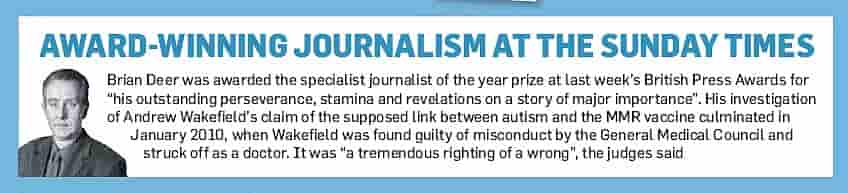
Newspapers praise as investigation leads to MMR retraction
In February 2010, following Andrew Wakefield’s disgrace before a statutory tribunal of the UK General Medical Council, the Lancet journal retracted a 1998 paper which Deer’s investigation had investigated over the previous six years. The retraction, in particular, received huge media attention, on TV, radio and in newspapers, especially in the United States.
Below is a selection of editorials.
Reprint

New York Daily News: Hippocrates would puke – Doctor hoaxed parents into denying kids vaccine
February 6 2010
British physician Dr. Andrew Wakefield has been branded a primary instigator of the mania that drove parents to avoid having their children undergo routine immunizations for fear that inoculations could produce autism.
It was Wakefield’s article, published in 1998 in the premier British medical journal, The Lancet, that gave authority to the proposition that combined inoculations for measles, mumps and rubella were connected to childhood autism.
Now, though, the United Kingdom’s General Medical Council, which licenses doctors, has concluded that Wakefield cherry-picked the children who became his study subjects, including paying kids at his son’s birthday party to give blood.
The council also found that he subjected children to unnecessary procedures, such as colonoscopies, for experimental purposes without getting ethical approval. Oh, and Wakefield was secretly bankrolled by lawyers who hoped to sue vaccine makers. Oh, and he owned a patent on a competing measles vaccine.
Perhaps no one did more than Wakefield to fuel fears of a link between vaccinations and rising autism rates – fears that persist despite numerous studies refuting any connection.
As Alison Singer, president of the Autism Science Foundation, put it, “That study did a lot of harm. People became afraid of vaccinations. This is the Wakefield legacy: this unscientifically grounded fear of vaccinations that result in children dying from vaccine-preventable diseases.”
Steadfastly defending both his integrity and his science – and backed by supporters who mutter about “show trials” and “witch hunts” – Wakefield has been shamed before the world. He deserves far worse.
Reprint

New York Times: A Welcome Retraction
February 5 2010
For a decade, many parents have worried that vaccines might somehow be causing autism in children. Repeated assurances from respected experts that there is no link have failed to quiet those fears. Now The Lancet, a prestigious British medical journal that published the paper that first gave wide credence to those fears, has retracted it, saying that the paper’s authors had made false claims about how the study was conducted. The journal acted after a British medical panel had found the lead author, Dr. Andrew Wakefield, guilty of dishonesty and flouting medical ethics.
The original paper, published in 1998, was based on only 12 children. It nevertheless drew an inferential link between an autismlike disorder and the triple-vaccine used to prevent measles, mumps and rubella. Although that paper stopped short of claiming the combination vaccine caused the disorder, Dr. Wakefield suggested at a press conference that parents would be wise to use single vaccines for each of the diseases.
What was not known at the time was that Dr. Wakefield had filed for a patent on a single measles vaccine that would benefit if the triple vaccine failed and that he was receiving payments from a lawyer planning to sue manufacturers of the triple vaccine.Die-hard believers in the theory that vaccines cause autism are already denouncing the British medical establishment for smearing one of their heroes.
Many parents have moved on to other theories as to how vaccines might cause autism only to be met with overwhelming evidence that there is no causal link. What is indisputable is that vaccines protect children from dangerous diseases. We hope that The Lancet’s belated retraction will finally lay this damaging myth about autism and vaccines to rest.
Reprint

Windsor Star: Autism and vaccinations study flawed
February 12, 2010
The Lancet is probably the most respected medical journal in the world. Founded in Britain in 1823, it’s considered the authority on everything from advances in health care to surgical procedures and groundbreaking studies.
When The Lancet speaks, people listen. But will people listen to what the distinguished magazine now has to say about the link between autism and childhood vaccinations?
We can only hope so. Last week, The Lancet disavowed itself of a controversial 1998 British study that suggested the vaccine for measles, mumps and rubella (MMR) led to autism. Ten of the 13 original authors of the study also signed a formal retraction, saying that while they’d never actually said MMR vaccines caused autism, people did make that “interpretation.”
Indeed they did, and it caused millions of parents in North America and Europe to forgo vaccinating their children, leading to many deaths and the return of diseases that had been all but eradicated.
There is now such a persistent belief of that link between MMRs and autism — fuelled by influential but uninformed celebrities like Oprah Winfrey and Jenny McCarthy — that it will be difficult, if not impossible, to change people’s minds.
What’s astonishing is not that The Lancet admitted this was a flawed study and therefore withdrew its support. What’s astonishing is that the findings were published in the first place. Only 12 children were involved in the study. It was conducted eight years after they were vaccinated, and it was based on the anecdotal reflections of parents, who seemed to recall that the first signs of autism coincided with the inoculations.
The fact that autism first presents around the time of childhood vaccinations should have raised a red flag. The credentials of Dr. Andrew Wakefield, the study’s lead author, should have raised another.
Last month, the British General Medical Council ruled that parts of Wakefield’s study were false and that he showed a “callous disregard” for the children involved. The council called him unethical and pointed out he had been paid by the lawyers of parents who were suing vaccine makers because they alleged the shots had caused autism in their children.
There were 30 charges against Wakefield, including conflict of interest and scientific misconduct. (The doctor was not present; he now lives in Texas, where he runs a centre for children with autism. He is not, however, licensed to practise medicine in the state.)
Ironically, the general medical council was able to make these charges because a reporter with Britain’s Sunday Times challenged the
doctor and his colleagues in a series of investigative stories published in 2004. Brian Deer uncovered what the government and The Lancet did not.
It’s good that those 10 colleagues have come clean, and that The Lancet has withdraw its support. “But the truth of the matter is the damage has been done,” Dr. Allison McGreer, an infectious diseases expert at Mount Sinai Hospital in Toronto, told the Canadian Press. In other words, the perception of the link is firmly entrenched. The effect this has had on parents and children is shocking and disgraceful. Now it’s time for the venerable Lancet to use its resources — and its clout — to spread the word and set things right.
Reprint

Los Angeles Times: Vaccination vindication
February 6 2010
A study that showed a possible link to autism has been retracted.
It has been obvious for years that a British study positing a possible link between a common vaccine combination and autism failed the physician’s injunction to “do no harm.” Still, it’s significant that the influential medical journal that published Dr. Andrew Wakefield’s discredited study in 1998 finally has retracted it.
The decision by the Lancet won’t change the minds of some parents. It will not entirely dispel the conspiracy theories about how the medical establishment covered up a connection between autism and the MMR vaccine, which protects infants against measles, mumps and rubella. Still, the conclusive repudiation of what has been a sacred text for the anti-vaccination movement should reassure at least some of the families that have refused to accept an overwhelming medical consensus that MMR was safe as well as effective.
In belatedly rejecting the Wakefield study, the Lancet criticized more than its bad science. Dr. Richard Horton, the journal’s editor in chief, linked the retraction to a medical panel’s judgment that Wakefield’s research had been not only dishonest but a violation of ethical rules. The panel also said that Wakefield had shown a “callous disregard” for the suffering of children who participated in the study. But it is not just the participating children who suffered — and not just Wakefield who showed callous disregard. Those who propagated the vaccine-autism connection exhibited willful blindness to multiple studies debunking it.
The Wakefield study seems to have had worse consequences in Britain, where vaccinations declined dramatically after its publication, than in this country. Even so, the anti-vaccination movement it unleashed — one that has been amplified by the Internet and a culture of skepticism toward mainstream medicine — certainly influenced decisions by parents in the U.S. not to have their children vaccinated. It’s hard to believe, for example, that anti-vaccine propaganda played no part in recent increases in measles cases or in the number of parents seeking “personal belief” exemptions from vaccinating their children.
Children with autism disorders face serious challenges, as do their parents, teachers and caregivers. The diagnosis is deeply unsettling to parents, who are understandably susceptible to theories pointing to an external cause. But the price of the vaccination scare stoked by the Wakefield study has been more sick children. We hope this will be a retraction heard round the world.
Reprint

San Francisco Chronicle: A reality check on autism and vaccines
February 6, 2010
Many worried and angry parents of an autistic child believe that vaccines may cause the disease. But it’s pure myth – disproved by numerous studies and now a final slap from a British journal disowning a report that started the dangerous nonsense.
Will these parents accept reality – and allow their children to receive shots against a dozen or more illnesses? And will fringe groups that play to fears of autism give up their indefensible claims?
The answers can’t come soon enough for public health experts. Vaccination rates, while generally high, have shown dips partly because parents are citing the notion of vaccine dangers in skipping shots for their children.
Smallpox and polio have been virtually eradicated thanks to vaccines. But whooping cough, pertussis and measles – all but stamped out years ago – can reappear via unvaccinated patients.
A law that allows parents to opt out of school-required shots has raised the worry level. This so-called exemption rate statewide is 2 percent, but it was 6.3 percent in Marin County and 5.8 percent in Sonoma County in 2008, according to the state Department of Health Services. Vaccine “denialism” has become a public health issue.
In the case of autism, a sketchy study by British physician Andrew Wakefield in 1998 set the vaccine blame game in motion. He claimed that a combined measles, mumps and rubella inoculation given to infants was linked to the disease, and his findings were published by a prominent British medical journal the Lancet.
But follow-up research by other teams failed to match his results. In recent years, his study fell apart amid charges of dishonesty, violations of research ethics and a “callous disregard” for the 12 children involved in the research. The Lancet disavowal this past week capped the collapse. How does he feel about the wholesale discrediting of his work? The findings are “unfounded and unjust,” he said.
The damage will be hard to undo. Autism, a range of conditions that disrupts communication skills and social interaction, has grown in reported numbers as parents and doctors learned to recognize its symptoms. Nearly 1 in 100 American children is diagnosed with autism or a related condition.
Without any effective treatment – or even a clear understanding of the causes of the disease – parents are primed to be impatient with slow research results and look for villains.
The Wakefield study provided an easy and dramatic message: Shots cause autism. Avoid vaccines and save your child from the troubling condition. It’s a scientific fact confirmed by a doctor. His findings expanded on other, equally ungrounded fears about other contaminants in vaccines.
But it was pure quackery. Public health experts fought the message but were savaged by anti-vaccine forces as flunkies of drug companies. Fringe medical figures had a field day, stoking the fears of worried parents desperate for an answer. Hollywood celebrity Jenny McCarthy, the mother of an autistic child, pushed the claims on talk shows and through a foundation she founded. This past week she continued to defend the discredited vaccine study.
The rejection of Wakefield’s published work is way overdue. Also overdue are similar rejections from anti-vaccine groups and leaders like McCarthy who are deluding desperate parents with autistic children and leading others to disregard vaccines. Too much money and time has gone into countering these ill-founded claims instead being directed toward research and reliable treatments for autism.
Disposing of a flawed theory on autism is one issue. But there’s another that may be harder to end: a disregard for science. That may be the ultimate casualty of a misguided hunt for an answer to autism.
Reprint

Toronto Star: A blow to vaccine `link’
February 4 2010
It took 12 years, but The Lancet finally got it right this week. The world’s leading medical journal retracted a 1998 study it had published that linked the children’s vaccine for measles, mumps and rubella to the onset of autism.
The study, by Dr. Andrew Wakefield and others, had been discredited before by scientists and disowned by some of Wakefield’s co-authors. But until now, it had remained part of The Lancet‘s prestigious published record.
“It has become clear that several elements of the 1998 paper by Wakefield et al are incorrect,” said The Lancet. “Therefore we fully retract this paper from the published record.”
Unfortunately, much of the damage has already been done. Doctors say there has been a decline in vaccination rates for children. They point to the 1998 Wakefield study as the spark, which was fanned in TV appearances by celebrity parents of autistic children such as former Argonaut quarterback Doug Flutie. A 2006 survey found that just 61 per cent of 2-year-old Canadian children had received the vaccine for measles, mumps and rubella.
If this week’s retraction of the study starts the pendulum swinging in the other direction, it is none too soon.
Reprint

New Zealand Herald: Dodgy science is bad medicine
February 7 2010
It’s a sad fact that the retraction this week of a controversial research paper on the effects of a common childhood vaccination will not have anything like the impact on public opinion of the paper’s original publication.
Poet John Milton observed that “evil news rides post, while good news bates” and it’s particularly true of medical alarm: fear penetrates the public consciousness more deeply than reassurance, and it latches on more firmly, too. We would sooner worry than believe that there is nothing to worry about.
In 1998, the British Medical Journal, the Lancet, published a paper by physician Andrew Wakefield and others that suggested a link between the measles, mumps and rubella (MMR) vaccine and autism in children.
The paper and Wakefield’s subsequent statements that parents should beware of the vaccine led to a slump to below 80 per cent in vaccination levels in the UK and around the world – in New Zealand, compliance dropped to barely 70 per cent – as anxious parents withheld permission for their children to start or complete the two-dose course.
Predictably, cases of measles rose. Britain saw its first death from the disease for 14 years.
Mumps reached epidemic levels in Britain in 2005.
The controversy would have been music to the ears of anti-vaccination campaigners, who work assiduously to foment a global distrust of the MMR vaccine in particular and vaccination in general. Wakefield was hailed as a hero fighting to prevent another thalidomide disaster. But his science was dodgy, his research unethical and his reporting dishonest.
The Lancet’s online announcement that “we fully retract this paper from the published record” followed a finding by the General Medical Council, the statutory regulatory authority of doctors in the UK, that Wakefield had acted “dishonestly and irresponsibly” in reporting his research.
The evidence, of conflict of interest, data-fixing and ethical breaches, makes grim reading. But grimmer still are the effects of the needless anxiety his “findings” caused.
As Helen Petoussis-Harris, the director of research at the University of Auckland’s Immunisation Advisory Centre, remarked: the “groundless controversy” had led to many preventable cases of disease internationally and in New Zealand.
That almost goes without saying. The widespread use of the MMR vaccine in the mid-1960s cut the incidence of measles by 90 per cent within two years in developed countries.
A similar result was achieved with rubella. These are not insignificant results – they translate into the saving of 5200 lives and 17,400 cases of brain damage in 20 years.
Reprint

The Chronicle Herald – Nova Scotia News: Consequences of a faulty study
February 7 2010
Children have died — and more will die — in the wake of the unethical actions of Dr. Andrew Wakefield.
The influential British medical journal, The Lancet, last week formally retracted its publication of Dr. Wakefield’s controversial 1998 study linking autism to a common childhood vaccination for measles, mumps and rubella (MMR). A week before, the British General Medical Council, commenting on that study, stated Dr. Wakefield’s actions had brought the medical profession into disrepute.
The work of Dr. Wakefield and his colleagues was hopelessly compromised. Their study had received funding from lawyers suing vaccine manufacturers, clearly a conflict of interest.
Dr. Wakefield had also developed an alternative to the MMR which, if used to replace the multiple-disease shot given most children in the U.K., would have benefited the medical researcher financially.
Beyond that, the fact is no credible scientific study has ever been able to match Dr. Wakefield’s results, which were based on a small sample of only 12 children. Over and over, scientists have found absolutely no link between autism and childhood vaccinations.
Unfortunately, as infectious disease expert Dr. Allison Greer at Toronto’s Mount Sinai Hospital put it last week, “the damage has been done.”
In the U.K., and to a lesser extent in the U.S., groups representing the parents of autistic children have campaigned against the supposed danger of vaccinating infants, leading many new parents — worried and confused by the debate — to choose not to have their kids inoculated.
The result, experts say, has been a resurgence in illnesses caused by measles and mumps, including unvaccinated children dying from those diseases
Reprint

The Ottawa Citizen: A hoax exposed
February 4 2010
Twelve years ago a British doctor started a nasty hoax that worked its way into the public consciousness, and though it has finally been exposed the case is a cautionary tale of the damage that irresponsible medicine can wreak.
The doctor, Andrew Wakefield, examined 12 children and concluded that the measles, mumps and rubella (MMR) vaccine may cause autism and bowel disease. His team published the findings in the Lancet, a major medical journal, giving the work instant credibility and causing parents to stop vaccinating their children.
Soon the study started to unravel. First it emerged that Wakefield was secretly funded by a group suing the makers of the vaccine. Then trial after trial showed that his conclusions are simply wrong. In 2004, his collaborators publicly retracted the work, leaving him as its sole proponent.
This week the Lancet finally announced it “fully retracts” the study. But it’s too late to undo much of the damage; vaccination rates have fallen in Canada and many countries, causing measles outbreaks.
Go hunting for vaccine information on the Internet, as parents of young children do, and you can’t avoid the anti-vaccine conspiracy theories. The fear has spread to all vaccines — most recently, to the H1N1 flu shot. That vaccine has turned out to be wonderfully safe, despite fearmongering by people who haven’t actually studied the drug.
Even though the H1N1 virus turned out to be far milder than health authorities feared, it has still killed more than 14,000 people around the world, many of them young. But that doesn’t matter to the anti-vaccine conspiracists, who remain convinced that flu shots are part of a deadly plot by governments, media and drug companies.
Yet all discussion of vaccination must include the context of the millions of deaths that vaccines have prevented.
Polio. Smallpox. Diphtheria. (Do you even remember what diphtheria is?) Measles.
All these were killers on a global scale — yes, measles too — yet today they are either eradicated or eliminated from developed countries. These advances are due entirely to vaccination. Some day, human papilloma virus may join the list. Perhaps even HIV.
Freedom from these infectious diseases is such a medical luxury that we forget vaccination’s value. We might be less squeamish about a measles shot if we still saw people ravaged by smallpox and crippled by polio.
Wakefield, a gastroenterologist, may even believe his theory. He stands by it publicly. Yet an inquiry showed that he fibbed extensively about the research methods (that alone makes the whole thing garbage in science circles), so there’s no reason to trust him. The disciplinary body that oversees British doctors found his work “irresponsible and dishonest” and said he showed “callous disregard” for the suffering of children.
With the Lancet’s statement — which comes ridiculously late — there remains not one scientific reason to avoid vaccinating a child for measles. Websites are still buzzing with dangers to your child’s health, but those of us who are parents have a responsibility to look past a crooked study of 12 children and make the choice based on evidence.
As for the rest, people who don’t vaccinate are getting a free ride courtesy of those who do, and should be slow to criticize.
Reprint

Louisville Courier-Journal: No autism link to vaccine
February 16 2010
Earlier this month, a renowned British medical journal, The Lancet, retracted a controversial scientific paper it published in 1998. It wasn’t just any old paper. It was the one that linked autism to the measles-mumps-rubella vaccine, an idea that picked up such steam and speed over the years that vaccination rates declined in Britain and the United States and outbreaks of measles increased in both countries.
Meanwhile, the reasons for rising rates of autism, a complex developmental disability that shows up in the first years of children’s lives and affects their communication and social skills, remain elusive, and no other study undertaken by scientists was able to replicate the 1998 paper’s findings.
Despite the pronounced skepticism of the medical community, the theory took hold. As another British medical journal commented before Lancet withdrew the article, however belatedly, “The arguments were considered by many to be proven, and the ghastly social drama of the demon vaccine took on a life of its own.”
The retracted paper had 13 co-authors and was based on research by a British doctor, Andrew Wakefield, who practices medicine in Texas now. There actually were more authors of the paper than there were subjects in Dr. Wakefield’s sample, which showed eight of 12 children evinced signs of autism, and bowel problems, after receiving the MMR combination vaccine. For his study, Dr. Wakefield took blood samples from children at his son’s birthday party, and paid them about $8 each. Recently, Britain’s General Medical Council determined Dr. Wakefield’s research was unethical, irresponsible and dishonest, and that he showed “callous disregard” to the children in his research.
That should take care of Dr. Wakefield, who still faces losing his license to practice medicine in his native country and ought to face similar questions about why he’s practicing in this country.
But it’s hard to unring a bell that has been clanging so loudly and for so long. What will the retraction of such an influential paper mean to parents who are still worried about vaccines?
News stories often quote Dr. Paul Offit, a vaccine researcher at Children’s Hospital in Philadelphia, citing more than a dozen studies concluding the MMR vaccine does not cause autism. He said some parents cling to MMR as a cause almost like a religious belief. Instead, they should look to the studies that have had more than a dozen subjects and show a different outcome. He said:
“We’ve reached the many hundreds of thousands mark of children who did or didn’t receive MMR to see whether risk of autism was greater in the vaccinated group and it wasn’t; consistently, reproducibly, redundantly.”
Reprint

Sydney Morning Herald: Debunking the link between autism and vaccination
February 4 2010
The Wakefield case is a scary example of how science can fail to get its message across, with literally fatal consequences.
Medical science has a dangerously real PR problem.
The real villain here, of course, is Dr Andrew Wakefield. Last week the UK General Medical Council, in a ‘fitness to practise’ hearing, made a series of ‘findings of fact’ that could lead to a finding of serious professional misconduct.
They were in relation to research that culminated in 1998 in a now-infamous paper in the distinguished Lancet journal, which drew a link between the MMR (measles, mumps + rubella) vaccine for children, and autism.
His research suggested that the MMR jab caused, in some children, a previously unknown bowel disorder that then somehow triggered autism.
Even back then it was received with caution… by scientists. They warned that such a radical claim based on such slim evidence (a bare dozen cases) needed much more testing and corroboration before the MMR jab – which saves thousands of lives – was abandoned. Wakefield himself only suggested separating out the three jabs, not getting rid of them altogether.
But the message to parents was clear. The MMR jab was dangerous.
Immunisation rates plummeted. After a while, inevitably, measles infections rose.
In 2006 a 13-year-old boy was the first person in the UK in 14 years to die from measles.
Fear, guilt and paranoia were fuelled by a small but vocal bunch of anti-vaccination campaigners, who were convinced about the link between vaccination and autism despite all evidence to the contrary. (For instance, they long held – and some still hold – the mercury-based ingredient thimerasol to blame, despite the fact that when thimerasol was removed from vaccines, autism rates went UP).
Meanwhile, science chugged along, as it does. The autism claim was always suspect, because autism ‘presents’ naturally at around the same age that children get their vaccine jabs. As any logician will tell you, Correlation Does Not Imply Causation. It’s only our natural instinct to see patterns that gets in the way of this obvious sense.
And gradually it became clear that the original study was a furphy, as more and more follow-ups failed to duplicate the original findings. Science was satisfied. The link was disproven. The caravan should have moved on.
It didn’t, of course. The anti-vax groups were by now fervent believers, given emotional justification by the rightness of their cause, defenders against what they believed was a cruel assault on children by profit-seeking big pharma and amoral scientists. They diligently got to work spreading that message.
In the US, Hollywood got on board. Comedic actor Jim Carrey and Playboy bunny-turned-actress Jenny McCarthy were convinced vaccination caused her son Evan’s autism, and they were welcomed with open arms to spruik their views on chat shows across the country.
But at the same time, some serious questions were starting to arise about Wakefield’s original research. UK investigative journalist Brian Deer produced some excellent, scathing articles.
He reported that, two years before the Lancet paper, Wakefield had been hired by a lawyer who hoped to raise a speculative class action lawsuit against drug companies which manufactured MMR. The children used in the study had been recruited through anti-MMR campaign groups, and most of their parents were clients and contacts of the lawyer. Deer also uncovered evidence that Wakefield had changed and misreported data used in the study.
Most of the co-authors of the study withdrew their names from it.
And then the icing on the cake: the Medical Council’s findings that Wakefield had been “irresponsible and dishonest”. His research had been performed without ethical approval. He had shown ”a callous disregard for the distress and pain that you knew or ought to have known the children involved might suffer … such as to bring the medical profession into disrepute” (relating to children he had paid for blood samples).
The panel did give this caveat: ”The Panel wish to make it clear that this case is not concerned with whether there is or might be any link between the MMR vaccination and autism.”. But the implications were clear. Five days later, the Lancet fully retracted the paper from the scientific literature.
It’s odd that the Lancet even needed to take that step. Though cases this extreme are almost unheard of, most medical research turns out to be wrong, or at least badly exaggerated. Science is rarely advanced in a single step forward. It is a gradual march, as evidence accumulates, proof is cross-checked, speculation is verified – or, of course, disproven.
This has not been a failure of science. Science has come to exactly the right conclusion about the link between autism and vaccines, and it did it in the usual way: initial hypothesis, then extensive testing.
But even now, the anti-vax groups are rallying in support of Wakefield, and refusing to accept the obvious conclusion about their beliefs.
The failure has been in scientists’ ability to communicate, in the media’s ability to explain, and in (some of) the public’s ability to put aside instinct and emotion to understand fully what’s going on.
Some uncomfortable parallels could be drawn with the current disastrous state of the climate change debate.
Wakefield should have been a minor speedbump. Instead, his errors were magnified into more than a decade of mistakes by thousands, that in some cases proved fatal, and put unknown numbers of children through the pain of disease that should not have happened.
Those who care about science and reason should not sit back and say ”Wakefield guilty, study retracted, case closed”. Processes have failed here that need serious, ongoing thought.
Reprint

Toledo Blade: Fixing a medical miscue
February 6 2010
IT TOOK too long, but The Lancet, an international medical journal that published an article that theorized a link between vaccination and autism in 1998, has finally retracted the research paper as a fraud.
Only time will tell whether the damage done by the study can be repaired. But the prestigious journal’s repudiation of the study may lead to improved childhood immunizations against measles, mumps, and rubella.
Use of the three-in-one vaccination to protect against these diseases dropped significantly in the United States, Britain, and other parts of Europe after the autism research of British doctor Andrew Wakefield appeared in the journal. Dr. Wakefield’s research – conducted on only 12 children – concluded that the combined vaccine was a primary cause of autism.
His hypothesis, now widely discredited, was that mixing the vaccines for measles, mumps, and rubella into a single shot weakened the immune system and damaged the gut, which, in turn, led to the development of autism. His assertions caused one of the biggest medical rows in a generation and prompted alarmed parents to stop immunizing their children.
Years of subsequent medical research disproved any vaccine-autism link, but not until a recent ruling by a disciplinary panel of Britain’s General Medical Council did the world take note and The Lancet formally retract the study.
The committee said Dr. Wakefield had presented his research in an “irresponsible and dishonest” way and shown “callous disregard” for the children he studied.
The doctor continues to defend his work and accuses his critics of making “unfounded and unjust” allegations.But it’s safe to say that most in the medical community are happy to put the erroneous study behind them, in hopes that public perceptions adversely affecting pediatric patients will change.
Since the publication of the article, measles has made a return in the United States with an outbreak in 2008. The U.S. Centers for Disease Control had declared the country clear of the disease only eight years earlier.
Reprint

Milwaukee Journal-Sentinel: A study repudiated
February 8 2010
There is no scientific evidence that vaccinations cause autism. In fact, vaccinations save lives.
The prestigious British medical journal The Lancet has, at long last, retracted a 1998 study that first suggested a link between vaccines and autism and spawned a wave of fear that swept from England to these shores.
The 1998 study of 12 children by Andrew Wakefield purported to find a link between autism and the combined measles-mumps-rubella – or MMR – vaccine. Ten of the 13 authors of the original paper partially retracted the paper in 2004. Wakefield never has.
Since the study was published, concern has mounted over the use of the preservative thimerosal, which contains mercury. But no link has ever been shown scientifically between vaccination and autism.
Parents have a right to say no to childhood vaccination, but they should base that decision on sound science. With the repudiation of the Wakefield study by The Lancet, perhaps sober, rational inquiry can return to this important topic.
Reprint

Deseret News: Redirect autism research
February 8 2010
For more than a decade, a debate has raged whether there is a connection between autism and the three-in-one measles, mumps and rubella vaccine, commonly known as the MMR.
The research of British laboratory researcher Dr. Andrew Wakefield, which was published in the medical journal Lancet in February 1998, blamed the MMR vaccine for the onset of inflammatory bowel disease and “regressive autism.” Behavioral issues surfaced in children within two weeks of undergoing the combined vaccine, according to Wakefield’s findings. This study of just 12 children — and a similarly sized control group — prompted many parents in the United Kingdom and the United States to question the safety of the vaccine. Wakefield, in a 1998 press conference, called for a boycott of the triple MMR.
In successive years, researchers were unable to replicate Wakefield’s research. In 2004, Lancet editor Richard Horton deemed the article “fatally flawed” and apologized for publishing it. Ten of the 13 journal article authors retracted their previous claims of a possible autism-MMR link after London’s Sunday Times revealed that Wakefield had been compensated by an attorney who was contemplating a class-action lawsuit against drug companies that manufacture the MMR vaccine. It was also reported that the control group for Wakefield’s research was composed of children attending his son’s birthday party.
Although the research had been largely discredited at that point, the genie was out of the bottle. An intense anti-vaccination movement ensued, resulting in significant drops in vaccination rates in Britain and the United States, as well as a resurgence of measles. Wakefield, whose license to practice medicine in Britain may be revoked, maintains he has done nothing wrong. He is practicing medicine in Texas.
Many lessons should be gleaned from this ordeal. A few years after it was published, Wakefield’s research started to unravel. Seemingly, Lancet would have more carefully vetted Wakefield’s article before it was published. The co-authors should have exercised greater diligence before attaching their names and reputations to Wakefield’s research.
No one can blame parents of children with autism for wanting further explanations as to why and how it occurs. No legitimate science has established a link between autism and vaccines, nor has a connection been proven between autism and the vaccine preservative thimerosol. It is time to look elsewhere.
Recently published research suggests a genetic variant could account for up to 15 percent of autism cases. Clinical trials are under way to investigate a compound that has proved effective in rescuing mice from symptoms of fragile X syndrome, which may be related to autism.
Clearly, more resources are needed for research and to support the educational needs of children with autism. We hope the retraction of Wakefield’s journal article will be viewed a turning point in this process.
Reprint

Times-Call, Colorado: Study recall a wake-up call for parents
February 9 2010
When The Lancet, a prominent British medical journal, published a study in 1998 that showed a potential link between a common childhood immunization and autism, it unleashed a tsunami of parent reaction that is being felt to this day.
That the researcher behind the study has been discredited and the methods for his work found to be unethical is not enough; the damage has been done in fewer parents getting their children immunized, greater incidences of childhood measles and no apparent reduction in autism, despite changes to the way vaccines are prepared.
The Lancet formally retracted the study last week, joining the majority of co-authors in announcing the science was deeply flawed.
Dr. Andrew Wakefield linked the immunization for measles, mumps and rubella to an increase in autism rates in England. However, in recent years, many other studies have refuted Wakefield’s conclusion. Perhaps more troubling, information about the doctor’s potential to benefit from the research — he had patented an alternative immunization method before the paper was published — has emerged.
The retraction of the initial immunization study should be a call to parents who opted their children out of shots. The benefits of having a populace shielded from the ravages of potentially dangerous childhood diseases have been proven time and again.
Reprint

USA Today: Our view on fighting disease: Vaccine fear-mongering endangers child health
February 16 2010
When ‘herd immunity’ declines, deadly illnesses make a comeback.
Americans no longer routinely see people disfigured by smallpox or crippled by polio, so it’s easy to forget what terrible scourges those diseases were before vaccination eradicated them here. Routine shots also nearly wiped out measles, a dangerous childhood illness that killed 450 and caused 4,000 cases of encephalitis annually in the USA before a vaccine became widely available in the mid-1960s.
But reported cases of measles, while still tiny, are now ticking upward, and the probable reason is troubling: Fearful parents are refusing to let their children be vaccinated against once-common childhood diseases. Anxiety — fanned by a discredited British researcher and misguided celebrities — has grown that childhood vaccines, chiefly the MMR vaccine (for measles, mumps and rubella), are a reason for an alarming spike in the number of children with autism, a disorder that impairs a child’s social and communication skills, often severely.
No one should demean parents’ fear of autism. A federal study released in December showed that about one in 110 children (and one in 70 boys) has been diagnosed with autism, up from one in 150 in a prior study. But the conviction that vaccines are the cause, despite convincing scientific proof that they’re not, is turning into a dangerous threat to public health.
The supposed MMR-autism link got a huge boost with a controversial study published by the British medical journal The Lancet in 1998. Though the lead author, surgeon Andrew Wakefield, was careful to say no such link had been proved, the study strongly suggested the possibility. Wakefield’s research was widely reported, and the idea caught hold with worried parents. Child vaccination rates in Britain fell from 92% in 1995 to 81% in 2005, jeopardizing “herd immunity,” in which enough children have been vaccinated that unvaccinated children rarely encounter pathogens.
Vaccine critics have also suggested that a mercury-based vaccine preservative called thimerasol is the link to autism. But research has shown almost identical autism rates in vaccinated and unvaccinated children, and autism rates continued to rise after thimerasol was removed from virtually all child vaccines in 2001.
Last month, Britain’s medical regulatory body said Wakefield’s conduct of the 1998 study had been “dishonest,” “irresponsible” and “unethical.” The Lancet retracted the study this month. Wakefield remains a hero to a passionate community of people who say the current vaccine regimen is unsafe. Though well-intentioned, their obsession with thimerasol and MMR has diverted attention from a search for likelier causes of autism.
Complications from inoculations are very rare but not unheard of. The notion that they should be avoided, however, is dangerous and can do real harm. During the recent swine flu epidemic, nearly one-fifth of those who didn’t get vaccinated cited fears that the shot was harmful. Diseases such as measles, meanwhile, are now just a plane ride away. Infected travelers have come to this country and infected unvaccinated children.
Though U.S. child vaccination rates never fell as they did in Britain, and remain at 92%, a growing number of parents have “exempted” their children from the shots that are otherwise mandatory for attending school — more than 6% of children in California’s Marin County, for example, or almost 27% of children in Washington’s Ferry County.
It would be tragic if the current generation has to learn what their parents and grandparents knew from watching children get sick or die — that yesterday’s diseases are still lurking, and that vaccines are most effective when virtually everyone gets them.
Reprint

Chicago Tribune: Get the vaccines
March 1 2010
In 1998, the British medical journal The Lancet published an article claiming that there may be a link between the MMR vaccine — measles, mumps and rubella — and the development of autism in children.
The story got plenty of press, touched off a raging debate about the safety of vaccines, and scared many parents away from inoculating their kids.
There was just one problem. Researchers hadn’t actually proved a link between the vaccine and autism. They were pushing a theory, one that lead researcher Andrew Wakefield was paid nearly half a million pounds to pursue. He was paid by lawyers who were trying to prove that the MMR vaccine caused autism.
Earlier this month, Lancet editors issued a startling statement: “We fully retract this paper from the published record.” It was a humbling admission. It came too late.
The article, combined with many anecdotal cases, scared people. No one can help but be rattled by the accounts of vibrant, lively toddlers who, within days or weeks of receiving a vaccine, retreated from human contact and showed other signs of autism. Many parents decided that the dangers of vaccines far outweighed the risks. And that created some significant health risks.
Measles was once prevalent, and killed one out of every 500 children who got it. Measles was virtually eradicated in the developed world, thanks to vaccines, but it has been making an alarming comeback. In 1998, there were just 56 confirmed cases of measles in England and Wales. In 2008, there were 1,348 cases there and two children died.
MMR immunization rates in Britain dropped from 92 percent shortly before The Lancet article was published to 79 percent in 2003. In some parts of London, the rate fell to 50 percent.
That poses a danger to the unvaccinated kids and even to some kids who got the vaccine. Vaccines don’t activate immunity in every patient who receives them. As long as 95 percent of kids in a group are vaccinated, the others are protected by a “herd immunity.” The virus, for lack of enough hosts, won’t survive long enough to be transmitted.
In Illinois, 98 percent of schoolchildren were immunized in 2008-09, according to the State Board of Education. But immunization rates were below 90 percent in three public school districts and 28 private schools. “If you’ve got clusters, it just takes one person getting (a disease like measles),” Dr. James Singleton, an immunization expert from the U.S. Centers for Disease Control and Prevention, told us. “If there’s a group of exempted kids that are going to school and aren’t immunized and exposed to that, you’ll get these localized outbreaks.”
When parents avoid immunizing their children, there is a greater risk of losing that herd immunity.
A dozen epidemiological studies have not found a link between the MMR vaccine and autism. But the fear of a link remains. And some parents complain that kids receive too many vaccines. In 1960, young children were routinely vaccinated against five diseases: diphtheria, pertussis, tetanus, polio and smallpox. The CDC now recommends vaccination by age 2 against 13 diseases.
The vaccines, though, have become safer. They require far fewer antigens — the molecules of bacteria or virus used to cause a reaction from the immune system. One example: the pertussis vaccine once used 3,000 antigens. Now it uses five. That decreases the likelihood and severity of side effects.
Some parents report seeing the onset of autism soon after their child received some standard vaccines. But that doesn’t mean vaccines cause autism. It is often diagnosed around the age of 2, which is when kids are scheduled for some routine vaccinations.
It’s understandable that some parents have focused on vaccines as the cause of their child’s autism. It is a mysterious disorder. Scientists don’t know what causes it. But if more parents refuse to vaccinate their kids, it is more likely that some nearly forgotten diseases will enjoy a renaissance.
As for the scientific community, we hope even more effort is poured into discovering the cause and treatments for all of the autism spectrum disorders.
Reprint

Daily Mirror: Dr Shameless
25 May 2010
Struck-off Dr Andrew Wakefield predictably claims to the end that he’s right and everyone else is wrong.
Yet the scaremonger’s flawed research, wrongly claiming a link between MMR vaccinations and autism, put lives at risk by frightening parents into denying children protective jabs.
Wakefield, like all doctors, was in a privileged position of authority. Yet this shameless man – found guilty of serious professional misconduct – abused that trust and his bleating disgraces the medical profession.
Reprint

Seattle Times: Discredited autism researcher’s penalty is a shot in the arm for medical integrity
25 May 2010
British medical authorities pulled the license of Andrew Wakefield, a doctor who stirred parental fears with unsubstantiated links between a common childhood vaccine and autism. Science is not on the side of those who frighten parents into not protecting their children.
THE long, sordid and destructive tale of Andrew Wakefield continues. The discredited British physician and autism researcher has been banned from practicing medicine in Britain.
One can hardly overstate the heartache and turmoil his unsubstantiated rants against the childhood vaccine for measles, mumps and rubella have caused. His sloppy work and loose talk raised fears about a link between the vaccine and autism. Wakefield frightened legions of parents away from rudimentary protection against entirely preventable illnesses.
Wakefield fled his practice in Britain in 2004 and landed at an alternative-medicine research center in Texas. He was still under investigation back home, and the lengthy review ended in January. The General Medical Council announced its decision on Monday.
Wakefield thrived by exploitation of the raw emotions of parents with children diagnosed with autism, and by inflating the fears of millions more who were worried about what might happen.
Parents crave information on which to make informed decisions for their infants and toddlers as vaccination cycles begin. Wakefield’s reckless behavior continues to haunt concerned families.
Science is not on the side of the doctor or those who mouth his theories.
Wakefield is most thoroughly repudiated by generations of healthy children and their families who have not suffered the pain, inconvenience and expense of 14 childhood diseases prevented by timely immunizations
Reprint

Aurora Sentinel: Diagnosing Wakefield: Bad medicine
May 25 2010
Slowly, it appears that common sense and reason will prove wrong once again the man responsible for putting hundreds of millions of children at risk for common juvenile diseases.
The government of Great Britain this week forbid Dr. Andrew Wakefield from ever practicing medicine in that country again. Wakefield was the chief pediatrician behind the repeatedly discredited research project that he says shows a distinct link between autism and vaccines for measles, mumps and rubella. For years, physicians and researchers have been trying to undo the damage Wakefield has done because of his fraudulent science. After his 1998 research was published and gave enormous credence by the media, millions of parents across the world began refusing to vaccinate their children, fearing they would become autistic.
Since then, numerous studies have failed to find a link between the vaccines and autism. Wakefield was essentially run out of the country after it was revealed that he flubbed much of the study and had committed a host of unethical stunts along the way. He has since set up shop in Texas, although he cannot practice medicine, attracting a big following of parents of autistic children, including a handful of celebrities.
The notion that autistic children suffer from so-called “leaky gut” syndrome was created by Wakefield. In his report, Wakefield tied some forms of autism and gastric maladies to the combined measles vaccine. The research has been discredited by numerous studies across the globe, but the stubborn disinformation continues.
Not only are children’s wellbeing needlessly jeopardized when parents cling to this and other myths, the health of other children, too, are endangered. Children who are too young or physically unable to undergo vaccination depend on the rest of the community to follow vaccination protocols to help control the incidence of disease at-large. With increasing numbers of children forgoing vaccination, some diseases are needlessly on the rise, creating a greater danger for us all.
The most recent act by the British government revokes Wakefield’s medical credentials because of how he conducted the studies, pulling blood from children at his son’s birthday party and paying them 5 British pounds each. The revocation did not address the faulty science.
Undaunted, Wakefield this week said he will continue his work in Texas, telling reporters that he absolutely “will not go away.”
Perhaps he’ll be just as mistaken about his longevity as he was about the vaccines. Worldwide, physicians and government agencies are taking up the cause, fighting back against Wakefield’s dangerous disinformation. The campaign can’t come too soon since so many are at risk.
Reprint

Boston Globe: Bad science gets its due
May 30 2010
The revocation of Dr. Andrew Wakefield’s license to practice medicine in Britain comes too many years too late.
It was back in 1998 that Wakefield, who now stands accused of unethical and irresponsible research, published a medical article suggesting a link between autism and the measles, mumps, and rubella (MMR) vaccine. Since then, the research has been discredited by follow-up studies that failed to find a link between the vaccine and the disease. As far back as 2004, 10 of Wakefield’s original co-authors retracted the findings of the article in a letter to The Lancet, the prestigious medical journal where it was initially published. Puzzlingly, it took the journal six more years to issue its own official retraction, which came out in February.
By then, alas, the damage had been done. The work worried millions of parents and prompted many others to endanger their children’s health by declining vaccination. Scientifically unproven treatments, modeled on a theory of autism spearheaded by Wakefield, have been given to children in attempts to treat the condition.
But sadder still is the possibility that, in the minds of thousands of parents desperately clinging to hopes of finding a cure for autism, Wakefield’s legend might survive untarnished, possibly even exalted. In reality, his work on autism offers an unfortunate example of poor research trumping the scientific method.
RELATED:
Vexatious Wakefield lawsuits fail
Brian Deer’s 2004 Dispatches film
Selected MMR-Wakefield resources