
Brian
Deer:
journalism
 |
|
This is the
briandeer.com
sitemap and contents
page, linking to
selected investigations,
documentaries and news
reports by Brian Deer.
Alternatively, you can
check out the Brian
Deer
homepage |
|
|
|
| Click here
for a narrative:
In February 1998, the Lancet medical
journal triggered a global alarm with
research proposing a link between the
measles, mumps and rubella vaccine and autism.
The researchers' leader, Andrew
Wakefield called for the vaccine
to be "suspended".
Brian Deer investigated for The Sunday
Times of London and exposed one of
medicine's darkest scandals |
| End game:
Black, gay soccer celebrity Justin
Fashanu was Britain's first
million pound ball player when in 1981 he
was recruited by Nottingham Forest. But
his career faltered and he drifted to the
United States where his life fell apart.
In a rented Maryland apartment in 1998,
he sexually abused a
17-year-old boy and within weeks was dead
from suicide in a London garage. Brian
Deer followed the trail back to Fashanu's
childhood - and found a strange parallel
with the player's victim. The Mail on
Sunday July 12 1998 |
|
 |
Tokyo
pop?
Japan looks more American
every year, adding
credence to the view that
the world is destined for
a monocultural future.
(Photograph: Brian Deer)
|
|
|
|
The pill
that killed:
Since its worldwide launch by Hoffman
La-Roche and Wellcome in 1969, the
antibiotic marketed as Bactrim,
Septra, Septrin,
Bactrim, and under
dozens of other names, has been among the
most profitable drugs ever.
But, as this news investigation revealed,
a sales deal mixed two chemicals -
unnecessary for most medical conditions -
leading to a toll of horrifying and
preventable deaths and injuries
from side-effects. [1] [2] [3] [4] [5] The Sunday Times
February 27 1994, March 20 1994, July 9
1995 |
| Brian
Deer's Dispatches investigations for the
UK's Channel 4 TV: an independent
national network |
| MMR - What
they didn't tell you:
Libel action-attracting expose of Dr
Andrew Wakefield, a British former gut
surgeon, who caused a baseless worldwide
health scare by publishing false research
claims while employed by lawyers, and
paid enormous sums, to attack the triple
measles, mumps and rubella children's
vaccine. Broadcast 18 November
2004 |
|
The drug
trial that went wrong:
Royal Television Society-nominated
investigation of an incident in March
2006 which left six young men seriously
injured by an experimental monoclonal
antibody being tested by the
international Parexel organisation at a
clinical research unit at London's
Northwick Park hospital. With links to
video. Broadcast 28 September
2006 |
Special
indexes
|
MMR:
What they didn't tell you:
Brian Deer's
documentary for the UK's Channel
4 Television
was part of a major
investigation into the
conduct of former gut
surgeon Andrew
Wakefield,
who manufactured the
appearance of a possible
link between MMR and
autism, causing a global
health crisis. Deer's
inquiries generated a
string of Sunday Times
exclusives
Defining
a media specialty:
During the
1980s, a new beat came to
prominence in British
journalism, pioneered by
Brian Deer at The Sunday
Times, the UK's first social
affairs correspondent
Septrin
- Bactrim - Septra:
Thousands of
people complained over
this blockbuster antibiotic
drug, citing deaths and
sometimes appalling
injuries, during a
successful investigation
and campaign for The
Sunday Times by Brian
Deer, which secured tough
restrictions in the UK on
its prescribing
Vioxx
- the UK connection:
Thousands of deaths
worldwide were linked to
the blockbuster
painkiller Vioxx
(rofecoxib), from Merck
Inc of New
Jersey. Brian Deer's
Sunday Times
investigation probed the
British end of the
scandal, where patients
were enrolled in trials
without full knowledge of
the risks of heart
attacks and
strokes they might be
running
AidsVax:
CDC chief busted:
When people pass
confidential documents,
it's often the beginning
of an interesting story,
as with Deer's
investigation of a US
biotech company, VaxGen,
claiming to have the
world's first Aids
vaccine
The
Westway charity scandal:
This bizarre
London property developer
was probed as a service
to a West London community
which had been suffering
for years |
|
|
|
|

Wellcome
stranger:
Nobel laureate
Dr George H Hitchings Jr,
inventor of
Septrin-Bactrim
ingredient trimethoprim,
interviewed at the
Burroughs-Wellcome
headquarters at Research
Triangle Park, Chapel
Hill, North Carolina.
(Photograph: Brian Deer)
|
|

| Telling
the tale:
The team behind the 2004
Channel 4 Dispatches
investigation, MMR, What
They Didn't Tell You.
From left: Hugo Godwin,
associate producer, Greg
Bailey, sound, David
Barker, camera, Tim
Carter, producer/director
(Photograph: Brian Deer) |
|

| Ho-ho
Hoey:
Kate Hoey, the Labour
member of parliament for Lambeth,
Vauxhall, is on the case
for the camera with a
troubled constituent. But
her critics complain that
she is little more than a
carpetbagger, who won't
live locally (Photograph:
Brian Deer) |
|
What
the media says about
Brian Deer
|
"Prize-winning
investigative
journalist" - Washington
Post
"Like a
bull pup with a taste for
trousers" - Guardian
"Brilliant
but mercurial
investigative
reporter" - Independent
"One of
Britain's top
investigative
journalists" - Sunday
Times
"Reporting
was always clearly in the
public interest" -
BBC |
|
|
|
|
No
end to the Raj:
After an investigation by Brian
Deer, in June 2008 UK celebrity
psychiatrist Dr Raj
Persaud was suspended
for plagiarism. Hear Persaud
victim Prof
Richard Bentall [mp3]
tell BBC radio's PM programme of
how he learnt that his research
had been stolen
The
vanishing victims:
Before the current debate about
the risks or safety of the MMR
triple vaccine, for
measles, mumps and rubella, a
similar controversy raged about
routine DTP or DPT
triple shots for diphtheria,
pertussis and tetanus. In this
inquiry Brian Deer dug up facts
that changed his earlier
views. The Sunday Times
Magazine November 1 1998
Lancet
"regrets" MMR fiasco:
After an investigation by Brian
Deer, the Lancet medical journal
apologised for a research paper
which caused a worldwide
scare over the measles,
mumps and rubella triple vaccine,
MMR. The Sunday Times February 22
2004
Travelling
white:
Voluntary Service Overseas, or VSO,
is supposed to be an overseas
development body, making
a difference in helping the poor.
The truth is that since it was
launched with a letter
from a bishop it has
run adventure holidays at old
outposts of the British empire.
The Sunday Times Magazine April
26 1998
Death
of the killer ape:
The traditional narrative about
our origins
tells of weapons and violence as
the spur to human
evolution. New evidence
from field research in East
Africa, however, suggests that
the rise of homo erectus
nearly 2m years ago was driven by
different - more peaceful -
concerns. The Sunday Times
Magazine March 9 1997
Matthew
and the burger bug:
The mutation of what was once a
relatively harmless bug
into virulent e coli strains
such as O157:H7 is a deadly
by-product of the rise of agrobusiness.
But as Rachael Bell of Lancashire
learnt when her three-year-old
son got sick, public agencies
will too easily blame the victims
rather than nail the culprits.
The Sunday Times Magazine May 17
1998
|
|
| A few
selected investigations by Brian Deer for
The Sunday Times and The Sunday Times
Magazine |
The VaxGen
experiment:
Barely had the cause of Aids
been established, two years after the first cases in 1981, than the
race for a vaccine began.
VaxGen Inc of San Francisco ran the first
trial, but when interviewed by Brian
Deerits president, Dr Donald
Francis, fumbled basic
questions, and vice-president Dr
William Heyward, was prosecuted. The Sunday Times
Magazine October 3 1999
Sexual
interest disorder:
With post-Viagra drug companies
promoting previously unheard-of medical
conditions, a Paris conference in July
2003 saw the unveiling of a new sexual
dysfunction, alleged to afflict one
in three women. Brian Deer
exposes moves that could turn boredom
with a partner into a diagnosable mental
illness. The Sunday Times Magazine
September 28 2003
Notting
Hell: As a
bitter lesson in betrayed ideals, Brian
Deer's investigation of the Westway
Development Trust (formerly
North Kensington Amenity Trust), a
controversial property developer Old
Bailey judge, has a universal message.
And it reveals what you can get away with
in the UK under the apparently benevolent
flag of charity status. The Sunday Times
Magazine June 17 2001
Labour's
new model:
Former Labour Party
leader Neil Kinnock imposed PE teacher Kate
Hoey on the London borough of
Lambeth's Vauxhall constituency in the
1980s. But accused of standing for little
more substantial than herself, she
quickly became seen as a divisive figure,
exploiting Lambeth council scandals for her
own advantage. The Sunday Times Magazine
August 8 1993
|
| Wellcome's
hard sell: When,
close to death, Sir Henry Wellcome
drafted his will in 1932, he dreamt it
would extend his reach over medicine from
beyond the grave. His idea was to achieve
immortality by combining a lucrative
pharmaceutical firm with a
charitable foundation, through which the
resulting money-go-round would win
friends and influence people in a single,
hugely-profitable business enterprise.
And that's how it would be for half a
century - setting the ethical benchmarks
for the modern drugs industry - until a
pair of two-page Sunday Times
review fronts (part 1, page 1 right) by
Brian Deer torpedoed his astounding
legacy. February 27, and March 6 1994 |
|
|
|
End
of empire:
After this investigation
by Brian Deer, Sir Henry
Wellcome's UK and US
pharmaceutical
organisation broke up
|
|
|
|
Hang 'em
high: As
British prime minister Tony Blair moved
to complete the political
transformation of Britain begun
by Margaret Thatcher, pockets of
"old Labour" traditional
socialists continued to rankle. No more
so than around the Labour Party's
birthplace in the wild west of Scotland,
where the city of Glasgow
was a stronghold of values despised by
the national party leader. Following this
investigation by Brian Deer, the Scottish
high court reinstated
Glasgow's Lord Provost, Pat Lally, to
Labour membership after he was expelled
from the party, for no very obvious
reason, on orders from the London
headquarters. The Sunday Times Magazine
January 25 1998 |
Japan
feels the squeeze:
Finding alternatives to America's
one-size-fits-all model of economic
development strains cultures everywhere -
and nowhere more so than Japan, where the
clash of values runs deep. Essay.
The Sunday Times August 7 1994
The life
of leisure: With
the rise of information technologies, the
future was predicted to be like
"Athens without the slaves".
Well, maybe not. An essay
by Brian Deer on the modern paradox of
disappearing free time.
The Sunday Times December 11 1994
Maiden
Voyage: For
reasons never fully explained, Brian Deer
was dispatched to Israel to cover the
first outing of heavy metal's Iron Maiden
with a new (and as it turned out
temporary) front-man, Blaze
Bailey. The Sunday Times
Magazine November 5 1995
|
| The
Best of Health: Brian
Deer's Sunday Times
project for the UK's
National Health Service |
 |
|
 |
|
| As
Britain's first
journalist to specialise
in the then-new field of social
affairs,
in 1988 Brian Deer
devised a unique project
for the National Health
Service. Managers were
invited to take part in a
Sunday Times inquiry,
mounted in the form of a
competition, to show what
was going on at local
level. Named "The
Best of Health", the
project was backed by the
National Association of
Health Authorities, the
Institute of |
|
Health
Service Management, the
NHS Management Board, and
was run by Deer with the
PA Consulting Group.
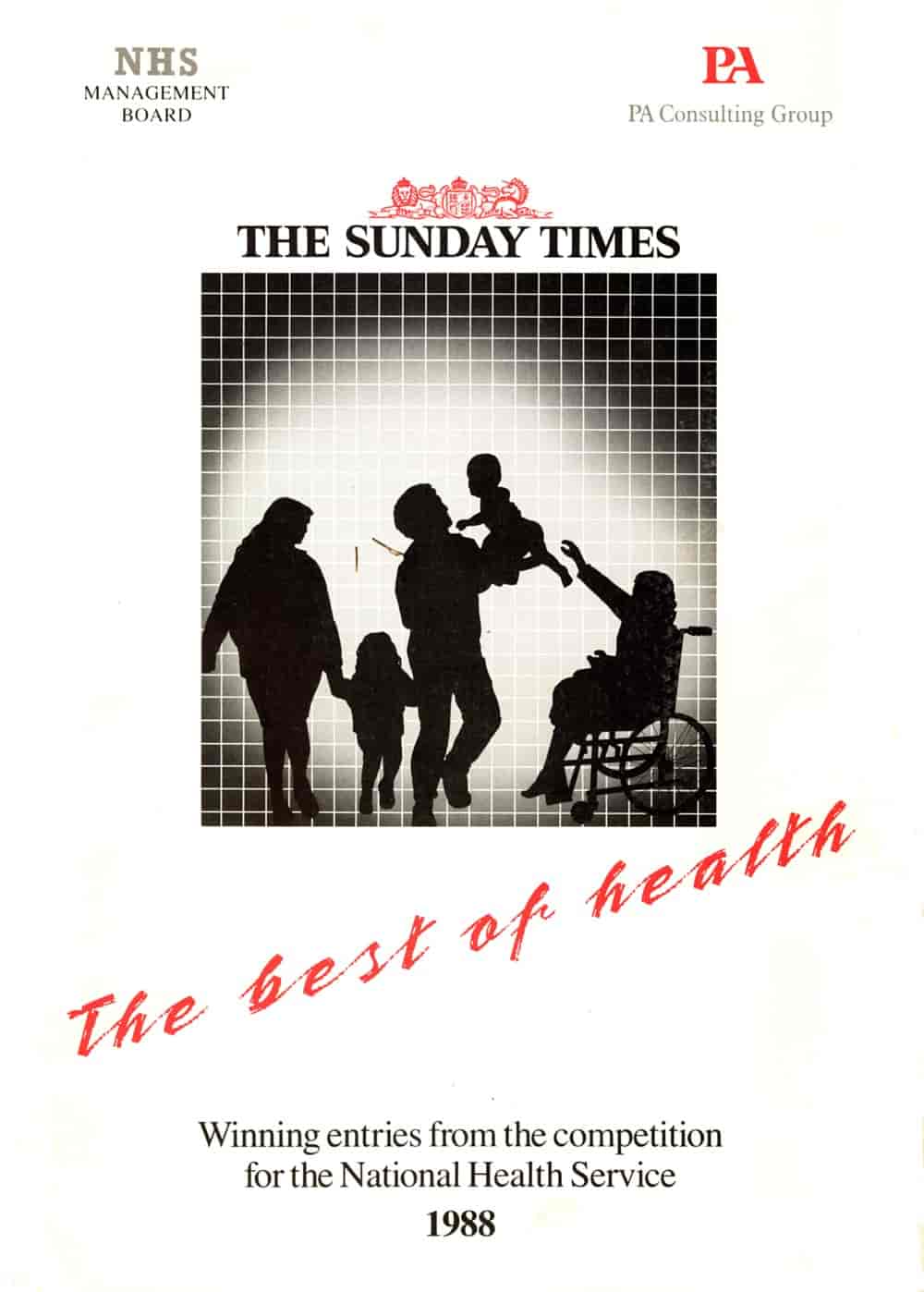
A photographic exhibition
toured the UK, and a book
(far left), edited by
Deer, contained the
winning entries. Managers
running a quarter of the
entire NHS took part,
with the project restaged
the following year,
focused on Britain's NHS
hospitals (left) |
|
|
|
|
|
|
|
 |
First
paragraphs
by Brian Deer
"On Friday, October
26, 1973, Dr John Wilson,
paediatric neurologist,
stepped to the front of
the London lecture
theatre of the Royal
Society of Medicine. For
the past couple of hours
he had been crammed among
50 professors,
consultants and other
specialists, listening to
research and discussion
papers about children's
convulsive disorders. Now
it was his turn to
address the gathering. He
slipped a typescript on
the lectern and began to
read." [Read
this]
"Justin Fashanu lit
a marijuana joint and
grinned an enormous,
lopsided grin at a
roomful of teenage kids.
He felt pumped-up. He was
in control. He could see
it in the faces around
him. No crowded football
terraces roared him on,
but the former soccer
striker was back.
Forgotten, if only
briefly, was a lifetime
of troubles, failures and
forced retreats. Amid a
smell of smoke and beer
in a rented Maryland
apartment, the grass hit.
He felt a rush." [Read
this]
"Forty years ago
last month, a letter
appeared in The Sunday
Times that was to produce
a remarkable effect. It
was from the Bishop of
Portsmouth, one Launcelot
Fleming, who proposed a
new form of social action
to bolster Britain's
impact overseas. He had
just finished chairing a
committee of the nation's
great and good that had
probed the then-emerging
rock 'n' roll culture -
and he had come to the
conclusion that there was
Something To Be Done with
what he described as
"suitable
boys". Rather than
be corrupted by
newfangled pinball
machines, motor scooters
and other contemporary
vices, he felt that young
chaps (he never mentioned
girls) should go and do
Good Work around the
world." [Read
this]
"Matthew Bell lay on
the sofa in the front
room of his home and
snuggled against a
cushion half as big as
himself as he gazed at
Batman Forever on video.
He was crazy about
superheroes in serious
outfits - Batman,
Spiderman, Fireman Sam -
and cut quite a figure
himself as a blond-haired
Superman at his local
toddlers' group in
Torrisholme, Morecambe.
But on this Monday
afternoon - it was nearly
4pm - his attention to
the movie faltered. He
had started to feel odd
sometime earlier in the
day, and now he had a
pain in his tummy.
Matthew grasped the
cushion in a vain search
for comfort, and wished
the hurting would go
away." [Read
this]
"When each morning's
swarms of 747s arrive
from North America, form
into line and drop their
wheels over London,
window-seat passengers
may read a telling
message from the country
that lies below. As the
aircraft turn away from
the sun to descend
westward into Heathrow,
they pass four giant
cream-coloured chimneys
that rise from a
crumbling cathedral of
bricks. On the south bank
of the Thames, by a big
patch of grass and trees,
the ruined power station
at Battersea signals. A
beacon on the flight path
of time." [Read
this]
"Were you to travel
to central London and
stand outside the
seven-story building at
183 Euston Road, you
wouldn't think, to look
at it, that you were
close to anything of
note. The structure's
white Portland stone
facade and Greek-columned
central pavilion are
reminiscent of nothing
more memorable than, say,
a US courthouse, or a
downsized Bank of
England. The external
elevations are
self-important but
unimaginative. To set
eyes on them once is to
forget them." [Read
this]
"When Justine Gibbs
died after taking
Septrin, her mother
Susanne's reaction was to
blame herself. Maybe if
they had gone to the
hospital more quickly,
she agonised, something
might have been done to
save her daughter's life.
Possibly, she speculated,
there was a genetic
weakness at work, passed
down through the family,
with herself as the link.
Or perhaps, she even
debated, her loss was a
divine punishment for
some past parental
misdeed." [Read
this]
"Nine years before
she would announce the
discovery of a new
disease, Dr Rosemary
Basson, consultant in the
Centre for Sexual
Medicine at Vancouver
General Hospital, Canada,
got a phone call from a
medical research company
working for the New
York-based drug giant
Pfizer. Would her clinic
be interested in joining
a trial of Viagra, the
now-famous
penis-stiffening blue
pill?" [Read
this]
"When in 1850 the
first steam engines came
chugging through south
London on the new Chatham
and Dover Railway, the
noise, the grime and the
curiosity were all too
much for the nuns of
Nazareth House.
Confronted with the
disturbance of the
industrial revolution,
they packed their bibles,
sold their land, and on
the site of their convent
up sprang perhaps
Britain's greatest single
landmark of Christian
charity." [Read
this]
"Once a month, at
around 3pm, Dr Donald
Francis, president of the
VaxGen corporation,
boards a 747 at San
Francisco airport for an
18-hour flight to
Bangkok. The route is
unpopular - with
maddening stops in Seoul,
Hong Kong or Taipei - and
he insulates himself in a
business class window
seat with earplugs,
eye-mask and face-cream.
The tedium drives him
crazy, but he doesn't
sleep much. His
adrenaline levels stay
high. Speculations loop
like a tape through his
head: 'What if I do?
Supposing I don't?'"
[Read
this]
"Blaze Bayley
springs and snarls into a
storm of teenage boys. It
is a fake kind of spring
and a contrived kind of
snarl - the moves of the
nerd with the air guitar
in front of the bedroom
mirror. But the boys are
with him. They want him
to win. And a sea of
their fists joins a chant
"Maiden...Maiden."
He shakes his forearms in
mock rage at the
sky." [Read
this]
Material
is copyright, Brian Deer.
For terms, please check
the copyright
notice
|
|
|
|