
Reprint

The Vanishing Victims
Can the whooping cough vaccine cause brain damage? A drug company paid out more than £2.75m, plus costs, when an Irish court declared that Kenneth Best was damaged by whooping cough vaccine. In this award-winning investigation, Brian Deer re-examined the evidence, including that of Kenneth’s mother Margaret, and asks: what if the law got it wrong?
The Sunday Times Magazine
November 1 1998
INVESTIGATION BY BRIAN DEER
On Friday, October 26, 1973, Dr John Wilson, paediatric neurologist, stepped to the front of the London lecture theatre of the Royal Society of Medicine. For the past couple of hours he had been crammed among 50 professors, consultants and other specialists, listening to research and discussion papers about children’s convulsive disorders. Now it was his turn to address the gathering. He slipped a typescript on the lectern and began to read.
The topic of his contribution was brain damage caused by whooping cough, or pertussis, vaccination. Wilson was a consultant at the Hospital for Sick Children in Great Ormond Street, and he planned to use the event to highlight what he believed were the dangers of the vaccine. Then, as now, it was routinely given with diphtheria and tetanus shots as the three-in-one “DTP” injection.
“Findings are presented in 36 children seen in the past 11 years who are believed to have suffered from neurological complications of pertussis inoculation,” ran his paper’s opening abstract. “The clustering of complications in the first 24 hours after inoculation suggests a causal rather than a coincidental relation.”
Wilson, 42, was the son of teachers, and since joining Great Ormond Street in 1965 had polished a fastidious demeanour. He was a doctor of philosophy as well as of medicine and a fellow of the Royal College of Physicians. He wore a dark suit and gold cufflinks. His black hair was immaculately combed. He read his paper slowly in the voice of a bishop, with cultivated, drawn-out vowels.
“Between January 1961 and December 1972 approximately 50 children have been seen at the Hospital for Sick Children, London, because of neurological illness thought to be due to DTP inoculation,” he said. “Several children with screaming and fever during the first 24 hours have been excluded from the study because of their benign outcome. The majority of the remainder, whose ages ranged from three months to seven years, were referred months or years after the acute episode.”
He was by no means the first doctor, or even the most prominent, to suggest a link between the vaccine and brain damage. But few in the lecture theatre’s steeply-ranked pews missed the dynamite in his presentation. Previous reports, dating as far back as 1933, had mostly been isolated anecdotes: a couple of cases here or there. They were also short on crucial facts, such as the time between the jab and the damage. Yet here was a consultant from the world’s most famous paediatric centre with three dozen dramatic examples.
“One child was exceptional in that she had transient blindness after recovering from a fit; she was later discovered to be suffering from a progressive cerebral degeneration,” his gruesome narrative continued. “The four children who did not convulse include the identical twin of the infant above. She vomited four days after her second DTP inoculation at 15 months, and developed severe cortical blindness and optic atrophy. She died in status epilepticus.”
It was a bravura performance, based on a remarkable feat in connecting these cases together. Despite worries about the vaccine, there was no agreed description in medical literature of exactly what harm it could do. “Brain damage” is a catch-all term, and there was nothing to distinguish injuries following vaccination from many of the 2000 causes of brain damage – including genetics, infections, birth problems, and traumas – that often reveal themselves at exactly the age at which DTP is given. In Britain, about 200 babies and infants develop such disorders every week, and by chance 6% will start within seven days of a jab. And because its pertussis component can trigger a fierce immune response, this particular vaccine can cause screaming, fevers and other upsets, making parents recall it if something serious should go wrong later on.
Wilson’s route through this maze produced whispers in the theatre and then murmurs throughout medicine. Three months later, his four-page paper, co-authored by two junior doctors, was published by the British Medical Association in Volume 49, issue 1 of the Archives of Disease in Childhood. With both numbers and detail, it became an instant classic, as often quoted a quarter of a century later as it was when it first appeared.
Not surprisingly, journalists pounced on his claims as worthy of public concern. In April 1974, ITV broadcast a half-hour, prime-time This Week documentary, focusing on one of Wilson’s patients. It unequivocally blamed the vaccine, with numbing images and terrifying calculations. “Every year about 100 brain damaged,” was one caption that filled the screen. Six minutes into the programme, Wilson appeared and, when asked if he thought whether the link was established, he took his crusade to millions of viewers. “I personally am,” he declared, in his bishop’s voice. “Because now I’ve seen too many children in whom there has been a very close association between a severe illness, with fits, unconsciousness, often focal neurological signs, and inoculation.”
“What do you mean, you’ve seen a lot?” the television reporter pressed him.
“Well, in my time here, the last eight and a half years,” he said of his Great Ormond Street experience, “I personally have seen somewhere in the region of 80 patients.”
The national furore that followed these remarks was the prototype for modern health scares. Before the broadcast, 80% of British children were inoculated against whooping cough. By 1978, after newspaper campaigns, the number had slumped to 31%. Cases of whooping cough soared. In 1974 there were about 12,000 notifications. In 1978 there were nearly 67,000. And in an epidemic towards the end of the decade, 36 infants died and at least 17 were left brain damaged by spasms of choking and retching
While Wilson’s alarming remarks had this devastating effect, he none the less believed that the dangers of whooping cough were greater than those of vaccination. He supported routine inoculation. But his crusade to warn the world about the potential dangers of vaccination gathered pace. He became adviser to the National Association of Parents of Vaccine Damaged Children, launched by Rosemary Fox, a 46-year-old social work administrator. He backed lawsuits against DTP manufacturers, and pressed for a government compensation scheme for all vaccine victims. And when a scheme was launched, in 1978, he became the chief assessor for making awards.
His message, meanwhile, spread from country to country. A global panic ensued. After a frightening television broadcast in the United States in April 1982, American vaccine makers were hit with lawsuit claims worth $10 billion. Wilson’s paper was repeatedly cited. And under pressure from parents and industry alike, Congress launched a compensation scheme in 1986 like the one he helped to run in Britain.
Wilson was not alone in his campaign; other doctors became equally vociferous. But the chain of events led back, link by link, to that Royal Society of Medicine paper. From it have sprung bureaucracies that in Britain alone have paid out more than £9m and probably cost as much again to administer. Using its authority, lawsuits have been brought that have run into billions in costs worldwide. And the scare that followed it has caused parents to agonise whenever a child has a vaccination.
But at the heart of this scare lay a disturbing truth, hidden for a quarter of a century. Wilson’s original three dozen vaccine victims were not as conclusive as he led people to believe. While he may have seen 80 children where he thought that there was a “very close association between a severe illness… and inoculation”, as he claimed on television, by 1988 he was having to admit that in eight of his original 36 cases there was no link whatever between the vaccine and subsequent brain damage, in 15 cases there was a reasonable alternative cause, and in only 12 cases did he stand by his original report.
Of these remaining 12, only three were cases where there was no alternative explanation and on which information was reliable. Even those three could not be shown as having been injured by DTP.
Studied today, the cases reveal how wide of the mark Wilson was. One child had a bang on the head. Another recovered fully. Two had genetic conditions: tuberous sclerosis and gangliosidosis. At least three were suspected of suffering from infections, including isolated Coxsackie virus. And most of the remainder were patients who were diagnosed as epileptic – a generic term embracing a host of different symptoms, causes and possible outcomes. One child’s father, sister, uncle and grandfather all had histories of fits.
Surprisingly, some of the children on whom Wilson reported suffered their first neurological symptoms before their DTP jabs. But the most striking feature of the series that he presented concerned the identical twins. Both were diagnosed with an inherited condition called Seitelberger’s disease. And although their cases helped to trigger one of the century’s great health panics, neither child ever had a whooping cough jab.
*****
To be honest, at the time I never paid attention to this saga’s first 23 years. I was either too young, or it was not my story. I have no children. I had never heard of Wilson. And so completely had the world accepted his conclusions that, in April 1988, I casually commented in The Sunday Times that “everybody knows” that the whooping cough vaccine and brain damage were sometimes, albeit rarely, linked.
But then I got a phone call, from a woman in Ireland, that would lead me to think again. And after months of research, particularly of court documents, I came to the conclusion that for the past quarter-century, parents have been tragically and unnecessarily scared.
The caller was Margaret Best, a short, energetic, then 47-year-old Irish housewife, who had successfully sued a drug firm over her brain-damaged son, Kenneth Best. I had also clashed with this firm, the Wellcome Foundation, now swallowed into Glaxo-Wellcome, Britain’s biggest company. And possibly on the adage that my enemy’s enemy is my friend, in November 1996 she invited me over to stay at her house near the city of Cork.
Although Kenneth’s case involved a stronger-than-normal batch of vaccine, at face value it was proof of Wilson’s thesis, the clearest case of vaccine damage in the world. After a string of David and Goliath trials in Dublin, which started in April 1989 and finished in July 1995, the Bests won £2.75m, plus costs, in a result which set the company back by nearly £10m. In January 1994, BBC1 broadcast an hour-long celebration of Margaret’s victory, entitled Against All Odds.
Margaret was living like a lottery winner in a five-bedroomed house down a maze of country lanes, near the airport. The property had electric gates, a gravel drive, floodlights and barking dogs. Furniture was chunky and fabrics rich. Everything, understandably, looked new. Kenneth was housed in a single-story annexe, with its own kitchen, laundry, bedrooms and lounge.
The story she told me was not new to her. She had been battling over it for decades. It was in 1969 when Kenneth’s problems began – the year men landed on the moon. She was just 22 and had been married for 13 months. Her husband was 26, a former fireman. They lived in a cottage on a hill outside Kinsale, then a poor south coast fishing village.
But it was all new to me and I found it a struggle to absorb the essential facts. On Wednesday September 17, 1969, it seemed, Kenneth was 4.5 months old and received his first DTP vaccination. He apparently had a fit, or “turn”, six hours later while eating his tea, and, after that, more than 10 times daily. “His face got very red and his eyes turned in to the right, in to the corners,” Margaret had told the Dublin judge. “Both his arms came up to his chest and it was as if his whole body was stiff.”
She said that she phoned her general practitioner that night, had taken Kenneth to him next morning, and then at least twice a week for months. She claimed, however, that he dismissed her, saying “it was probably a reaction to the vaccine” and “there was nothing to worry about”.
There were certain confusions, to which I paid no attention at the time. Despite the GP apparently blaming the vaccine, for instance, Margaret took her baby for two further routine DTP jabs at monthly intervals. And although the doctor’s records contained six entries for the family, mentioning trivial ailments such as “nappy rash” and “flu”, there was nothing neurological until January 1970.
Eight months later, a paediatrician diagnosed Kenneth as having West’s syndrome, a progressively disabling seizure condition which usually starts at between three and eight months of age, and which is often genetic in origin. The records of this doctor, and those of another consultant, also contained oddities. Neither was told about the DTP and both took down dates for the boy’s first fits that were many weeks after his jab.
Such discrepancies were serious: experts who believe in the vaccine damage link say that fits must occur with 72 hours to be plausibly linked to it. The contradictions inevitably raised the question of whether Margaret’s story was accurate. Yet, in its legal defence, Wellcome’s lawyers simply said that she had muddled the dates. “I am not suggesting for a moment Mrs Best is telling lies,” its barrister said in court. Counsel for the GP agreed, sympathetically: “I am sure poor Mrs Best believes these things.”
It was a fascinating story and, one morning in her kitchen, we did a short interview. We talked about her father, a bookie’s clerk, about how she left school at the age of 12, and about her first job as a care assistant. Then we discussed her husband, Ken, and their subsequent separation. And finally the fateful night.
“So, where did you phone the doctor from?” I asked, trying to get a picture in my mind.
Margaret got up, walked across the kitchen and did something or other at the cooker. “Well,” she said. “There was a neighbour whose phone I sometimes used.”
“Um, so is that what you did?”
She paused. “No,” she said, and moved back to the cooker.
I waited until she returned. “So, er, what, you used a phone box?”
“Yes,” she said.
It was background colour, of no great consequence. But later I listened to the tape. Why mention the neighbour if she had used a phone box? What was the reason for delaying her reply? Surely, the night which saw her child’s life wrecked was indelibly etched on her mind?
*****
The panic over Wilson’s paper came and went, as health scares inevitably do. By the end of the 1970s, journalists had run out of angles, while the killer whooping cough epidemic and education campaigns won parents back to vaccination. Any risk to children of being inoculated, it was recognised, was less than of them going without.
But in May 1981 a 184-page government book restored life to the consultant’s crusade. It was titled simply Whooping Cough and was issued in a blue cover by Her Majesty’s Stationery Office. It contained reports confirming the brain damage link, including two that estimated the risk. They were the hardest evidence produced anywhere. The book joined Wilson’s paper as a classic.
The first report was from a panel of six doctors, who studied notes on 229 children. Most were referred by Rosemary Fox, whose association was besieged by handicapped children’s parents whenever media stories appeared. She distributed questionnaires, sifted out cases that she considered unlikely to be due to DTP and sent the rest to government doctors. The panel found 125 “suspected” vaccine victims and said that 1 jab in 155,000 led to brain damage, or death.
The second report gave findings from a huge medical survey. Named the National Childhood Encephalopathy Study (NCES), this asked all hospitals to notify investigators of children admitted with certain symptoms. It ran for three years from mid-1976, during which 2m DTPs were given. It concluded that the risk of injury or death was 1 in 310,000 jabs.
Wilson was a member of the six-doctor panel and an advisor to the hospital survey. But the blue book acknowledged two other consultants who by now had assumed prominent roles. Both were epidemiologists and professors of community medicine. One, Gordon Stewart, of Glasgow University, drafted Fox’s questionnaire. The other, David Miller, of the Central Middlesex Hospital, London, headed the NCES team.
Government authority and professional prestige oozed from the blue book’s pages. The 1-in-310,000 figure was adopted throughout the world (and is still used by health agencies as the official risk estimate). Journalists pounced on the issue again and restarted emotive campaigns. But, as with Wilson’s original series of 36, there were grave problems in both reports that have been hidden from parents to this day.
On a strictly scientific basis, the panel’s “suspected” cases counted for little. The doctors blamed the vaccine if paperwork – mainly Fox’s questionnaires – said that symptoms closely followed a jab. The impact of coincidence was overpowering: more than 2% of infants have fits, for various reasons, and the panel’s cases were skimmed from millions of families alerted by media reports. The questionnaires (headed “Adverse Reactions to Vaccines”), moreover, was often filled-in years afterwards by parents seeking compensation.
Such shortcomings were glossed over, but the veneer cracked when a specimen of the cases looked at by the panel came to court. The child in question was Johnnie Kinnear, born in December 1969, and, like Kenneth Best, an apparently obvious vaccine victim. In 1974, his father, a factory worker, had read about Fox’s association in The Sun and, with Wilson’s and Stewart’s support, won £10,000 compensation. He then got legal aid to be the English test case for more than 250 pending actions.
The Kinnear trial began in the spring of 1986 and ran for 29 remarkable days. It was the first time in Britain that any drug company – again it was the Wellcome Foundation – had defended the safety of a product in court. The judge was Mr (later Lord Justice) Stuart-Smith, a 58-year-old father of six.
Johnnie, from west London, had the whooping cough vaccine in February 1971 at the age of 14 months and, according to his mother, had a fit seven hours later. She said she took him to her GP the next morning, but, although severe seizures continued every day for months, the doctor brushed her off. She said he told her that it was “normal for children to have reactions,” and there was “nothing to worry about”.
But the mother’s evidence was so incredible that the Kinnears’ barristers informed the judge that they could not carry on. Not only was her tale irrational and contradictory, but it clashed with a Hammersmith Hospital record taken five months after the jab. “Baby boy admitted via casualty,” it said. “‘Fit’ 4 days ago – occurred without warning whilst eating tea.” Johnnie was mentally handicapped – possibly owing to breathing problems at birth – but the (blue-booked and compensated) boy, then 16, was not a vaccine victim. His barrister told the judge: “Anybody who was in court and heard the relevant witnesses, and heard them, particularly, cross-examined, and saw the discrepancies between their accounts and the medical records, can be left in no doubt.”
Wilson’s claimed link between brain damage and whooping cough vaccine was now in trouble. But it was Gordon Stewart, then aged 67, who bore the brunt of the embarrassment. After contacting Fox during the 1970s panic, this white-haired professor had become the victims’ champion, backing hundreds of compensation claims and becoming patron of the American campaign. During 80 hours of evidence, he was caught wrongly describing aspects of the NCES and misunderstanding some case studies to such an extent that he was described in court as an “evidential liability”. At one point, the company’s counsel quoted from an expert report by the professor that apparently summarised a research paper about reactions to the vaccine in children.
“Do you remember anything about the age of the children?” the barrister asked.
“No, not offhand,” the professor replied.
“Or the ethnic origin?”
“No, I cannot remember that. It was an American study, I know that.”
His interrogator passed him the paper in question. It was a write-up of experiments on rats.
After this farcical hearing, there was a second test case that hinged on the crucial question of whether the vaccine could cause brain damage. Susan Loveday, a 17-year-old suffering from autism, was suing through her mother after receiving a course of jabs from a London GP in 1970. But instead of bolstering the vaccine-brain damage link, her case was even worse than Johnnie’s. Fox had weeded-out Susan’s questionnaire as implausible. Wilson’s compensation system had rejected her mother’s claim. Even Stewart thought that she was not a victim. “She was not vaccine-damaged,” he said. “She was damaged before.”
In spite of this consensus, the trial went ahead on the general principle of the link between the vaccine and brain damage. The judge decided not to hear direct evidence from the mother about fits and timing until after he heard the general issues. And during a mammoth 63-day hearing, Stuart-Smith watched the world’s best experts grilled on whether the vaccine could cause serious harm. He probed clinical medicine, animal experiments, biochemistry and epidemiology. He studied scores of individual cases. It was the most exhaustive such inquiry ever held.
For all this effort, the trial turned on one key question: was the National Childhood Encephalopathy Study compelling evidence of a link between the vaccine and brain damage? The NCES was, after all, the only scientifically-controlled study ever to point to such a link. If this study stood up, as at first sight it seemed to, that link was probably real.
In passing, the judge reviewed a number of cases, only to find that they again became vanishing victims. “The parents’ account is inconsistent with a previous account given by them,” he noted for one child. “Onset of symptoms was in the previous October; it was changed to an onset of less than 24 hours on the basis of the parents’ account given many months later,” he said for another. “The parents’ claim, as recorded in the documents, that the child was normal before vaccination, is plainly incorrect,” for a third.
In spite of these oddities, the NCES was compelling, because it appeared to find some clear-cut victims. During the three years for which it ran, hospitals notified Professor Miller of 241 children who he recorded as mentally handicapped after an illness and, of these, seven had apparently received DTP one week or less before the onset. Coincidence was possible, but a statistical comparison with healthy children’s histories produced the 1-in-310,000 risk.
But after the judge ordered the patients’ notes to be produced from the Central Middlesex Hospital, against Miller’s objections on grounds of confidentiality, another crop of victims disappeared. Of the seven children, who the professor had said suffered permanent brain damage, one had Reye’s syndrome, which is not caused by vaccination. Three were afflicted by viruses. And the remaining three cases were not brain damaged at all: records showed that the children were normal.
Based on these cases, the vaccine’s assumed risk of 1-in-310,000, published in the blue book, collapsed to approximately nil.
There was also something else very odd about the NCES. During the Kinnear and Loveday hearings, two contradictory computer print-outs were discovered which gave scores for children’s abilities. And, although they referred to the same examinations of the same patients, the more recent print-out figures were erratically lower, making healthy children appear to be handicapped.
“Do they seem to you to be somewhat curious?” the defendant Wellcome’s lawyer asked Miller.
“Yes, on the face of it, they do,” the professor, who said he had not compiled either set of figures, replied. “And I cannot offer any explanation.”
In March 1988, Stuart-Smith rejected the vaccine-brain damage link, without hearing from Susan Loveday’s mother. He said that when he started out on his inquiry he was “impressed by the case reports” and by the “widely-held belief” that rare injuries occurred. “I have now come to the clear conclusion,” he said, “that the plaintiff fails to satisfy me on the balance of probability that pertussis vaccine can cause permanent brain damage.”
*****
Margaret Best followed the London trials. She sat in the courtroom during the second. Her son Kenneth’s case would be heard 12 months later, and she needed to be prepared. Stuart-Smith’s ruling was undoubtedly a setback. She wondered now whether she could win.
She had been run off her feet preparing to do battle, even flying to America three times. The sister body of Fox’s organisation, based in Virginia, had learnt that because the vaccine was an organic product, batches unavoidably varied in strength. They dubbed the strongest “hot lots” and zeroed in on them to launch punitive lawsuits.
Kenneth’s first trial ran for 35 days in front of Justice Liam Hamilton, the Irish high court’s president, aged 61, a father of three. Some of Margaret’s experts came a long way: one from Hamburg, another from Los Angeles. But, although she was gregarious and part of a big family, only her estranged husband corroborated her account of Kenneth’s fits. Her chief expert was Peter Behan, 49, a neurology professor from Glasgow University. He said the DTP vaccine could injure in the manner of a virus, possibly through an allergic reaction.
The plaintiff’s counsel asked him: “What in your view caused this condition?”
“I should say I met his mother,” the professor responded. “I was struck by how decent and honest she was.” Later, he summed-up: “The temporal profile, the repeated seizures, are all, to me, virtually textbook examples of what has previously been reported.”
Margaret also got help from a London solicitor who supplied a document which showed that Kenneth’s vaccine was at least 2.5 times stronger than normal. In 1969, a company microbiologist had released a 100-litre batch – 200,000 doses – that had not been properly tested. It was never established that this would have made any difference, but the child’s jab had come from a “hot lot”.
The company was in trouble, but the trial’s outcome still pivoted on her evidence about the fits and when they occurred. During closing arguments, Wellcome’s lawyer insisted that her recall about the timing was wrong, but again did not say that she lied. “Her genuineness is accepted,” he submitted.
But the high court president did not agree. “I think it goes further,” he said. “I am satisfied: if her account is not accurate she is lying, that there is no grey area, and there is no point in trying to fuzz it.”
“I am not trying to fuzz it,” the company’s barrister protested. “People can convince themselves of the truth of events in retrospect. We see it every day of the week in road traffic accidents – and all sorts of accidents – people engineering themselves into that position and believing it themselves. I don’t think your lordship has to find she is lying if you reject her evidence. She may well believe – ”
The judge cut him off. “If she is not lying deliberately, the husband is. Both of them would not convince themselves.”
Hamilton said he intended to “grasp the nettle,” and such exchanges produced 18 months of suspense before he delivered his judgment in January 1991. He said there was “a possibility” that the vaccine could cause brain damage, that the company knew this in 1969 and that it was “negligent in releasing the batch”. But when he turned to Kenneth’s fits, he said that he accepted the three doctors’ written records. “It inevitably follows that I do not accept the evidence of Mr and Mrs Best with regard to the onset of the attacks.”
He did not say that the parents were lying, but adopted the company’s submission. “I consider that they, and in particular Mrs Best, have been under considerable strain because of the tragic condition of their son,” he added, before contradicting his own previous opinion. “And have convinced themselves of the association of his condition with the immunisation.”
On the judge’s assessment another victim had vanished, but his verdict, rejecting the claim for damages, was not to stand. Seventeen months later, in June 1992, Margaret returned to Dublin to hear three supreme court justices give her victory after an appeal. The doctors’ records were circumstantial, they ruled, while Margaret claimed certain recall. There were also flaws in the GP’s actions, such as delays in rushing Kenneth to hospital.
But ultimately the appeal turned, once again, on the question of whether a mother could be believed. Margaret gave such a detailed account about the fits, her visits to the doctor and his alleged response, that if it was false, the Supreme Court deduced, then it followed that she could only be lying. But as the company had conceded she was not lying, then, logically, it ruled, her story must be true. “Having regard to the defendants’ express disavowal, which they maintained in this court on this appeal, of any suggestion that the Bests were inventing the story which they told concerning these convulsions,” the chief justice, Tom Finlay, ruled, “it seems to me extremely difficult to conceive of any form of strain or obsession which could possibly create the detailed account.”
*****
I returned to see her towards the end of August, pulling up again at her electric gates and crunching up the drive to the house. We sat that night at the kitchen table, where 21 months previously I had prodded her for background colour. Spurred by her victory, at least six more court cases were pending in Ireland and the government had begun a trawl of medical records in search of more “hot lot” victims. Another trial was due in Australia. And in Britain four new potential test cases had been granted legal aid, with dozens more under review.
Over steak and chips, I remarked on my confusion over where she had phoned the doctor from. She said that in 1969 a lady had lived 500 yards down the hill from her cottage outside Kinsale. “She was the only one that had a telephone within the area,” she said. “But on the night in question the nearest telephone was actually down in the village, outside the actual post office. It was a public box.”
A few minutes later we got to Kenneth’s repeat DTPs after his apparent first fits. “You would need to be very stupid,” I suggested, “to be told that this was a consequence of the vaccine and then go back and do it again.”
“You wouldn’t,” she replied. “Because there was nothing wrong with Kenneth: to say Kenneth was still Kenneth at four months and you wouldn’t see any difference. You might see what Kenneth was getting were fits. But they would stop after 30 seconds. They might stop after 10 minutes and then Kenneth was grand again.” She stressed that she was then only 22. “You can’t put an old head on young shoulders.”
Finally, we came to the supreme court’s argument. I tried to summarise it: that her story was so detailed that either she was telling the truth or she was deliberately lying. But since the company had not accused her of lying, she must be telling the truth. Nobody, I suggested, would stand up in court and accuse her of making things up.
“No, well, they needn’t have said that I wasn’t either,” she responded. “They could have kept their mouths shut, perhaps then, and left the gate open, you know? But they said it: that I wasn’t. But they didn’t have to say anything. If they’d said nothing and just conducted their defence and didn’t open their mouths about whether they thought I was lying, or whether I was telling the truth, or whether I was confused – it didn’t matter a damn – if they had said nothing they might have been better off.”
Indeed they might, but these were legal technicalities. There was also the human dimension. As we talked, Margaret kept glancing towards a closed-circuit TV screen, then monitoring the electric gates. Kenneth, now aged 29, was out for a drive with Margaret’s live-in friend Christy Foley. They would be back at any time.
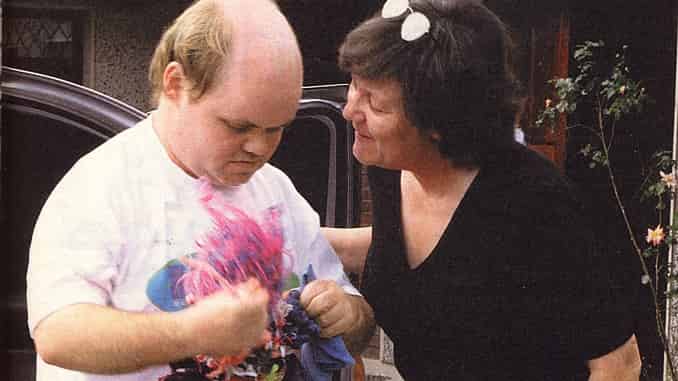
At 10pm the headlights of a Nissan Maxima blurred the screen. Margaret pressed a button to open the gates. Then Kenneth walked in, picked up some chips and was led off to his annexe room.
He was short, not much more than 5ft in height, with a big, severely balding head. His right hand was thrown back across his shoulder, clutching a clump of tangled wool. It was his greatest passion to blend balls of wool. He also liked the motion of cars, the sounds of music and the splash of bath-time water. He recognised nobody, was doubly incontinent, had never spoken, but sometimes screamed.
As Margaret dealt with him I had a moment for reflection, from the safety of not being a father. What would it have been like to have been in her situation: to have the agony of suspicion and then the horror of knowing there was “something wrong” with your child? Then the hospital visits, the prayers for cures, the disbelief, the anger, the rage. Then comes the question “Why us?” – a question that often leads to divorce. Was it something we did? An accident at birth, or even some error before that? In Ireland, especially, grandparents ransacked history to discover “which side” it came down. It was easy to see why the vaccine and drug companies might be welcome scapegoats for the burden of guilt.
Later would follow the practical questions. Who will look after our child? From childhood to adolescence, to adulthood and beyond. What happens then, when parents are gone?
Moments later I heard banging and scratching at a door. “Is that a dog?”
“No,” Margaret said. “That’s Kenneth.”
*****
Like Stuart-Smith, I had started my inquiry with the conventional assumption that the vaccine sometimes injured children. But as I saw how beliefs had generated facts, an emotion from my own childhood surfaced. It was the strange frustration of being left empty-handed when I brought snowballs into the house. There was no doubt that the parents in these cases were sincere. Margaret Best was especially decent. And yet victims vanished, again and again. It was quite some lesson in life.
As for the experts: they spoke for themselves, and sometimes they spoke under oath. Even Professor Behan, whose testimony was described as “paramount” in Dublin, was later crushed in a London trial. After his evidence was undermined last year in a case about organophosphates, he was investigated by Glasgow University, which later said: “there had been no intention to deceive”.
Professor Miller, of the NCES, refused to comment, despite the seriousness of the vaccine-damage question to parents. Professor Stewart stuck to his story. “Any vaccine can be damaging, in different ways,” he said. “Whooping cough vaccine is not very effective and sometimes in some children is very unsafe.”
Rosemary Fox was co-operative, and agreed to an interview at her home in Shipston-on-Stour, Warwickshire. She is a big-framed woman of 70, full of energy, with the manner of a top civil servant. She was a farmer’s daughter from County Tipperary: another determined Irish mother. Her daughter, Helen, had become handicapped in 1963 after a polio vaccination.
She had 600 families on her association’s list, 300 of which, she said, were “active”. They were currently preparing for a new offensive to increase the scale of government compensation payments. Some argued that payments should be increased to more than £1m for each child. Fox was preparing to send 150 MPs a briefing with which to lobby ministers.
We sat in her conservatory. She made a ham salad and produced a plastic bag full of yellowing cuttings, parliamentary debates, science papers and letters. She put it by her chair like a less active 70-year-old might settle down with a bundle of knitting.
We quickly passed over the usual contradiction between the written word and a parent’s recollection. According to a Birmingham Post cutting in the bag from 1973, her daughter Helen had a polio jab at 7 months and “within a few days” began vomiting. But Fox told me the problem started as a coma “the day after the vaccination”.
By this time, expert after expert was lining up around the world to say that they used to believe in DTP damage, but now they thought it a myth. Textbooks were being rewritten, questioning NCES, and new surveys were finding no risk.
“So how do you feel about it, 25 years later,” I asked her. “You’ve still not been able to show a case.”
“I know,” she said, gloomily. “I don’t know where the weakness is.” She admitted that the science suggesting a link was “hopeless”, but she thought that the compensation scheme showed that the link must exist. The government would not give money away if the vaccine did no harm. Since 1978, 891 awards had been made (mostly £10,000) and she had just got a letter saying that ministers were reviewing the size of future grants. That was 891 of the quarter-million British children who, for various reasons, were brain damaged in the last 25 years.
“At the end of the day,” I suggested, “your belief that the vaccine causes damage is an article of faith, really.”
“Maybe so,” she said. “But it would be very difficult for me, after starting it off and believing it and establishing it by reference to other parents as to what their experiences are…” Her words petered out.
I said that technologies in brain scanning, biochemistry, DNA and so forth had leapt forward since her daughter was diagnosed as vaccine-damaged. Would she consider having Helen reassessed?
Fox said that she would not. “She’s what 35, 36 years old. Her condition is established, if you like, how she is. I wouldn’t want to know.”
“But in 30 years, science has – ”
“It’s not worth it to go back and think: ‘did you realises that such and such’.”
“Right,” I said.
“Then I’d start thinking: should I give back the money to the government? Why did I do this? Was I wrong? Are all these 891 people…? Do you want to have me in a mental hospital?” She laughed. “Go away.”
Wilson, now 67, was not so cheerful, and after agreeing to meet me at a Great Ormond Street address, later called back and cancelled. “I really think I have nothing useful to contribute,” he said.
When I phoned him at home he argued that his 36 cases delivered to the Royal Society of Medicine were only “hypothesis-generating”. He said: “They were raising the issue, and I think certain things transpired from that which have been beneficial. But I’m very ready to accept that there’s a downside to this whole exercise which one obviously regrets.”
Although he omitted an explanation for his vanishing victims, he defended his campaign. To understand his position, he said, you would have to imagine yourself as a doctor faced by “this recurring story from parents” of children who were ill after jabs. “You are puzzled by this,” he said. “You look back at some of the things that have been written. And, yes, there is evidence in the literature, case reports of children who have been very severely damaged, especially when the child seemed to be unwell at the time the immunisation was given. What do you do? Do you think ‘Ah, this might rock the boat and stop the immunisations; it may cause public alarm’? What do you do?”
He acknowledged mistakes, but said it was through mistakes that scientific knowledge advanced. What came to his mind was the cliché about a teacher at the front of a lecture theatre. “There was a very wise doctor who made the introductory observations to a new batch of medical students,” he said. “That in 20 years’ time half of what you now learn will be proved to be wrong. But the problem is: we don’t know which half.”
READ HOW DEER’S WAKEFIELD
INVESTIGATION WAS CHECKED
Invite Brian Deer to speak at your event
Hear the astonishing true story of the plot behind today’s controversy over vaccines, and its exposure by an investigative journalist
Contact Brian
MORE TOPICS:
Bactrim-Septra: a secret epidemic
Research cheat Andrew Wakefield