
Reprint

Notting Hell
The Sunday Times Magazine, June 17 2001
INVESTIGATION: BRIAN DEER
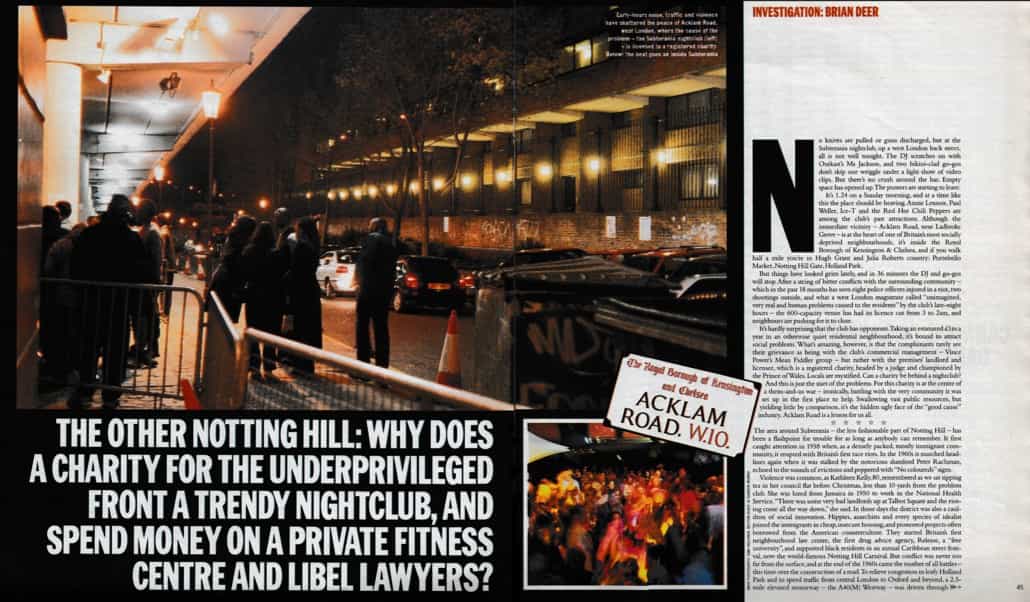
No knives are pulled or guns discharged, but at the Subterania nightclub, up a west London back street, all is not well tonight. The DJ scratches on with Outkast’s Ms Jackson, and two bikini-clad go-gos don’t skip one wriggle under a light show of video clips. But there’s no crush around the bar. Empty space has opened up. The punters are starting to leave.
It’s 1.24 on a Sunday morning, and at a time like this the place should be heaving. Annie Lennox. Paul Weller, Ice-T and the Red Hot Chili Peppers are among the club’s past attractions. Although the immediate vicinity – Acklam Road, near Ladbroke Grove – is at the heart of one of Britain’s most socially-deprived neighbourhoods, it’s inside the Royal Borough of Kensington & Chelsea, and if you walk half a mile you’re in Hugh Grant and Julia Roberts country: Portobello Market, Notting Hill Gate, Holland Park.
But things have looked grim lately, and in 36 minutes the DJ and go-gos will stop. After a string of bitter conflicts with the surrounding community – which in the past 18 months has seen eight police officers injured in a riot, two shootings outside, and what a west London magistrate called “unimagined, very real and human problems caused to the residents” – the 600 capacity venue has had its licence cut from 3 to 2am, and neighbours are pushing for it to close.
It’s hardly surprising that the club has opponents. Taking an estimated £1m a year in an otherwise quiet residential neighbourhood, it’s bound to attract social problems. What’s amazing, however, is that the complainants rarely see their grievance as being with the club’s commercial management – Vince Power’s Mean Fiddler group – but rather with the premises’ landlord and licensee, which is a registered charity, headed by a judge and championed by the Prince of Wales.
Locals are mystified. Can a charity be behind a nightclub? And this is just the start of the problems. For this charity is at the centre of a them-and-us war – ironically, battling with the very community is was set up in the first place to help. Swallowing vast public resources, but yielding little by comparison, it’s the hidden, ugly face of the “good cause” industry. Acklam Road is a lesson for us all.
*****
The area around Subterania – the less fashionable part of Notting Hill – has been a flashpoint for trouble for as long as anybody can remember. It first caught attention in 1958 when, as a densely-packed, mostly immigrant community, it erupted with Britain’s first race riots. In the 1960s it snatched headlines again when it was stalked by the notorious slumlord Peter Rachman, echoed to the sounds of tenants being evicted and was peppered with “No coloureds” signs.
Violence was common, as Kathleen Kelly, 80, remembered as we sat sipping tea in her council flat before Christmas, less than 10 yards from the problem club. She was lured from Jamaica in 1950 to work in the National Health Service. “There was some very bad landlords up at Talbot Square and the rioting came all the way down,” she said.
In those days the district was also a cauldron of social innovation. Hippies, anarchists and every species of idealist joined the immigrants in cheap, insecure housing, and pioneered projects often borrowed from the American counterculture. They started Britain’s first neighbourhood law centre, the first drug advice agency, Release, a “free university”, and supported black residents in an annual Caribbean street festival – now the world-famous Notting Hill Carnival.
But conflict was never too far from the surface, and at the end of the 1960s came the mother of all battles – this time over the construction of a road. To relieve congestion in leafy Holland Park and to speed traffic from central London towards Oxford and beyond, a 2.5-mile elevated motorway – the A40(M) Westway – was driven through North Kensington, in the face of bitter banner-waving protests. Acklam Road was flattened, with one side replaced by a yellow-brick council estate.
And then, to complete the history, the idealists had an idea to rescue something worthwhile from the jaws of defeat. They said “Let’s start a charity” and in February 1971 they launched the North Kensington Amenity Trust [renamed Westway Development Trust after this report]. It was to reclaim something from the moonscape of post-construction wasteland, in an effort to “give something back”. Cynics argued that it would prove a distraction – the kind of thing developers promise to buy off opposition. Little did they know that, in the name of charity, it would spawn yet more bitter wars.
*****
Politically, the idea of the North Kensington Amenity Trust was so beguilingly simple that it has since become a template for similar ventures around the country. With a staff of 60, a salaried director on more than £60,000 a year and a turnover of £2.8m, it was the founding inspiration for the Development Trusts Association, with 200 members from Devon to Northumberland and assets of more than £100m. It is a celebrated example, moreover, of a £30 billion “grey economy”, embracing more than 180,000 registered charities and an estimated million trustees.
As charities do, it started well, with ideals that were hard to fault. In building the Westway, the Department of Transport left 23 redundant acres around Ladbroke Grove tube station, some ready-roofed, like railway arches, others open spaces. “What we wanted was facilities aimed at the poor community, especially children,” John O’Malley, the secretary of the action group that founded the charity, told me. “What really grew out of it was playgroups.”
In February 1971, the management committee of 15 trustees adopted legal objectives that are still in force today: “(1) the advancement of education; (2) the provision of facilities for recreation or other leisure-time occupation in the interests of social welfare, with the object of improving the conditions of life of the said inhabitants; (3) assisting charitable institutions established for the benefit of the said inhabitants; (4) in the advancement of education, but not further or otherwise, the trust may provide assistance to children and young persons.”
Progress was slow, but by 1976 the trust had built a community centre – the Acklam Hall – in the premises that are now Subterania. There was a nursery, stables, an administration building, offices and space for stallholders and small businesses. The idea was to create a mix of public services and private enterprise – the rental from which could be garnered by the charity to help address the neighbourhood’s needs.
Those needs were many – then as now – with Golborne ward, in which the nightclub sits, still one of the most challenged in Britain. For all the popular image fostered by the movie Notting Hill, hidden up backstreets such as Acklam Road is deprivation rarely dwelt on in films. Unemployment last year hovered around 13%, and twice as many people live in public-sector housing as own or privately rent their homes.
For a while there was progress, but then renewed conflict erupted as all eyes turned to the land. Although North Kensington is a solidly Labour area, seven or eight of the management committee were nominees of the Tory-dominated borough council, controlled from wealthy South Kensington, Chelsea and Knightsbridge. And in 1976 they appointed as trust director Roger Matland, then a 31-year-old charity worker with a degree in psychology and a new agenda for the trust’s development.
Gradually, under Matland, the charity sidelined its founding ideals and switched from serving the likes of Mrs Kelly to creating a luxury leisure empire. In 1988, Subterania (£8 admission) was rented to the Mean Fiddler group (Vince Power says: “You could say they gave it to me for nothing”), followed by ambitious expansion, using public grants and loans, to build an indoor tennis club (adults £15 an hour), a members-only fitness club (£100 joining fee, plus £45 a month), and an upscale cocktail lounge (seared wild salmon and roasted red pepper brochette on kizami and black pasta mesh with herb tahini, £11.50). In short, the new plan was to develop the property for the affluent, like a modern-day enclosure of common land.
The justification was to generate income for charitable purposes, and day-trip visitors were dazzled. In 1991, the trust’s 20th anniversary year, the Prince of Wales, who would later become a hands-on supporter, declared that it had “forged ahead with a wide-ranging programme for the economic and social benefit of local people.”
But even amidst such courtly praise, around the motorway – which surges across the roof of Subterania – the neighbour’s unrest was festering. “It’s disgusting,” Mrs Kelly, who was president of the local Swinbrook tenants’ association, told me. “As far as the community around here, we don’t get any benefit from the amenity trust, and nobody can tell you any different.”
*****
There were no celebrations in February this year for the trust’s 30th anniversary. When I called the urbane, Gitane-smoking Matland, now 56, he told me he was “busy” and I would get “a better story” if I contacted him again in a year. And after a series of complaints to my editor, we ended up in a protracted written duel between the charity’s lawyers and ours.
I didn’t at the time reveal the trigger for my interest: a memo I saw from Matland to the trust’s solicitors, the firm of Sinclair Taylor & Martin. It read like something from a John le Carre novel, and when I checked it out it made me wonder if anybody policed charities at all. Without sharp-eyed shareholders, or the political accountability of public authorities, it seemed that the world of trustees and professional staff could let the weirdest situations arise.
“At about 10.45 on Monday 9 November 1998,” Matland wrote. “I was driving down Golborne Road when I saw Lyn Hardy-Smith transferring goods from a red VW saloon across into his cafe called Havana. I parked at a discreet distance away, walked back and wrote down the registration number, which is E513 PBP. I have asked Janice to obtain the usual from Swansea.”
When I found him, it turned out that Hardy-Smith was a local activist, and former bicycle-shopkeeper, who had been priced off his stall by the trust’s leisure plans, and who in 1987 had accused Matland of dishonestly influencing a £180 Bloomsbury Court case brought against him. In response, the charity had sued him for libel and, 14 years later at central London County Court, is attempting to seize his family house to recover its legal costs. In an action “that the property be sold notwithstanding that the respondents refuse to consent to the said sale,” the charity is now looking to recover from the bicycle man almost £43,000.
Hardy-Smith – 57, slim, grey and nervous – had acted like a fool, making an emotional accusation he had no prospect of standing-up. After a High Court writ was issued against him in 1990, he apologised through solicitors, offered to make an undertaking in court and agreed to pay “reasonable costs”. But his apology was rejected as “far from unreserved” – and though the alleged libel was only made in a private letter to the trust’s chair, the trust went on in 1992 to throw £30,000 of its charitable funds at defending “the professional repute of its staff”.
It was a vindictive action, which broke Hardy-Smith. The only evidence I found of anybody being seriously damaged by the episode is in a letter from Hardy-Smith’s doctor saying that he had been treated for stress and depression “caused by the protracted litigation”. And since the management committee had paid for the lawsuit, evidently nobody believed what Hardy-Smith said in the first place.
What most bothered me here was the evident lack of charity to this man. Why sledgehammer this particular walnut? A second trust document put me on the road: the essential sting of the allegation seemed to be true. Despite feting royalty. Matland was, on the face of it, prepared to use dishonest tactics to achieve less than charitable ends.
The second document was written the day after Matland’s memo to Sinclair Taylor & Martin, and concerned the red VW in Golborne Road – about a quarter mile from trust land. In an apparent bid to seize the vehicle to pay legal bills, Matland, using staff member Janice, wrote to the Drivers and Vehicle Licensing Centre in Swansea, falsely claiming it was somewhere else: “Red Golf VW saloon – E313 PBP… The above vehicle is parked on Trust land and we wish to ask the owner to remove it. I would be most grateful if you could supply me with the name and address of the owner as of today’s date so that I may write to them.”
Hardy-Smith – now unemployed and suffering from diabetic hyperglycaemia – reported this deception to the data protection registrar and complained to the trust’s chair, Judge Gerald Gordon, 55, who sits at the Old Bailey and recently presided over the fraud trial of John “Goldfinger” Palmer. Gordon, who has headed the management committee since 1993 and is a former Tory deputy leader of the borough council, took no action, but merely replied to the bicycle man that if the registrar made “any inquiries of the trust, we will, of course co-operate.”
A one-off aberration? At first I thought, maybe. Then other conflicts emerged, which have caused even senior Tories to express dismay about the charity. James Arbuthnot, a former Kensington councillor and chief whip in William Hague’s shadow cabinet, for instance, wrote to Matland three years ago saying he remembered the charity with “a curious mixture of loathing and fascination”.
Some of the most potentially inflammatory clashes have been with elements of the local black community. In 1996, for instance, local steel bands who used to park two floats on unused trust land, 50 yards from Subterania, were evicted in a protracted lawsuit that cost the musicians more than £10,000. The charity then erected a 10ft steel fence, using grant money, which kept them out. Then last summer there was more controversy when the trust banned the Notting Hill Carnival from two 40-by-20 yard plots of paved land at the epicentre of the festival zone. And, yards from where newsagents once sported “No coloureds” postcards, six stalls traditionally set out each year on Acklam Road – by now elderly Afro-Caribbeans – were prevented by police, on the charity’s orders, from selling “a bit of food”.
Such actions have sparked fury among the trust’s black neighbours – who incidentally got up a petition in 1995 about aspects of the nightclub’s door policy. “I don’t want to say much in case I get in trouble,” said Mrs Kelly, who said she bit her tongue after hearing what happened to Hardy-Smith. “They can take me to court, but I haven’t got any money, so they won’t get anything.”
The area’s Labour councillors say they are worn out by the quarrels, and appeals to the trustees get nowhere. After a painter who decorated the charity’s offices in 1999 complained to Gordon that it appeared to be attempting to avoid proper payment for the work that it had ordered from him, the judge responded: “Allegations of dishonesty if untrue are libellous and if made in relation to a person’s employment are actionable without proof of damage.” The painter caved in to a “consent order”, abandoning his claim for £1,000 at Lambeth County Court, with an unusual clause demanded by the trust: “That neither party shall discuss the matter with third parties.”
*****
After a short battle with cancer and a longer struggle with the trust, Mrs Kelly died on February 1. And she didn’t get a quiet old age. She told me how she ventured out in her nightie onto the walkway at the front of her flat and pleaded with Subterania’s customers to let the neighbourhood sleep. “It’s the cars’ nose, the language, the arguments,” she explained. “It’s really terrible, really bad.”
She had campaigned since 1994, when the charity applied for a 6am licence for the club, and in October she led a dozen people to West London Magistrates Court to resist an appeal by the charity against a council order to cut the opening hours. She won that battle, after a two-day hearing, when District Judge Terry English awarded £13,000 costs against the charity on the grounds of its “unreasonableness”. The trust’s swift response to keep the extra hour for Power’s business was to appeal the appeal – to Blackfriar’s Crown Court (in an action now abandoned) – despite Judge English hearing from an angry witness parade of the very people the charity was meant to help.
But if all this wasn’t bad enough, I soon found another story that said even more about this “charity”. For not only was the nightclub wrecking the community’s peace, but since the trust handed over the old community hall to Power, it had been running a scheme to dodge business rates and licence fees, to the public’s considerable loss. People such as Mrs Kelly were not only suffering, they were also paying for the privilege.
According to my calculations, based on council staff figures, at least £118,000 due to the council on the nightclub has, for reasons unknown, been avoided. Power was the beneficiary, although all he seems to have done is accept the trust’s arrangements. The way it worked was simple: Matland told council officers that the premises (merely described as “12 Acklam Road”) were mainly used by charitable community groups – and for years the paperwork was rubber-stamped by unwitting junior clerks.
Strangely, Gordon – who lives in a Georgian square two miles south – told me he didn’t personally know what was at “12 Acklam Road”, but was sure that council staff knew all about Subterania. This is in spite of the trust failing to mention the premises in annual reports and of council officers having been in a five-year battle to get the charity to set out the facts about the club. Although senior Conservatives – including mayors, committee chairs and deputy leaders – had sat on the trust’s management committee, a mass of paperwork reveals that council officers were repeatedly frustrated or fed with half-truths.
Matland, meanwhile, was filling-in exemption claims in an attempt to cover his tracks. In at least four documents, he certified that the club’s licensed use “will be solely for entertainment which is of an educational or other like character, or is given for charitable or other like purpose.” When asked of the premises (100% of the profits from which go to Mean Fiddler) “Who will receive the proceeds of these functions?”, Matland replied: “North Kensington Amenity Trust.” Asked, “Are the premises ever rented out to a third party for any public or private events? If yes, does the third party receive the profits from the event?”, Matland’s answer was: “Yes. Local charities. Yes. Local charities.”
The thinking behind these answers was never squarely explained, but the loss of income as a result of this mysterious wheeze is only one example of how the public purse has lost out to the charity’s operations. After an intervention by the Prince of Wales with the transport department, for instance, the land around the Westway – some prime Notting Hill brownfield – was handed to the trust at a paltry £10,800 an acre, obscuring comparison between the value of its assets and any good work it does.
And what of its good work? Undoubtedly there had been some, as both Matland and Judge Gordon stress. It maintains a small garden near the trust’s offices, last year distributed £85,000 to local beneficiaries and spent a notional £76,000 subsidising the rent of non-commercial tenants. There may also be some “trickle-down” if users of its luxury facilities spend money in local shops and pubs.
But since 1989 it has relied on loans and grants from other charities and funding bodies (the latest is £8m from Sport England Lottery Fund) to prop up a leisure empire that is otherwise sustaining colossal deficits. Nearly £1.2m has been lost running the fitness club (despite a £400,000 sports lottery refurbishment grant), another £500,000 on the indoor tennis club, and it spent an estimated £500,000 from the City Challenge urban regeneration scheme [earmarked in plans for an employment centre] building the cocktail bar – also leased to Mean Fiddler. With staff costs running at £1m a year, it’s hardly a balance sheet that glows with financial control. Were it a public company, its board would most likely have been fired.
*****
So where does the money go? It’s hard to say, since after the trust established the nature of my inquiries it refused to speak to me. “I am more than happy to be co-operative and straightforward,” Gordon initially wrote to the editor of The Sunday Times. “However, I would ask that reconsideration is given to my request to have advance information on the complaints made.” Later, Gordon required any questions to be put in writing, and hung up when I called him at home.
Was the judge too busy? Unaware of any misconduct? What did he know? Did he turn a blind eye? In an interview before he broke off contact, he confirmed that his committee was running the Hardy-Smith pursuit, but he said only to collect money due under a “consent order” agreed before he took the chair in 1993. He refused to comment on the “red Golf” deception, since, he said, it was subject to official investigation. He denied that the trust was litigious, and said the carnival floats had been evicted from unused ground because they posed insurance risks. The carnival organisers were banned from trust land, he said, because of the state in which they had left it in the past.
Although he is a former chair of the borough’s town planning committee and received detailed guidance in Charity Commission booklets on this subjects, he said that he didn’t know the position on charitable rate and licence fee exemptions, which had never been raised at any management committee since 1993. “As a trustee,” he said, “I would not see it as my role to review every single premises in the trust every year in respect of every aspect of its operation.” He undertook to investigate the “intent” behind Matland’s dealings with council officers, but in the event released no new information. “The question of whether the council was misled and whether or not rebates were allowable are, in the first instance, matters for the council,” he wrote later. “I have therefore written to the leader of the council informing him of your allegations and inviting him to initiate an investigation with which the trust will co-operate fully.”
In a conversation the following day, Matland denied misconduct of any kind. He said he didn’t know the legal position on the rates and licence issue and refused to comment on the red Golf incident. Astonishingly, he said he didn’t believe Hardy-Smith had even libelled him in the first place, and later wrote to me, as if this helped: “It was not until my trustees were legally advised of the seriousness of it all that it dawned on me.”
Both Gordon and Matland suggested that the land inherited 30 years ago had been well and wisely used. Because the trust was a charity, it could bring funds to the area that the local authority couldn’t. And, unlike the council, it had an innovative structure, flexible and responsive to needs. “The members of the management committee give up a lot of their time during the year because they happen to believe in the trust,” Gordon said.
Their critics say they will now go to the Charity Commission, but they don’t plan to hold their breath. When Hardy-Smith complained to this body about charity money being spent on suing him for libel, it replied in May 1999 refusing to tell him anything, declaring that its investigations were “not necessarily handled in a different manner from a charity support issue”, and stating that after three months, “for financial and practical reasons,” his “correspondence will be destroyed.”
And so that’s how I left the war that Sunday morning at Subterania, with a quick toast to the late Mrs Kelly. At 2.01am, the music stopped and I joined the crowd on Acklam Road, wondering how on earth the charity could get away with this stuff. And I couldn’t help asking what else like this was happening across Britain in such unaccountable, unsupervised bodies. It seemed to me that here was a perversion of the very meaning of “charity”, only brought to light by a quirk of geography – that its victims see each other in the street.
“They treat us like dirt,” said Pat Mason, 50, a Labour councillor for the Golborne ward and a former trust employee. “People round here have been fighting them for years. It’s like they think they can blow us away.”
In July 2002, Judge Gerald Gordon finally resigned after nearly nine years as chair, and the enterprise renamed itself Westway Development Trust.
Another face of charity: Voluntary Service Overseas, VSO
MORE TOPICS:
Bactrim-Septra: a secret epidemic
Research cheat Andrew Wakefield