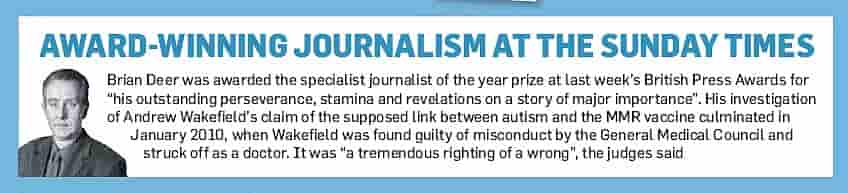
| the mmr & autism investigation: part 1 |   | briandeer.com |


Brian Deer: the Lancet scandal

 
Following a Sunday Times investigation by Brian Deer, Britain's premier medical journal was forced to retract fraudulent research which caused a global health crisis by linking the measles, mumps and rubella vaccine with autism


Part 2: The Channel 4 TV investigation | Part 3: More from The Sunday Times


Click here for a summary: In February 1998, the Lancet medical journal triggered a global alarm with research proposing a link between the measles, mumps and rubella vaccine and autism. The researchers' leader, Andrew Wakefield called for the vaccine to be "suspended". Brian Deer investigated for The Sunday Times of London and exposed one of medicine's darkest scandals

Research scandal revealed: When in February 1998 13 doctors, led by former gut surgeon Andrew Wakefield, from London's Royal Free hospital, published research, in the Lancet medical journal, linking MMR with autism, it triggered a slump in immunization levels and led to outbreaks of infectious disease. But the key finding was a sham: laundering anonymized allegations by claimants in a lawsuit against vaccine makers - which Wakefield had been paid huge sums to back. The Sunday Times, February 22 2004

GMC inquiry: In January 2010, a panel of the UK's General Medical Council vindicated Brian Deer's investigation. Among four counts of proven dishonesty, the panel found that Wakefield had dishonestly misled The Lancet and its readers over both the nature of the research and how children came to be included in the paper. It also found that the ethical statement in the paper was false, that there was no ethical approval for the research, and that Wakefield was "callous". Read the GMC's findings
 
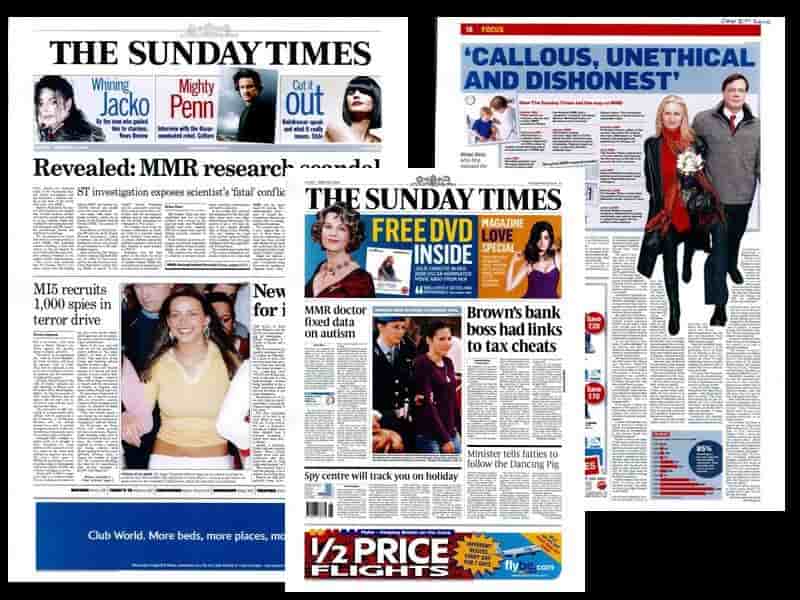
Fatal interests: On February 22 2004, the London Sunday Times splashed on Brian Deer's investigation, with two more pages inside
  What they didn't tell you: Brian Deer continued his investigation in a Channel 4 Dispatches documentary, revealing more extraordinary findings about the Royal Free and Andrew Wakefield. One discovery was a string of patent applications - for a vaccine and products that could only have succeeded if MMR's reputation was damaged. Criticism of MMR shots was tracked to a bizarre professor, Hugh Fudenberg, who claims to cure autism in his kitchen. And unreported results from Wakefield's own lab were found that rebutted his theories

"So serious": In the week after the first part of Brian Deer's Sunday Times MMR investigation was published, Britain was gripped with concern over the revelations about Wakefield, who had been regarded as an independent scientist. In an atmosphere of public uproar, many newspapers noted allegations left unresolved. Some tried to reconstruct events in the affair, which focused on two ex-Royal Free doctors: Andrew Wakefield, and Richard Horton, editor of the Lancet. The Independent


Tony Blair joins calls: The day after Brian Deer's February 2004 reports were published, the British prime minister spoke out against the six-year attack on MMR which had spun off the 1998 Lancet paper, and Wakefield's campaign. Blair said he hoped people would now see that there was no link shown between the vaccine and autism, and urged an end to the controversy. The Guardian

The Lancet panics: Three days before Brian Deer's story ran, he briefed the Lancet's editor, Dr Richard Horton and six Lancet staff. The meeting took five hours, and was attended by Dr Evan Harris MP. Only 48 hours later, Horton press-released the meeting, breaching a confidentiality agreement. Horton denied a breach, claiming it was his duty to make the information known immediately

Running scared: With the Lancet responsible for publishing the sham scientific finding, the journal's editor, Dr Richard Horton - a former Royal Free hospital doctor who had worked under Wakefield's mentor, Professor Roy Pounder - now rushed out "regret" for the "fatally flawed" research that he had championed for six years. He even wrote two books justifying this. BBC Online News

2004 - partial retraction: Since the Thalidomide scandal of the 1970s, journalism had scored few such clear hits on medicine as on March 3 2004 - ten days after the first installment from Deer's investigation was published - when 10 of the 13 authors of the Lancet paper formally withdrew their finding of a possible link between MMR and autism, producing huge national media attention (right). Wakefield himself would refuse to join them, preferring to issue a statement claiming that he didn't know what was being retracted. March 2004  

February 2004: Just ten days after Brian Deer's first report, the Wakefield allegation of an MMR-autism link was partially retracted

  2010 - full retraction: Six years after the partial retraction, the Lancet finally capitulated to Brian Deer's investigation, after Deer was backed by the UK General Medical Council. Following a record-breaking 197 days of evidence, submissions and deliberation, on 28 January 2010 a GMC panel confirmed all of the central findings of The Sunday Times inquiry, branding Wakefield "dishonest", "unethical", "irresponsible", and "callous". Five days later, Lancet editor Richard Horton said he had been "deceived". February 2010

Investigation reverses decline in UK parents' confidence in triple vaccine but fails to stop resurgence of measles

Trend reversed: After years of decline, following Andrew Wakefield's campaign against the vaccine, the graph to the right shows how Brian Deer's 2004 MMR investigation reversed the decline in vaccination rates, as parents realised they had been misled by Wakefield's claims. As UK department of health charts showed, falls in public confidence could be linked directly to Wakefield's attacks, which began with allegations from him that the triple shot may cause the inflammatory bowel disorder Crohn's disease. In the aftermath of Deer's first findings, the tone of most media coverage changed

Measles outbreaks: In the years after Wakefield's claims, measles outbreaks returned to the UK, including the first death in 14 years. Meanwhile, parents of many autistic children suffered guilt, blaming themselves, wrongly believing Wakefield's implied message: that it was their own fault that their children had problems, because they had agreed to vaccination. By 2009, health bodies in Britain, the United States, Canada, Australia and many other countries were reporting outbreaks of measles: which many experts had forecast could be eradicated
 
Bouncing back: Andrew Wakefield's campaign caused a collapse in UK immunisation rates, reversed by Brian Deer's investigation for The Sunday Times of London. These official data are for England
Endemic again: Wakefield's legacy is fear, guilt and, above all, disease - as the graph here of confirmed measles infections reveals
  MMR - the truth: The recovery in vaccination rates came as the public realized that Andrew Wakefield's claims against MMR were based on a severe conflict of interest. The global scare rested on claims by the parents of only eight children. But most of them were lawyers' clients and members of campaign groups - countering assertions that the study was based on routine referrals - and Wakefield had been funded through an undisclosed deal to help them sue drug companies. The Sunday Times, February 22 2004, with vastly more money revealed in The Sunday Times on December 31 2006

Payments revealed: Later in the investigation by Brian Deer, huge payments to Wakefield were revealed by the Legal Services Commission, responding to a Freedom of Information Act request from Deer. In December 2006, the commission released a table, showing fees to Wakefield - never before publicly disclosed - of £435,643 [approximately $780,000 US]. Indeed, Wakefield's supporters repeatedly denied that he was ever paid at all to conduct his alleged research. Others were also paid huge sums for the legal attack on MMR

Ethical concerns come over children's treatment to the fore as General Medical Council moves against Wakefield

Royal Free ethics doubts: Confidential documents obtained during Brian Deer's inquiries reveal that the hospital's ethics committee was told that a battery of tests on vulnerable children was "clinically indicated" and so not needing ethical approval. But, as reported in The Times, this was challenged, and became central to a disciplinary case. A chart here asks visitors to make up their own minds

Lancet study "not ethically approved": Despite claims by the Lancet to be at the forefront of moves to raise ethical standards, the research as published by Wakefield et al was challenged as not approved by any ethics committee. The page at this link compares the Royal Free ethical submission with what was actually published in the journal. Later Wakefield claimed he didn't need approval

MMR in parliament: On March 15 2004, Dr Evan Harris MP called a brief parliamentary debate, during which he took up the ethical issues raised in Brian Deer's investigation: whether a battery of potentially hazardous tests on autistic children were justified. He said he believed the issues could be as serious as how the public had been misled by the discredited Lancet paper's claims. Hansard

Road closed: On February 27 2004, the UK's Legal Services Commission - which had paid for the vaccine controversy - announced that a judicial review had rejected a request for reconsideration of a decision to end funding the lawsuit, which had contributed £15m towards manufacturing the worldwide scare. It said that the courtroom was no place to "prove new medical truths" Press release

Determined to deceive: As Deer's investigation went forward through 2007-2010, a dirty tricks campaign was launched by a group of cranks and opportunists, with no connection to the subject, falsely alleging that Deer was working with the drug industry. One architect of this campaign was a shadowy character from Spain, who latched onto families with a string of fabrications. Statement

Post perspective: Among the extensive international reportage of the MMR investigation was a long and detailed account in the Washington Post by distinguished journalist Glenn Frankel. Among his findings was a plan by Wakefield to move his crusade to Texas where, according to one source, his "entrepreneurial spirit" will find "fertile ground" in US privatized health care. Washington Post

Vehement denials: Although Andrew Wakefield refused requests from Brian Deer to discuss the vital issues at stake for children's safety, he issued a string of statements entirely rejecting every criticism. Later, he sued Deer, The Sunday Times and Channel 4 Television for libel, but in January 2007 abandoned his claim and paid Brian Deer compensation for the costs of defending this website

MMR mail: Readers' emails came in quickly following the Sunday Times reports on February 22 2004, and continue to be received. A minority are abusive, as litigant-parents paradoxically blame Brian Deer for Wakefield's betrayal of their trust. Also, among a spattering of crank mailers was "expert witness" Carol Stott, a low-grade psychologist, also hired by the lawyers, for £100,000, to back the now collapsed UK anti-MMR vaccine campaign, which was soon to be exported to the United States of America. But Deer stayed on the trail

    Dateline NBC: On 30 August 2009, Brian Deer and Andrew Wakefield appeared on Dateline NBC, reporting on the former surgeon's claims. In the clip here, some of Deer's early findings (but not the February 2009 revelations) are discussed. Wakefield replies in another segment. With regard to the Lancet children he says: "Now let's be clear. They were admitted to the Royal Free for investigation of their symptoms. Nothing to do with research, nothing to do with class action, nothing to do with vaccines." These claims were untrue

  As taught in schools: In 2008, Deer scored a professional first when findings from his investigation became the subject for an exam question for British teenagers, set by the UK Assessment and Qualifications Alliance. See question 5 at this link, and, if you feel you need to, go here to see how you would have scored on this GCSE topic

Brian Deer's Sunday Times reports investigating the MMR vaccine, autism and Dr Andrew Wakefield

22.02.04 Revealed: MMR research scandal
22.02.04
Focus: MMR - the truth behind the crisis
22.02.04
The editor: Dr Richard Horton
22.02.04
The investigator: Brian Deer
07.03.04
Key ally of MMR doctor rejects autism link
25.04.04
Fresh doubts cast on MMR study data
14.11.04
MMR scare doctor planned rival vaccine
12.12.04
Doctors in MMR scare face public inquiry
06.03.05
MMR jab scare research dealt a 'killer blow'
11.09.05
MMR scare doctor faces list of charges
02.04.06
Schoolboy, 13, dies as measles makes a comeback
21.05.06
Just how much new research can we trust?
|
|
|
|
|
|
18.06.06 How a spurious health scare brought an old killer back
18.06.06
MMR: Countdown to a crisis
31.12.06
MMR doctor given legal aid thousands
15.07.07
Memo warned MMR doctor of research flaw
08.02.09
MMR doctor fixed data on autism
08.02.09
Hidden records show MMR truth
08.02.09
How the MMR scare led to the return of measles
08.02.09
MMR - key dates in the crisis
24.01.10
News Review: Truth of the MMR scandal
31.01.10
Focus: "Callous, unethical and dishonest"
31.01.10
Leading article: Bad science needs good scrutiny
02.02.10
BMJ column: Reflections on investigating Wakefield

Contact Brian at this link: Visitors often offer vital information for this and other investigations. Please feel free to email Brian Deer with your suggestions, comments and ideas. If you plan to borrow from this site, please check the copyright and plagiarism notice
 

Andrew Wakefield: his paper fully retracted

February 2010: In a statement from the Lancet medical journal, the claims made by Andrew Wakefield and his associates, linking the MMR vaccine with autism were fully retracted. The decision - finally capitulating to Brian Deer's
multi-part investigation for The Sunday Times - came just five days after Wakefield was found to be "dishonest", "unethical", "irresponsible" and "callous" by a disciplinary panel of the UK General Medical Council (GMC), following up on Deer's reports.

The statement, dated 2 February 2010, said: "Following the judgment of the UK General Medical Council's Fitness to Practise Panel on Jan 28, 2010, it has become clear that several elements of the 1998 paper by Wakefield et al are incorrect, contrary to the findings of an earlier investigation. In particular, the claims in the original paper that children were 'consecutively referred' and that investigations were 'approved' by the local ethics committee have been proven to be false. Therefore we fully retract this paper from the published record."

In a media furore similar to the events of 2004, described on this page, The Guardian newspaper reported: “The medical journal's editor, Richard Horton, told the Guardian today that he realised as soon as he read the GMC findings that the paper, published in February 1998, had to be retracted. ‘It was utterly clear, without any ambiguity at all, that the statements in the paper were utterly false,’ he said. ‘I feel I was deceived.’”

The full retraction came just two weeks short of six years after Brian Deer first revealed Wakefield's conflicts of interest and dishonest research methods, leading to the partial retraction described on this page. At that time, the Lancet dismissed most of the very serious charges found proven by the GMC panel in January 2010. Horton even wrote a book, again rejecting what he would later admit to be true.

"A prominent British medical journal on Tuesday retracted a 1998 research paper that set off a sharp decline in vaccinations in Britain after the paper’s lead author suggested that vaccines could cause autism," reported The New York Times. "The retraction by The Lancet is part of a reassessment that has lasted for years of the scientific methods and financial conflicts of Dr Andrew Wakefield, who contended that his research showed that the combined measles, mumps and rubella vaccine may be unsafe."

The Times said: "A British medical panel concluded last week that Dr Wakefield had been dishonest, violated basic research ethics rules and showed a 'callous disregard' for the suffering of children involved in his research. Dr Richard Horton, editor in chief of The Lancet, said that until that decision, he had no proof that Dr Wakefield’s 1998 paper was deceptive.'That was a damning indictment of Andrew Wakefield and his research,' Dr Horton said.

In the report, Times writer Gardner Harris, explained: "Dr Wakefield’s paper reported on his examinations of 12 children with chronic intestinal disorders who had a history of normal development followed by severe mental regressions. He speculated that the combined measles, mumps and rubella vaccine may have caused some sort of chronic intestinal measles infection that in turn damaged the children’s brains. He suggested that the combined vaccine should be split into three separate shots and given over a longer period of time.

"But an investigation by a British journalist found financial and scientific conflicts that Dr Wakefield did not reveal in his paper. For instance, part of the costs of Dr Wakefield’s research were paid by lawyers for parents seeking to sue vaccine makers for damages. Dr Wakefield was also found to have
patented in 1997 a measles vaccine that would succeed if the combined vaccine were withdrawn or discredited."

The retraction didn't answer all the questions, however. Deer's investigation also revealed, in February 2009, wholesale mismatches between data in the Wakefield paper and the medical records of children enrolled in his research.

Andrew Wakefield: "my quest for truth"

Wakefield's final disgrace in 2010, when he and his research were confirmed as dishonest, contrasts with the heady days of just a few years before. On 22 April 2002, for example, he declamed to a crowd at a "Power of One Idea" rally in Washington DC, alleging not only that MMR caused autism, but that other doctors knew this and were covering it up.

"We are in the midst of an international epidemic. Those responsible for investigating and dealing with this epidemic have failed. Among the reasons for this failure is the fact that they are faced with the prospect that they themselves may be responsible for the epidemic.

"Therefore, in their efforts to exonerate themselves they are an impediment to progress. I believe that public health officials know there is a problem; they are, however, willing to deny the problem and accept the loss of an unknown number of children on the basis that the success of public health policy - mandatory vaccination - by necessity involves sacrifice.

"Neither I, nor my colleagues subscribe to the belief that any child is expendable. History has encountered and dealt with such beliefs.

"You, the parents and children, are the source of the inspiration and strength for our endeavours; our quest for truth through science - a science that is compassionate, uncom-promising and uncompromised.

"I do not mean to stir you to mutiny, but be assured that armed with this science it is in your power to force this issue, in your pediatricians office, in Congress, in the Law Courts.

"Keep faith with your instincts. They have served you well."

Hear lawyer Richard Barr tell Brian Deer that he paid for Wakefield's 1998 Lancet MMR paper [mp3 audio]


CONTACT BRIAN
 
HOMEPAGE
 
MMR NARRATIVE
 
GO TO PART TWO
 
GO TO PART THREE