
Reprint
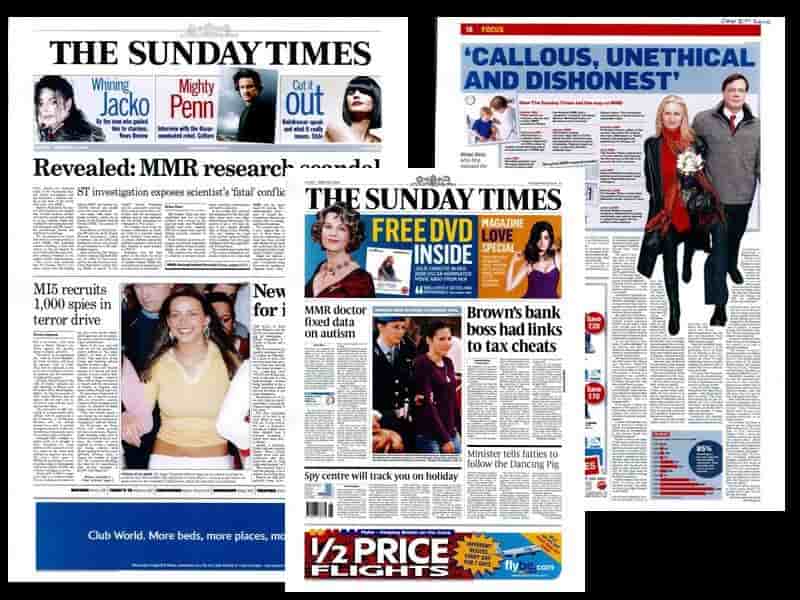
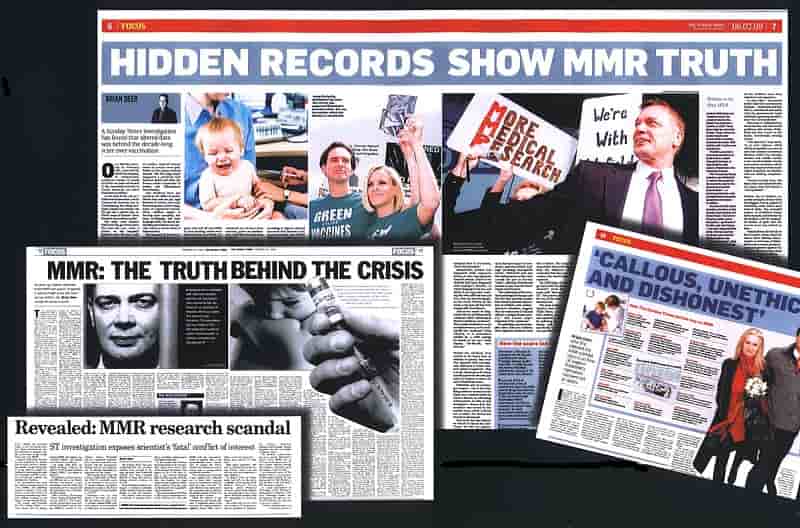
Focus: MMR – the truth behind the crisis
The Sunday Times, February 22 2004
Brian Deer
Six years ago Andrew Wakefield linked MMR with autism. It sparked a national health scare that could yet see children die. Brian Deer reveals the doctor’s secret
To call a national press conference in order to announce the results of a scientific trial is rare. For a prestigious teaching hospital to do so for a study involving just 12 children is unprecedented. So when journalists were called to attend an urgent press briefing at the Royal Free hospital in London in February 1998 they arrived expecting a scoop.
Under television lights, five doctors, including the dean of the medical school, lined up to make their announcement. They had, they informed the hushed room, important news from the front line of medicine: injections of the combined measles, mumps and rubella vaccine (MMR) had been linked for the first time to a bowel disorder and the onset of a severe form of regressive behaviour, generally known as autism, in children.
Richard Horton, the dapper young editor of The Lancet, waited expectantly in his office for the reaction. It was shocking news by any standards. Government policy dictated that every child should receive the first of two MMR inoculations between 13 and 15 months. Thousands of jabs were being given daily. Now parents were being told that the vaccination might be associated with a form of serious brain damage in children.
READ HOW DEER’S WAKEFIELD
INVESTIGATION WAS CHECKED
Advance copies of The Lancet’s sensational study were quickly distributed. “Twelve children were referred to (the hospital) with a history of normal development, followed by a loss of acquired skills, including language, together with diarrhoea and abdominal pain”, read its remarkably media-friendly opening page. “Onset of behavioural symptoms was associated, by the parents, with measles, mumps and rubella vaccination in eight out of the 12 children.”
Eight out of 12: it was a stunning proportion. Worse, the damage had become evident on average just “6.3 days” after the jabs were given. Professor Arie Zuckerman, dean of the medical school, then sounded a word of caution. It was “absolutely essential” that public confidence in MMR was not damaged by the publication of the study. Eight children did not, after all, provide proof of a link between MMR and autism, he noted.
However, if Zuckerman was cautious, others were not. At the centre of the speakers’ table sat the principal author of the study, Dr Andrew Wakefield. Cutting a dashing and charismatic figure, the young gastroenterologist had a very different message to impart. Yes, it was just one study and yes, there was no proof, but he personally believed that action was needed.
“One more case of this is too many,” he declared. “It’s a moral issue for me and I can’t support the continued use of these three vaccines given in combination until this issue has been resolved.” He wanted single jabs.
Until then the emerging public debate over MMR had been based on little more than anecdote. Now it had been given the imprimatur of The Lancet and an urgent call for government intervention. The result was explosive. “Alert over child jabs” shouted the front page of The Guardian the next day. “Ban three-in-one jab urge doctors” said the Daily Mail. Thousands of similar newspaper stories, television and radio broadcasts followed over the next few months.
GPs’ surgeries were inundated with calls from parents and vaccination rates started to fall. Six years on and an epidemic of measles, which can maim and even kill, now threatens. Overall, the inoculation rate has fallen to just 79% — well below the 95% needed to confer “herd immunity” in crowded schools, nurseries and playgrounds.
David Elliman, a consultant community paediatrician at Great Ormond Street hospital, warned last week that with almost half of children unvaccinated in some parts of London, the risk of a death from measles had become real. He said that outbreaks of the disease caused by inadequate vaccine coverage in Italy, Ireland and Holland had led to deaths in recent years.
“The worry is that the coverage here is so low in some areas that this could happen here, and people should be made aware of that,” he said.
At the Department of Health and in the wider medical establishment, experts were deeply concerned by the reaction to The Lancet study. Yes, the journal had pushed it and yes, officialdom had gained little in the way of public trust after the debate over “mad cow” disease, but Wakefield appeared not so much an objective scientist, more as a man with a mission. He had even written to the department attacking the MMR vaccination before his own research was completed.
“I am writing to you in order to express formally my anxieties over your intention to re-vaccinate all pre-school children,” he wrote on September 6, 1996 to Sir Kenneth Calman, then the government’s chief medical officer. The letter closed with the blunt instruction: “Do not re-vaccinate.”
Now a Sunday Times investigation has revealed that Wakefield’s Lancet report was not the objective piece of science that it had appeared to be. All along he has kept a secret from the public, from The Lancet and even from his colleagues. His secret was this: in August 1996 — the month before he dispatched his letter to Calman and a month before he applied for ethical approval for the Lancet study — he had secured up to £55,000 from the Legal Aid Board specifically to investigate a possible link between MMR and autism in respect of 10 named children.
Of the eight children whose parents were eventually reported in The Lancet as having associated the jab with the onset of their child’s autism, “four, perhaps five” were covered by the legal aid contract. Not only did Wakefield know at the time of publication that the parents of these children had an interest in seeing a scientific link between MMR and autism established, but he was also being funded to investigate that possibility. Only if he were successful in establishing that link would the children’s parents be able to sue for compensation. He knew all this but declared none of it in the Lancet study, to his principal co-authors or to the public.
All the public got was Wakefield’s warning against MMR and the concluding paragraph of his study which stated: “In most cases, onset of the symptoms was after measles, mumps and rubella vaccination.” Through the offices of public relations advisers and lawyers, Wakefield continues to maintain that he acted properly. But the revelations do more than cast his original study in a new light; they taint his findings.
Even Horton, a former colleague of Wakefield, said last week that in retrospect The Lancet should never have published his study. Late on Friday, after being shown the evidence in confidence by The Sunday Times, he chose to make a public statement.
“If we had known the conflict of interest Dr Wakefield had in his work, it would have been rejected. As the father of a three-year-old who has had the MMR, I regret the adverse impact this paper has had,” Horton said.
HOW did Wakefield end up publishing something so potentially misleading in a highly respected medical journal? “Andrew always wanted to be a surgeon,” recalled his mother Dr Bridget Wakefield, a retired GP in Bath who is married to a neurologist and is the daughter and granddaughter of doctors. “He’s very like my father. If he believed in something, he would have gone to the ends of the earth to go on believing.”
After qualifying in medicine and training as a surgeon in Canada, Wakefield joined the Royal Free as a research scientist. Among the bowel problems that he had seen during his training was Crohn’s disease, an ulcerating inflammation of the gut. The more he studied it, the more he suspected that it was caused by a common virus: measles.
In the early 1990s Wakefield published several studies proposing a measles-Crohn’s link. Although the studies did not lead very far, he kept the faith and persevered. At the same time Richard Barr, a solicitor in Norfolk, was developing a practice in litigation against drug companies. Barr had pursued some cases against Opren, an arthritis drug, and in the early 1990s he learnt of concerns about MMR, which had been introduced in Britain in 1988. A number of clients came to him concerning legal action against three drug companies which manufacture MMR: GlaxoSmithKline, Aventis Pasteur and Merck.
Barr identified clients through newsletters and publicity. “Vaccine damage is not some capricious concept,” he claimed in one pamphlet, “but is very real and is demonstrable using scientific principles.”
Jackie Fletcher, one of Barr’s clients, ran a campaigning group called Jabs which involved concerned parents. It is not clear exactly when Wakefield and Barr first came into contact. Barr thinks he met Wakefield in 1994. A colleague in Dawbarns, the firm where Barr then worked, says it was in 1995. Last week Wakefield said it was 1996, but then conceded that it might have been 1995.
What is clear is that when the two met, a flurry of activity ensued. Damaged children in Barr’s network started to be referred to the Royal Free. This was an “unusual” pattern, The Lancet said on Friday.
According to Barr, he and Wakefield began to talk regularly by telephone. Between the two of them a hypothesis was taking shape: that measles from MMR was damaging the gut, causing inflammation. Harmful chemicals were then getting into the blood, resulting in brain damage and autism. It was a neat idea but little more than that. Then, sometime in the first six months of 1996, Barr and Wakefield approached the Legal Aid Board to fund the clinical investigation of 10 apparently brain-damaged children. In August 1996 the board granted them £55,000 to investigate possible links between MMR and autism, The Sunday Times has established.
Wakefield’s clinical colleagues at the Royal Free — who physically examined the children — say they were not told of the Legal Aid Board contract by Wakefield. All the children were presented to them as ordinary patients referred by their GPs. Soon afterwards these same doctors — surprised at what they had seen in the children — applied to the Royal Free’s ethics committee to undertake a study for publication on up to 25 children with behavioural disorders who had had measles vaccine.
Wakefield’s name was also prominent on the proposal which was submitted in September 1996. It was this study that would give rise to the Lancet article. There was no disclosure on the ethics application form of the legal aid contract. A few of the children were already under investigation but now the numbers increased. Each was subjected to a battery of tests, some highly invasive: one involved manoeuvring a 4ft fibre-optic endoscope deep into the bowel; another was to hunt for measles through a lumbar puncture or spinal tap.
Wakefield says these investigations were judged to be “clinically indicated” by his medical colleagues and therefore justified. They did not know, however, about the £55,000 legal aid contract. Barr was delighted for his clients at the way things were going. Indeed, when interviewed by The Sunday Times last month, he said: “We weren’t trying to get an independent paper published under the carpet. I remember noting at the time that the funding acknowledgment wasn’t there, but it didn’t seem to be a big deal . . . things have moved on since then.”
The issue of funding aside, there is another, perhaps more fundamental, issue. After lengthy investigations by The Sunday Times, Wakefield finally admitted last week that “four, perhaps five” of the children in his Lancet study were among the 10 named in the legal aid contract. Was it four or five? “Let’s make it five,” he said. The questioning went on. Were they litigants? Yes. Was he being paid to help them to build their case? Yes. Were his colleagues told that they had ended up in the Lancet sample? I don’t recall. Did he reveal the conflict of interest to The Lancet as its rules explicitly require? No. Why not? “I believe that this paper was conducted in good faith. It reported the findings. There was no conflict of interest. Do we have any reasons (now) to change our opinion? No, but again it’s a debate.”
The Lancet yesterday described Wakefield’s continuing insistence that he had done nothing wrong as “perverse”. John Reid, the health secretary, has called for a General Medical Council inquiry. Others are equally bemused. Elliman said he was amazed that Wakefield had used children who were litigating as his subjects.
“These are people with a clear vested interest in the result of the research and it would have been appropriate to let that be known,” he said. “Wakefield has got himself into a very difficult position.”
Wakefield says that in 1997, as The Lancet study was being prepared for publication, he and his colleagues had another “debate”. It was about whether to include the key finding that the parents of eight out of 12 children associated the jab with the onset of brain damage in their offspring.
His co-authors, however, say they did not have the full facts: Wakefield had not told them of the “overlap” of five children or even of the existence of the legal aid contract. When Professor John Walker-Smith, the lead clinician named on the Lancet study, was told of Wakefield’s funding, he said that he was “astounded”.
“We were seeing these patients by clinical need and we were reporting the first patients we saw,” he said. “There was no awareness of any legal involvement when we saw these children.”
THERE were several key points at which Wakefield could or should have declared his and the children’s involvement in the litigation. The Lancet’s rules for its authors are clear: “The conflict of interest test is a simple one. Is there anything . . . that would embarrass you if it were to emerge after publication and you had not declared it? The editor needs to be informed and will discuss with you whether or not disclosure in the journal is necessary.”
Did Wakefield hold discussions? No. Is he now embarrassed? “I have no regrets,” he said. Shouldn’t he have disclosed that he was acting for Barr’s clients? “I don’t agree . . . clearly there is a debate . . . we can argue about this.” On Friday, after considering The Sunday Times’s evidence, questioning Wakefield and inspecting the Royal Free’s records, The Lancet issued a statement which concluded that Wakefield should have disclosed his interest. He should have told the editor about his study for the litigants and its £55,000 funding, even if there had been no children overlapping with the Lancet study.
“If we had known then what we do now, we certainly would not have published that part of the paper that related to MMR,” the editor added. Wakefield had another opportunity early on to set the record straight. After the Lancet study appeared in February 1998, the Medical Research Council (MRC) convened a meeting to discuss it. Numerous doctors and professors were present, along with officers of the MRC. Minutes of the meeting record: “How were the patients selected? Members were interested in how the children had come to be referred to the (Royal Free) team, as this had a bearing on the issue of bias.”
It was an obvious moment for Wakefield to declare his hand, to disclose his interest and put the record straight before the MMR scare that the Lancet study had sparked got out of control. But again he failed to reveal the legal aid contract.
Professor Sir David Hull, chairman of the government’s joint committee on vaccination and immunisation, was present. “Certainly the fact that these patients were litigants would be relevant to interpretation of the data,” he said. “It was already very questionable whether anyone seriously looking at the data would draw the same conclusions as (Wakefield).” Ironically — and to much less fanfare — Wakefield published a few months later a little noticed study that revealed just how skewed his original Lancet study had been. The brief synopsis, published in a journal called Gut, had data on the original 12 children of the Lancet study and a further 18. Parents of only three of the new children attributed the onset of their children’s behavioural problems to MMR. Put another way, the incidence of parental association between MMR and autism had dropped from 66% to just 12%.
Did this undermine the Lancet findings? “You may be right,” Wakefield said last week. “I simply don’t know. It does seem that as we examined more numbers the percentage of parents who ascribed (their children’s problems) to the vaccine fell away.”
EVER since the BSE scare, when the government first declared beef to be completely safe but then decided that it could kill, the public has been distrustful of the health authorities. When Wakefield and The Lancet published his study in that climate, the public was ready to disbelieve government protests that MMR was safe. “After (the study) first came out we were struggling just to get parents to immunise their children,” said Dr Michele Hamilton-Ayres, a consultant paediatrician in Cheltenham. “Things got terribly bad.”
Immunisation rates have fallen dangerously low and the incidence of measles cases has risen sharply. Meanwhile, legal cases have proliferated: since Wakefield and Barr were granted the £55,000, legal aid for those suing the vaccine companies has reached £15m. Of that, about £5m has gone to Barr’s present firm, Alexander Harris, and about £4m has gone to doctors, some earning £100 an hour to study reports.
The Legal Services Commission (successor to the Legal Aid Board) cut off funding last year, but lawyers pursuing compensation claims have taken that decision to judicial review.
Wakefield remains unrepentant. He insists that he and his colleagues have discovered a novel bowel disease in some children with developmental disorders. He claimed last week that the £55,000 study, finally submitted for publication, has found “live” measles in the guts of children with behavioural disorders. But even he admits that this is all a long way from proving that measles, let alone MMR, causes autism. No causal link has been found between them.
Is he embarrassed? Would he like to apologise? Last week, after these questions were put directly to him, the real passion that drives him suddenly broke through. “Should we stop, should we go away, should we stop publishing because it is inconvenient?” he asked. “I’ve lost my job. I will never practise medicine in this country again. There is no upside to this. “But if you come in to me and say, ‘This has happened to my child’, what’s my job? What did I sign up to when I went into medicine? To look after your child. How many other children does this affect because your child’s expendable if it’s only your child (suffering damage). That’s not my job. I’m not here to make that kind of decision. I’m here to address the concerns of the patient. There’s a high price to pay for that. But I’m prepared to pay it.” His co-authors, however, feel betrayed. “I am very, very angry,” said one of them yesterday. “I would never have put my name to the study if I had known there was this conflict of interest, and had I not done so it would never have got published.”
READ HOW DEER’S WAKEFIELD
INVESTIGATION WAS CHECKED
Invite Brian Deer to speak at your event
Hear the astonishing true story of the plot behind today’s controversy over vaccines, and its exposure by an investigative journalist
Contact Brian
RELATED:
Vexatious Wakefield lawsuits fail