MMR: the money
After £15m of public money was spent on pursuing a High Court action – money which fed directly into creating the scare over MMR – the UK Legal Services Commission cut the cash.
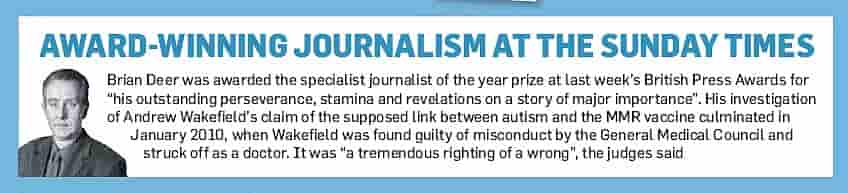
READ HOW DEER’S WAKEFIELD
INVESTIGATION WAS CHECKED
Despite a vast investment of taxpayers’ money, there simply was no convincing evidence of what Wakefield had claimed: that the triple shot may be linked with autism. Here are two press releases which marked the end of the road for some 1,500 families
1 October 2003
DECISION TO REMOVE FUNDING FOR MMR LITIGATION UPHELD ON APPEAL
The Legal Services Commission’s (LSC’s) decision to remove funding for the Measles, Mumps and Rubella (MMR) litigation was upheld by a Funding Review Committee at a hearing yesterday.The Funding Review Committee is an independent body, made up of solicitors and barristers from private practice. The Funding Review Committee that heard the MMR appeal consisted of an eminent Queens Counsel barrister and solicitors who are experts in this area.
The parents involved in this action believe the MMR vaccine has injured their children. It is clear to see that the children are suffering from a number of conditions, most seriously, regressive autism or a new type of bowel disease. These illnesses are severe and of sufficient wider public interest to justify the LSC’s significant investment of £15million in this case.
Despite this investment, medical research has yet to prove a conclusive link between the MMR vaccine and Autistic Spectrum Disorder. Additionally, no link has been proven by any other medical body. There remains no acceptance within the worldwide medical authorities that MMR causes the symptoms seen in these children. Therefore, the litigation is very likely to fail. It would not be correct to spend a further £10million of public money funding a trial that is very unlikely to succeed.
Clare Dodgson, Chief Executive of the LSC said: “I appreciate that this decision will come as a great disappointment to the parents involved. I sympathise with their situation. Their children are clearly ill and they genuinely believe the MMR vaccine caused their illnesses. However, this litigation is very unlikely to prove their suspicions. It would be wrong to raise their hopes unreasonably by proceeding with this litigation.” All the research paid for by the LSC will be sent to the Medical Research Council who are investigating the causes of autism.
Notes to Editors
1. The Legal Services Commission is responsible for providing legal aid for Multi-Party Actions, providing the individuals involved meet our financial means test and the case has good legal merits.
2. The LSC, formerly the Legal Aid Board, has funded the MMR litigation since 1992. The funding provided has primarily been spent on research into the medical link between the children’s symptoms and the MMR vaccine.
3. The MMR case has been brought under the Consumer Protection Act 1987, on the basis that MMR is a defective product and should not have been used. There is a limit of 10 years on the time in which an action can be brought under the Consumer Protection Act. Therefore, it was necessary to start court proceedings before the medical research had concluded. The court has scheduled a 6 month trial starting in April 2004, where the possible link between MMR and the children’s symptoms will be tried.
4. Under the Legal Aid Act 1988 the LSC is obliged to withdraw funding where a case no longer meets the legal merits test. Cases must have reasonable prospects of success, and the cost of the action must be reasonable, compared with the potential damages. If funding is withdrawn by the LSC, any legally aided individual has a right of appeal to a Funding Review Committee.
5. This was the first case in which research had been funded by legal aid. In retrospect, it was not effective or appropriate for the LSC to fund research. The courts are not the place to prove new medical truths. The Medical Research Council (MRC) is the appropriate body to investigate the cause of these children’s illnesses. The latest MRC report on autism states that the causes “remain, to a large extent, unidentified”. The MRC are looking for research into the medical “mechanisms” causing autism.
27 February 2004
JUDICIAL REVIEW AGAINST MMR FUNDING DECISION DISMISSED
In the High Court today, Mr Justice Davis has dismissed the judicial review against the Legal Services Commission’s decision to remove legal aid for the MMR litigation. The judicial review was brought by Alexander Harris solicitors on behalf of a child whose parents believe he was harmed by the MMR vaccine. That child is part of the larger group action known as the MMR litigation.
The Legal Services Commission (LSC) withdrew funding for the MMR litigation on 29 September 2003 on the grounds that the litigation, which was seeking to establish a link between MMR and autism or bowel disease did not have any reasonable prospect of success. On 30 September 2003, this decision was supported by a Funding Review Committee, an independent appeal body, made up of an eminent Queens Counsel barrister and three expert solicitors.
Clare Dodgson, Chief Executive of the LSC, said: “I welcome today’s judgement. I was always satisfied our decision and that of the Funding Review Committee was correct. I have every sympathy for the parents. Their children are clearly ill and they genuinely believe the MMR vaccine caused their illnesses. However, I am not convinced that legal action is the best way of deciding this matter. Any more legal challenges will drag out the process, which could ultimately result in further distress for the families.”
Notes to editors
1. The Legal Services Commission (LSC) is responsible for providing legal aid for Multi-Party Actions, providing the individuals involved meet our financial means test and the case has good legal merits.
2. Under the Legal Aid Act 1988, the LSC is obliged to withdraw funding where a case no longer meets the legal merits test. Cases must have reasonable prospects of success and the cost of the action must be reasonable, compared to the potential damages. When the LSC withdraws funding, any legally aided individual has a right of appeal to a Funding Review Committee.
RELATED:
Vexatious Wakefield lawsuits fail
Brian Deer’s 2004 Dispatches film
Selected MMR-Wakefield resources