
Reprint

MMR scare doctor planned rival vaccine
The Sunday Times, November 14 2004
Brian Deer
THE doctor whose work provoked a worldwide scare over MMR failed to reveal that he was developing his own commercial rival to the vaccine.
It has emerged that a patent was filed on behalf of Dr Andrew Wakefield for a measles vaccine and other products that would have stood a better chance of success if public confidence in MMR’s safety was undermined.
Wakefield now faces criticism that he should have declared the conflict of interest when he announced a possible link between MMR and childhood autism.
Since then there has been a decline in the number of children inoculated with the vaccine for mumps, measles and rubella.
An investigation by The Sunday Times and Channel 4’s Dispatches programme has found that Wakefield and the medical school of the Royal Free hospital, London, where he worked, made a series of applications to patent measles-related products. The first was filed at the Patent Office nine months before Wakefield’s press conference in February 1998.
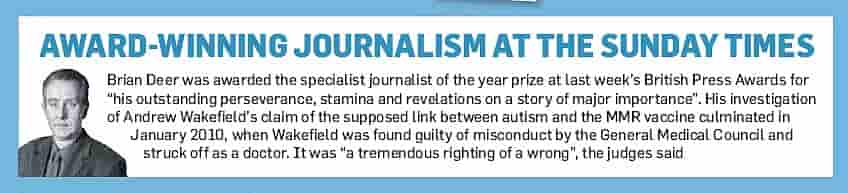
READ HOW DEER’S WAKEFIELD
INVESTIGATION WAS CHECKED
Three months after the conference, Wakefield was named as the inventor on a follow-up document trying to patent a “measles virus vaccine”. Although he never produced a vaccine, the fact that he was planning a rival to MMR while casting doubt on its safety has raised concern.
“I think a lot of parents will be very angry,” said Dr Michael Fitzpatrick, a north London GP and pro-MMR campaigner who has an autistic son.
Discovery of the plans follows revelations by this newspaper in February that Wakefield’s research on MMR had begun with a commission from solicitors attempting to sue vaccine manufacturers.
The patent application papers detail products aimed at preventing, even curing, diseases allegedly caused by MMR, the vaccine against measles, mumps and rubella.
They included a rival vaccine for measles. At the time the products appeared to have little chance of commercial success in Britain given the dominance of MMR and the confidence in its safety.
The first application was lodged by the Royal Free on June 5, 1997 and two were filed on June 4, 1998 — after the press conference at which Wakefield, a mid-rank academic and surgeon, unleashed the scare.
According to the paper by Wakefield and 12 other researchers, the Royal Free had seen 12 children in a few months. In eight cases their parents claimed the children had developed autism within days of an MMR shot.
However, the paper failed to make it clear that the children were not a random sample. Instead, Wakefield’s MMR research had first been commissioned by solicitors suing the vaccine manufacturers.
Nor did Wakefield or the study disclose another conflict of interest: the Royal Free’s plans for its MMR-related products, in which Wakefield was a participant.
One application was for a “pharmaceutical composition for treatment of MMR virus mediated disease” and which “may be used as a measles virus vaccine”.
Wakefield also failed to disclose plans for such a rival product when he questioned whether it was safe for MMR to combine three vaccines. In a publicity video distributed by the Royal Free, he says: “My feeling is that the risk of this syndrome (autism) developing . . . is related to the combined vaccine, the MMR, rather than the single vaccines.”
While Wakefield was under no legal or professional obligation to disclose the patent, campaigners believe his attack on MMR may have been viewed differently had it been known.
Professor Ian Bruce, a molecular biologist who once worked with Wakefield, said: “It’s something that should have almost certainly been made public before now.”
Wakefield and the medical school also tried to patent treatments for inflammatory bowel disease and what they called “regressive behavioural disease”, or autism. Wakefield claimed that the MMR injection caused an inflammatory bowel disease and could lead to brain damage.
One of the applications dated June 1998 claims that it is “not only most probably safer to administer to children by way of vaccination/immunisation, but which also can be used to treat regressive behavioural disease, whether as a complete cure or to alleviate symptoms.”
The product was to be made by a process involving the measles virus, the white blood cells of mice and goats’ milk.
Professor Tom MacDonald of Southampton University, Britain’s pre-eminent gut immunologist, described the recipe as “total bollocks” when he was shown it last week. None of Wakefield’s products appears to have progressed much beyond the concept stage.
Last week the Royal Free denied any conflict of interest. It said it had never attacked MMR and had dissociated itself from Wakefield’s comments on the vaccine.
Wakefield declined to comment because of the investigation into his research by the General Medical Council and the possibility that he may take legal action.
“Mr Wakefield has been in the past and will hopefully again be happy to discuss these important issues,” his lawyers said.
Brian Deer’s investigation is on Dispatches, Channel 4, Thursday, 9pm.
READ HOW DEER’S WAKEFIELD
INVESTIGATION WAS CHECKED
RELATED:
Vexatious Wakefield lawsuits fail