
Investigation: selected resources
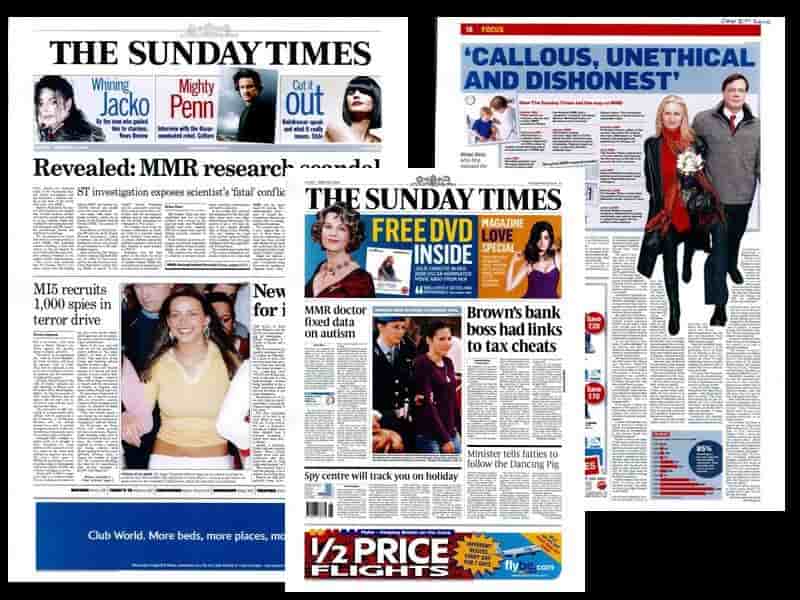
Brian Deer’s Sunday Times investigation of vaccine research cheat Andrew Wakefield is summarised at this link. Some selected materials are below.
Journalism
At this link is an almost complete list of Deer’s Sunday Times and BMJ reports which, over the years, peeled back the onion of the most pernicious medical research fraud of modern times. A few later reports remain to be uploaded.
Secrets of the MMR Scare: Brian Deer’s 2011 series for BMJ, the British Medical Journal, which expanded on The Sunday Times reports, with additional information and an orientation towards a medical readership.
View Brian Deer’s 2004 TV documentary, based on Sunday Times reporting: MMR – What they didn’t tell you.
Some key documents
Click these links for Wakefield’s first and second patent claims for his vaccine/immunisation for the “prevention and/or prophylaxis” of measles virus infection – even the existence of which he denies.
View the cheque sent to Deer by Wakefield’s lawyers to cover the costs of defending this website, after the research cheat abandoned three vexatious “gagging writ” libel actions that a judge condemned as having been brought for “public relations purposes”.
Wakefield loses a fourth vexatious lawsuit as a Texas appeals court throws out his case and orders him to pay costs. Between 1996 and 2014, all courts and tribunals hearing of him would rule against him.
See Wakefield threaten, belittle and betray a vaccine safety whistleblower who, in strict confidence, disclosed what he said was evidence of UK government bungling over MMR.
Watch Wakefield lying about his role in the vaccine controversy and betraying the whistleblower, while concealing Wakefield’s own role in the collapse of compensation claims by thousands of parents of children with autism.
Trend reversed: After years of decline in the face of Wakefield’s campaign, this graph shows the impact of Deer’s investigation as measured by uptake of the three-in-one MMR in England and Wales.
Two Lancet retractions
2004 – partial retraction: Since the Thalidomide scandal of the 1970s, journalism had scored few such clear hits on medicine as when, ten days after Deer’s first report, the authors of the 1998 paper, excluding Wakefield, withdrew their claim of a possible link between MMR and autism.
2010 – full retraction: The Lancet finally capitulated after Deer’s findings were backed by the UK doctors’ regulator, the General Medical Council. On 28 January 2010, a GMC panel (see below) branded Wakefield “dishonest”, “unethical” and “callous”.
Characters behind the attack
Wakefield associate John Walker-Smith escaped justice from the GMC by changing his story and refusing to co-operate with the regulator. But the truth about his role was to be found in his altered autobiography.
How an unscrupulous filmmaker Miranda Bailey lied in a 2017 “documentary” titled The Pathological Optimist to support Wakefield, fooling distributors and audiences alike in her bid to profit from wounded parents.
Read the side-show tale of a paid smear campaigner, Martin J Walker, hired to plant among vulnerable parents the fabricated Wakefield claim that the drug industry was behind the investigation of his behaviour.
As MMR became a “crank magnet”, Wakefield’s close collaborators included one David L Lewis – fired by the EPA – who bizarrely complained that the standard of Deer’s journalism was too high.
For many years, Wakefield could only succeed through the support of a network of enablers who, without bothering to check, parroted his falsehoods and smeared those who challenged him. One such individual was Jennifer Larson of Wisconsin.
A close Wakefield ally was Carol Stott, who made a fortune from her association with his claims, and who launched a barrage of creepy abuse, threatening Deer: “Try me, shithead”.
Dinah Lord and her company Caravan Media plagiarised Deer’s investigation of Wakefield, taking findings of Deer’s, selling them to Channel 4 Television, and placing them in the mouths of sockpuppet surrogates to hide their source.
Eamonn Matthews and his company Quicksilver Media embellished the plagiarism by Lord, Caravan Media, above, and their producer Flora Bagenal by seeing it entered for an international broadcasting award knowing their submission was substantially lifted from Deer’s work.
Sample the fabrications of a dishonest (now-ex) lawyer named Clifford Miller, who spent two decades – yes, twenty years – running a malicious campaign to smear and defame Deer.
READ HOW DEER’S WAKEFIELD
INVESTIGATION WAS CHECKED

Invite Brian Deer to speak at your event
Hear the astonishing true story of the plot behind today’s controversy over vaccines, and its exposure by an investigative journalist