Royal
Free applied for patent on vaccine products
before unleashing MMR scare
This page is
research from an investigation by Brian Deer for the UK's Channel 4 Television
and The Sunday Times of London into a campaign
linking the MMR children's
vaccine with autism. | Go to part I:
The Lancet scandal | Go to part II:
The Wakefield factor |
In a video and at
a press conference in February 1998, called - the
Royal Free said - to launch the
Lancet article, Andrew Wakefield advised parents
to demand that the component shots be given
separately. What parents weren't told, however,
was that Wakefield and the hospital's medical
school had already filed the first of what would become a
string of extraordinary patent applications
(1) 05.06.97:
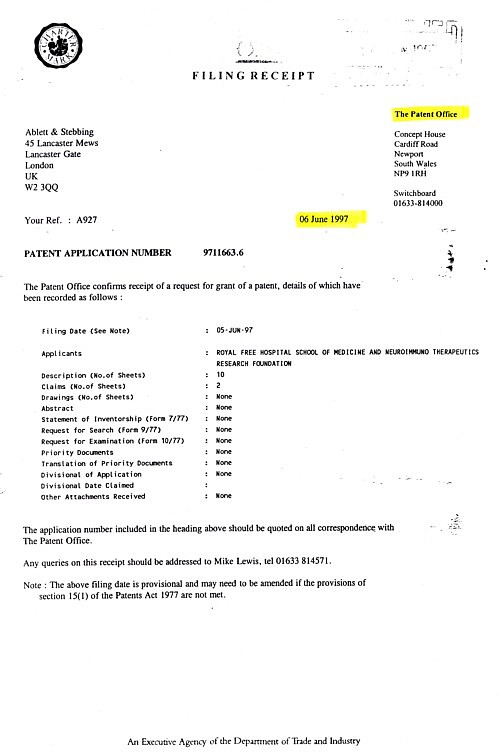
Wakefield lodges a product patent claim
Below is a
London patent office report on the claim filed on
5 June 1997 - almost nine months before
the press conference - in the name of the Royal
Free hospital medical school and the Neuroimmuno
Therapeutics Research Foundation. The foundation
is the private company of controversial
immunologist Professor H Hugh Fudenberg of
Spartanburg, South Carolina. Giving evidence to
the UK General Medical Council in August 2007,
the former dean of the medical school, Professor
Arie Zuckerman, said the Royal Free had no
knowledge of the application, and that he was
"absolutely shocked" to discover that
Wakefield had lodged it.
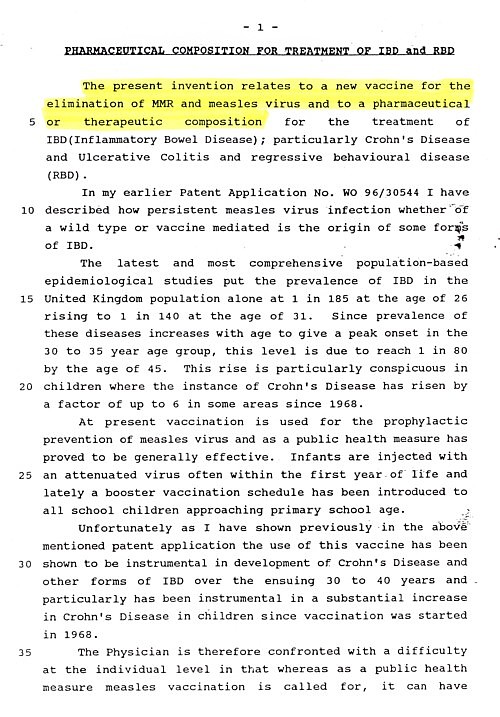
The patent
title is "Pharmaceutical composition
for treatment of IBD and RBD". IBD
means inflammatory bowel disease. RBD is
sometimes described in later documents as
"regressive behavioural disease" and
sometimes as "regressive behavioural
disorder", or autism. This document is the
patent office notification, not the claims
supplied by Wakefield and Royal Free to the
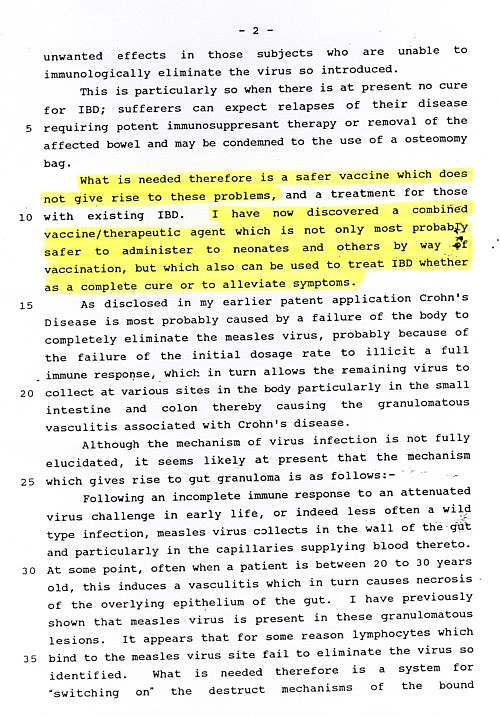
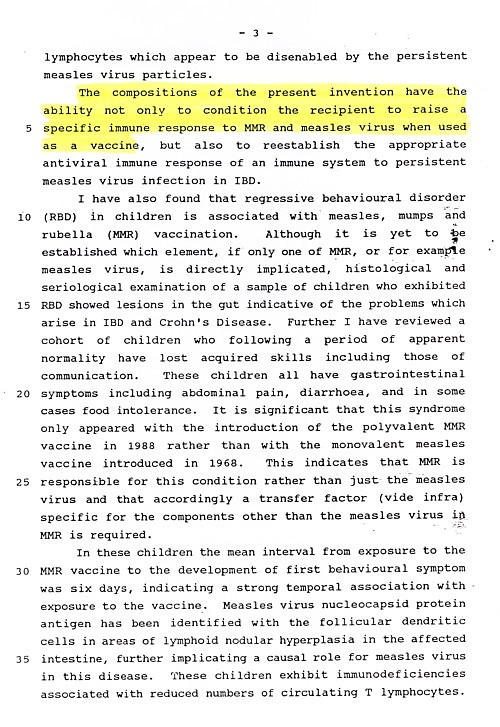
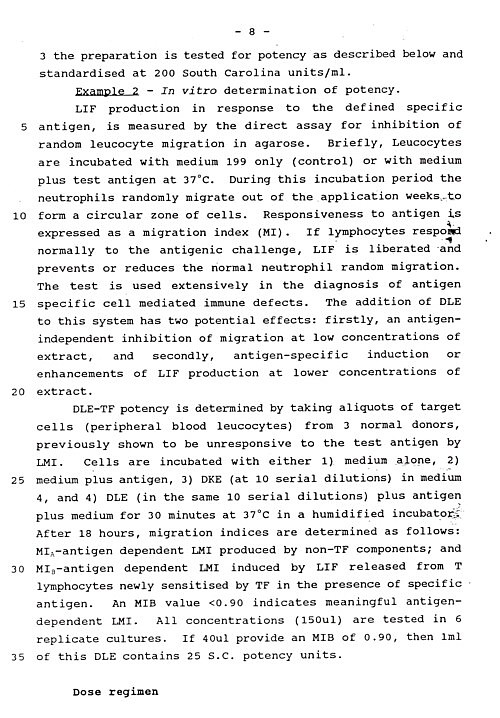
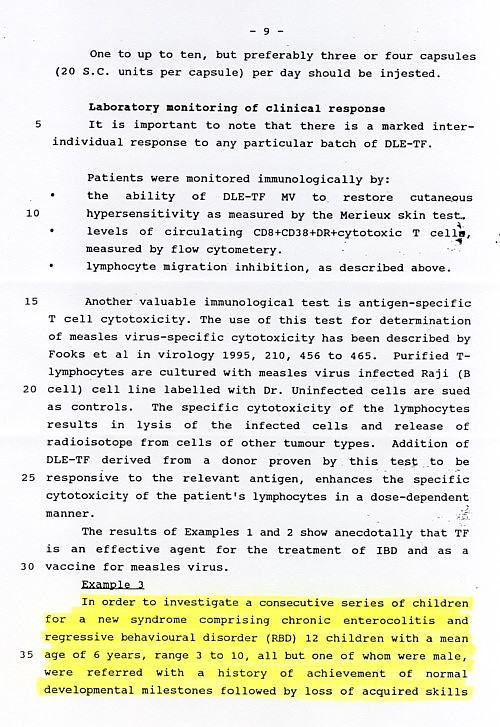
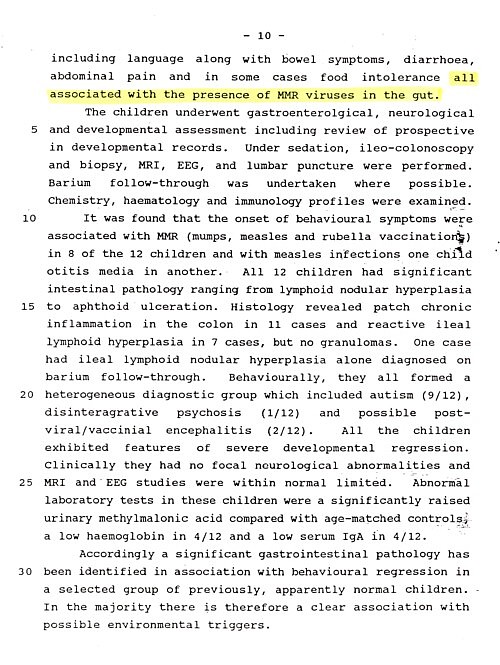
office. The first Wakefield MMR
patent application, describing an allegedly
safer single measles vaccine - a
potential competitor to MMR - is available in
full at this website.
(2) 02.02.98:
Wakefield tells hospital of vaccine idea
Nearly four
weeks before the press conference, and as the
hospital was preparing the video to distribute to
broadcasters, Wakefield filed an ethics committee
application to test a product based on
the plans in the first patent submission. It
makes clear that the idea of a possible vaccine
was already in Wakefield's mind.
(3) 28.02.98:
Wakefield launches MMR vaccine scare
Without
disclosing their ambitions for products which
could only find a market if MMR's reputation was
damaged, Andrew Wakefield and the Royal Free
medical school called a press conference, backed
by an elaborate 20-minute video news release, to announce a
low-grade Lancet paper, peppered with errors and
omissions, which has since been substantially
retracted. The press conference triggered an
unwarranted global scare over Wakefield's
unsubstantiated claims and recommendations, which
purported to link MMR with autism and advised
parents to ask for single vaccines
instead of the three-in-one MMR.
(4) 04.06.98:
Wakefield files anti-MMR claim in full
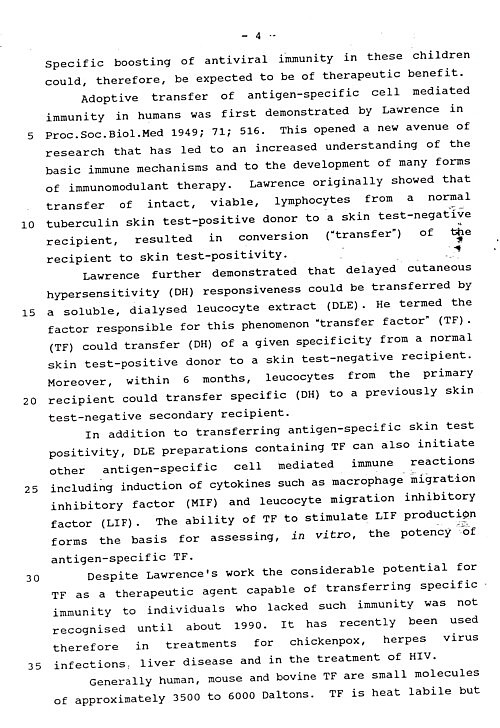
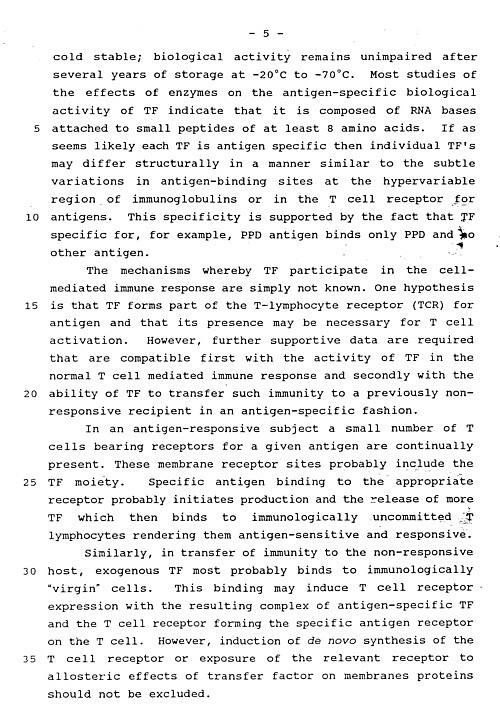
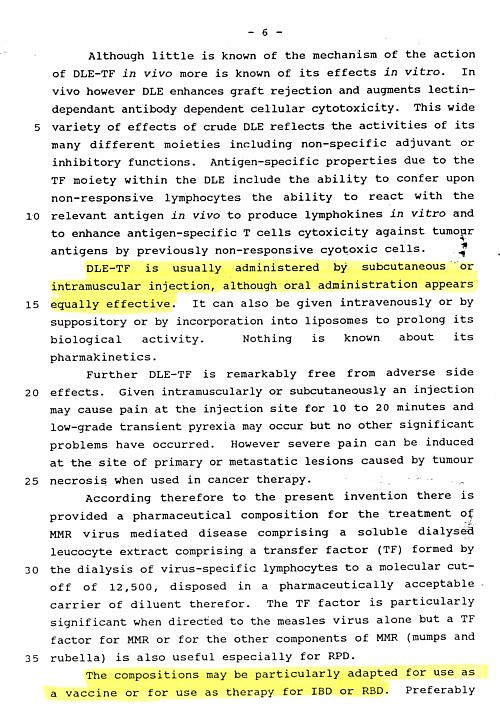
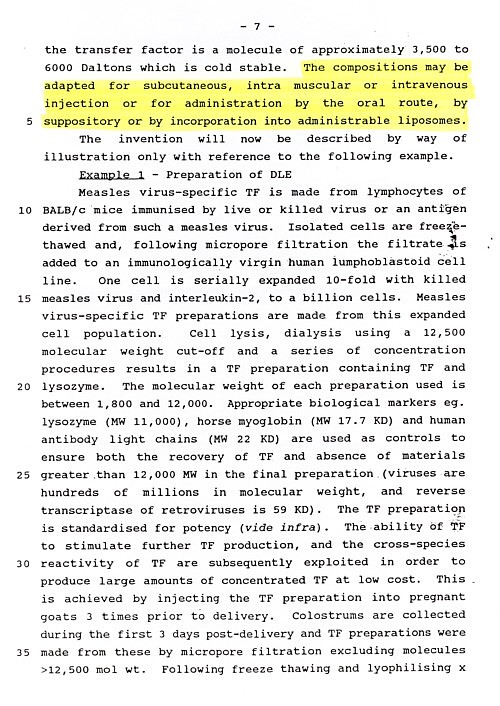
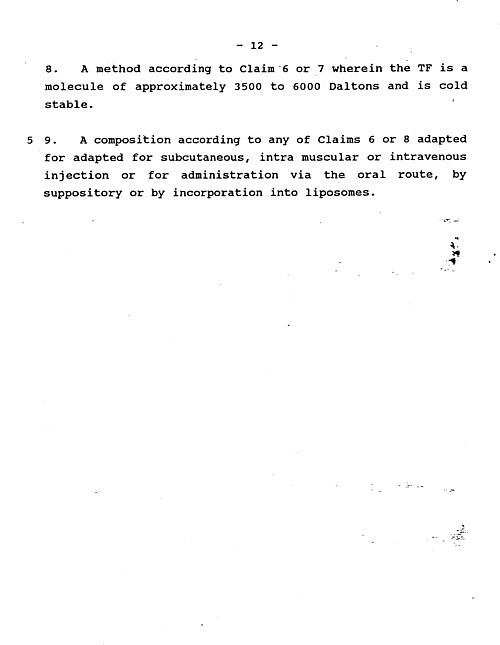
Under patent
law, applicants have twelve months before they
must publish the full characterisation of their
invention, which must correspond with the initial
claim. The full Royal Free/Neuroimmuno
Therapeutics patent is filed on 4 June
1998 - just three months after the press
conference - with Andrew Jeremy Wakefield and
Hugh Fudenberg (misspelt as
"Fundenberg") named as the inventors of
a new kind of single measles vaccine, plus
apparently revolutionary treatments for a disease
and a disorder they allege to be caused by MMR.
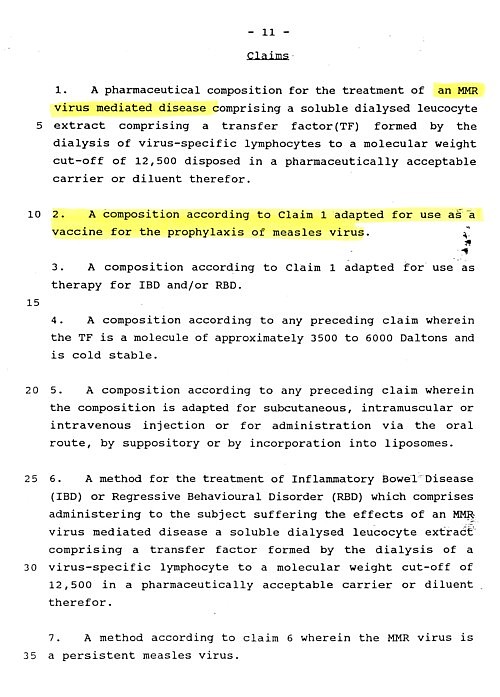
The patent
title is "Pharmaceutical composition
for treatment of MMR virus mediated disease
comprising a transfer factor obtained from the
dialysis of virus-specific lymphocytes".
It states: "Such a composition may be used
as a measles virus vaccine and for the treatment
of inflammatory bowel disease and regressive
behavioural disorder." Talk of cures for autism is found
elsewhere in patent documents. The key date on
the document is the "priority" date
(32), which dates the claim for a vaccine and
treatments to the beginning of June 1997.
There is a
large volume of patent documents, with minor
variations, including those registered in various
jurisdictions,including the United States, the
European Union, Canada, Australia and worldwide,
at different dates. Applications continued in the
medical school's name until Wakefield left its
employment in December 2001, when all rights were
transfered to him. For space reasons, only the
title page and claims section of this UK document
are republished below, with other extracts
republished at this website.
(5) 14.11.04:
Royal Free issues statement on patents
In response
to Brian Deer's inquiries, the medical school
issued the following statement:
"Universities in the UK
are the owners of any intellectual
property rights (IPR) derived from work
performed by their staff and have an
obligation to ensure that intellectual
property of potential commercial value is
properly assessed and if necessary
protected and exploited.
"After Dr Wakefield
initiated patents in 1997, through a
wholly-owned commercial subsidiary of the
medical school, these avenues were
appropriately explored. When expert
advice within the school indicated that
the scientific basis and commercial
exploitability were poorly sustained, the
schools claim on the IPR was
relinquished, and all the schools
rights to IPR deriving from his work were
assigned to Dr Wakefield when he left the
school.
"Any implication that
the school had a vested interest in
supporting an attack on MMR and raising
public concerns about its safety, because
it had commercial interests in the
development of a rival vaccine and in a
treatment for inflammatory bowel disease
and autism, is ill-founded and wrong.
"The school never
attacked, nor supported any attack, on
MMR. In all its actions it
consistently supported the continued use
of MMR, including the repeated release of
press statements dissociating itself from
Dr Wakefields comments and
publications, urging all parents to
protect their children with MMR and
explicitly stating that the Lancet paper
did not provide virological evidence of
associations between inflammatory bowel
disease, behavioural disorders and MMR
vaccine."
In a statement published on the
worldwide web after Brian Deer's revelations in
the Channel 4 documentary, Wakefield asserted
that the vaccine claims, revealed above, were
"an afterthought". He said "my
genuine concerns about the safety of MMR are
wholly unrelated to any desire or opportunity to
develop a competing vaccine". The full first
application is here
|