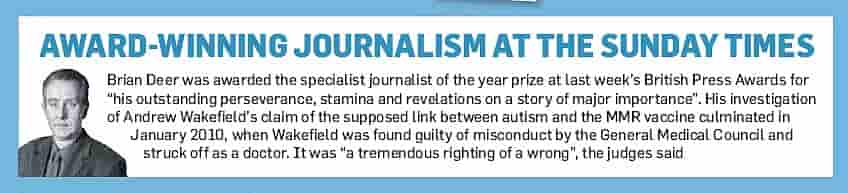
Brian
Deer: Solved
- the riddle of MMR
 |
|
In the
third part of a Sunday
Times investigation, Brian
Deer
cracks the secrets
of the most controversial
medical research in a
generation, and reveals
why nobody
could repeat findings by Andrew
Wakefield linking
a vaccine with autism |
|
|
|
| Click here
for a summary:
In February 1998, the Lancet medical
journal triggered a global alarm with
research proposing a link between the
measles, mumps and rubella vaccine and autism.
The researchers' leader, Andrew
Wakefield called for the vaccine
to be "suspended".
Brian Deer investigated for The Sunday
Times of London and exposed one of
medicine's darkest scandals |
. Behind
the Lancet pages
|
| For more
than a decade, scientists
were baffled as to why
nobody could repeat
the findings of British
former gut surgeon Andrew
Wakefield, who in the Lancet
of 28 February 1998
launched a global health
crisis by linking the MMR
vaccine with autism.
Eleven years later, in
February 2009, Deer solved
the riddle, with
access to the original
records
of anonymised children
reported in the journal.
He revealed that the
Wakefield paper was thick
with changed
and misreported
diagnoses, histories and
descriptions |
|
|
|
|
| ."MMR
doctor fixed data on autism";
investigation by Brian Deer; The Sunday
Times, pages 1, 6-7; 8 February 2009 |
|
|
|
"The
first cracks in the vaccine theories of
autism appeared in early 2004. An
investigation by British journalist Brian
Deer in The Sunday Times of London
revealed that the children Wakefield
described in the Lancet study had not
simply arrived on the doorstep... The
investigation has since expanded,
with new charges by journalist Deer that
Wakefield or his coauthors misrepresented
the children's medical records"
|
|
|
|
"The
charge is explosive: a British doctor who
led the first scientific study suggesting
a link between autism and the MMR vaccine
misrepresented data in
a prestigious medical journal. The
allegation appears in an investigation
published Sunday in the Times of London
and has raced around the world since...
Deer is in the US this week to deliver a
lecture on his work"
|
|
|
|
"Dr
Andrew Wakefield, the British physician
who jump-started the scare about a link
between the measles-mumps-rubella (MMR)
vaccine and autism, manipulated and
changed data to make his case in the 1998
Lancet paper, according to an
investigation by the Sunday Times of
London... by studying confidential and
public records,
investigative reporter Brian Deer...
found a different story"
|
|
|
|
"Last
week a federal court confirmed what has
been the mainstream view of the
scientific community from the
beginning...Backing that up was an
article in the London Sunday
Times that detailed how doctors
in England had distorted data to create
the vaccine panic...Worse, as
investigative reporter Brian Deer
revealed... many of the children had
shown symptoms of autism before they
received the vaccine"
|
|
|
|
"An
English doctor who linked childhood
vaccines to autism, 'changed and
misreported results in his research,'
reports the London Times... All
of the researchers involved in the study deny
misconduct, says the Times.
'Through his lawyers, Wakefield this
weekend denied the issues raised by our
investigation, but declined to comment
further'" |
 |
|
 |
|
| Press
Gazette interview:
In the week after the new
revelations about Wakefield's
research, while Brian Deer was in
Michigan (left), the UK's
magazine for the newspaper
industry profiled the Sunday
Times investigation, in a report
(far left) by Owen Amos.
"I've had enough of
vaccines," Deer is quoted as
saying in the report. "But
I'm not sure they've had enough
of me." |
|
| Michigan
debut: For the
first time ever, a journalist has been
able to get behind the face of research
in a medical journal, and expose the
secret patient information. Deer's
findings were first presented in February
2009 at the University of
Michigan, Ann Arbor. Events
included a seminar for fellows, as
well as the prestigious Grand Rounds in the department
of pediatrics, and the Susan B Meister
lecture (above), where he was
joined by Dr Catherine DeAngelis, editor
of the Journal of the American Medical
Association |
| United
States court reaches the same conclusions
as Brian Deer and highlights concerns
over Wakefield |
In federal
court: On 12
February 2009, just four days after Brian
Deer's Sunday Times investigation was
published, special masters in US courts
handed down judgments in three landmark
test cases on whether vaccines can cause
autism. In lengthy decisions, all three
made no such finding. They offered
scathing opinions of Andrew Wakefield
[who was not called to give evidence and
whose research was dumped by the
petitioners] and his network of
supporters, including doctors Arthur Krigsman and Jeffrey Bradstreet
Wakefield
accused of scientific fraud: Handing down the
first of the three judgments in US
federal court, special master George L
Hastings highlighted allegations of fraud
and deception made against
Wakefield, even though the former gut
surgeon did not take part in the
proceedings. He had originally been planned as
the star petitioner witness in trials of
his MMR-autism allegations, but was never
called in the wake of Deer's first Sunday Times
revelations and TV findings, which were in
the background throughout the
trial
|
Family
"misled by
physicians"
|
|
| Special
Master George L Hastings
in Cedillo v HHS:
"The petitioners in
this case have advanced a
causation theory that has
several parts, including
contentions (1) that
thimerosal-containing
vaccines can cause immune
dysfunction, (2) that the
MMR vaccine can cause
autism, and (3) that the
MMR vaccine can cause
chronic gastrointestinal
dysfunction. However, as
to each of those issues,
I concluded that the
evidence was
overwhelmingly contrary
to the petitioners...
They have visited at
least one physician, Dr
Krigsman, who has
explicitly opined that
Michelle's own chronic
gastrointestinal symptoms
are MMR-caused. And they
have even been told that
a medical laboratory has
positively identified the
presence of the
persisting vaccine-strain
measles virus in
Michelle's body, years
after her vaccination.
After studying the
extensive evidence in
this case for many
months, I am convinced
that the reports and
advice given to the
Cedillos by Dr Krigsman
and some other
physicians, advising the
Cedillos that there is a
causal connection between
Michelle's MMR
vaccination and her
chronic conditions, have
been very wrong.
Unfortunately, the
Cedillos have been misled
by physicians who are
guilty, in my view, of
gross medical
misjudgment... the
evidence strongly
indicates that Michelle
was already showing
evidence of brain
abnormality and of autism
prior to her MMR
vaccination." [extracts] |
|
|
|
|
Wakefield
"did not
disclose"
|
|
Special
Master Patricia E
Campbell-Smith in
Hazlehurst v HHS:
"To the extent that
the claim precipitated by
the work of Dr Andrew
Wakefield viewed
regressive autism as a
relatively new phenotype
of the disorder, that
claim is undercut by
evidence of an
epidemiologic study
conducted in 1966, more
than 40 years ago, that
documents a loss of
skills in about 30
percent of the studied
children... Dr MacDonald
asserted that Dr
Wakefield 'invented new
pathological
abnormalities which were
not recognized by anyone
in the world'... 10 of Dr
Wakefield's 12 coauthors
on the 1998 Wakefield
article retracted the
earlier offered
interpretation of the
conducted study,
retracting, in
particular, the
conclusion that a
potential causal link
existed between the MMR
vaccine and autism. At
the time that Dr
Wakefield authored the
1998 Wakefield article,
he did not disclose in
the article that he had
been contacted by lawyers
for the Legal Services
Commission to participate
in the United Kingdom
autism litigation against
three MMR vaccine
manufacturers. Dr
Wakefield was one of the
three top recipients of
payment in the claimants
action in the United
Kingdom." [extracts]
|
|
|
|
|
"'Abundant
evidence'" of fraud
|
|
Special
Master Denise K Vowell,
in Snyder v HHS:
"Doctor Rust used
the term 'scientific
fraud' in describing the
information upon which
the MMR theory of
causation is based. While
noting that scientists
are very careful about
using that term, he
testified that there was
'abundant evidence' of
scientific fraud in the
body of evidence
developed to support the
MMR-autism hypothesis.
Sadly, the petitioners in
this litigation have been
the victims of bad
science, conducted to
support litigation rather
than to advance medical
and scientific
understanding of ASD...
To conclude that Colten's
condition was the result
of his MMR vaccine, an
objective observer would
have to emulate Lewis
Carroll's White Queen and
be able to believe six
impossible (or, at least,
highly improbable) things
before breakfast." [extracts]
|
|
|
|
| UK
national broadcaster ranks Brian Deer's
MMR - autism investigation in a
journalistic class of its own |
In
the public interest: Following a BBC
television programme in April
2009 in which Brian Deer's Sunday Times
investigation was accidentally conflated
with poorly-evidenced work by others,
especially that of Daily Mail columnist
Melanie Phillips (third left, above), the
corporation issued an apology to Deer,
stating: "his reporting was
always clearly in the public
interest". Stories
discussed included those by Alison
Pearson, in the London Evening Standard
(left), and by Julia Carling (second
left), also in the Daily Mail
Liar for
hire: As
Andrew Wakefield has appeared before a
fitness to practise panel of the General
Medical Council [see below], he has
worked with a character publishing false
accounts of the proceedings.
After running a two-year smear campaign
against Deer, this individual let slip
that he was being funded by American
interests, and had sponged money from
families struggling with disability. This
character's activities were co-ordinated
with those of Carol Stott, and others
involved in spreading abuse and
misinformation
Misconduct
rife: Scientists
have long tried to get a measure of how
much serious misconduct occurs in medical
research, concealed behind the veil of
anonymised data published in journals. In
June 2009, the online open-access journal
PLoS published an analysis of past
attempts to assess the scale of the
problem, which ranges from outright
fabrication, to falsification and manipulation
of data
Contact
Brian at this link: Visitors
often offer vital information for this
and other investigations. Please feel
free to email Brian Deer
with your suggestions, comments and
ideas. If you plan to quote from this
site, please acknowledge, and check the copyright notice. Links to this
site are appreciated, and may further an
issue of great public importance: the
safety of children by vaccination
|
| World
Conference of Science Journalists hears
Brian Deer on investigation of MMR and
Andrew Wakefield |
|
|
|
| Brian
Deer was among the speakers at
the 6th World Conference
of Science Journalists,
which brought more than 1,000
reporters and editors from
throughout the world to London
between June 30th and July 2nd
2009. Deer spoke on the future of
investigative journalism, where,
in a session chaired by James
Randerson, he joined fellow
investigators Luc Hermann, David
Leigh and Gavin MacFadyen. His
Powerpoint presentation on the
origins of the MMR crisis was
particularly popular with
delegates. Contact
Brian if you would like
to ask him to speak at your event |
|
| Wakefield
response:
After a formal letter was sent to
Wakefield and his lawyers, they
responded, denying the
findings of Brian Deer's investigation,
and insisting that his report could
prejudice the GMC's deliberations.
Otherwise, they declined to comment.
Throughout the affair, in a series of
statements following Deer's reports,
Wakefield denied that be was paid by
lawyers for research, that he planned his
own vaccine, or that he fixed the Lancet
findings suggesting a link between MMR,
autism and bowel disease |
| January
2010: Andrew Wakefield
judged
"dishonest",
"unethical",
"irresponsible"
and "callous" |
|
GMC
prosecution:
After the longest-ever hearing
by a UK General Medical
Council panel, on 28
January 2010 Wakefield
was branded
"dishonest",
"unethical",
irresponsible" and
"callous".
Brian Deer's
investigation was thus
vindicated.
Judged
against a criminal
standard of proof,
Wakefield was found
guilty on four counts of
dishonesty, 11 counts of
research on
developmentally-disordered
children without ethical
approval, nine counts of
performing that research
contrary to their
clinical interests, three
counts of causing a child
to undergo a lumbar |
|
puncture
which was not clinically
indicated, and three
counts of ordering
medical tests without the
necessary qualifications
and in breach of his
non-clinical employment
contract. Further proven
charges related to a
dishonest and unethical paper
published in The Lancet
medical journal in
February 1998.
The GMC
case was brought in
response to Deer's Sunday
Times
and Channel
4
stories. Charges were
also proven against
professors John
Walker-Smith and Simon
Murch. The five- member
panel sat for 197 days. Read
the full GMC findings |
|
|
|
|
|
 |
Andrew
Wakefield is
"unethical,
dishonest"
On
28 January 2010, a
five-member panel of the
doctors' regulator for
the United Kingdom, the
General Medical Council,
handed down rulings
vindicating Brian Deer's
investigation, and
dubbing Andrew Wakefield
"dishonest",
"unethical",
"irresponsible"
and "callous".
Some three dozen serious
charges were found
proven, including: four
counts of dishonesty; 11
counts of causing
highly-invasive,
"high risk"
research to be carried
out on
developmentally-disordered
children without ethical
approval; nine counts of
causing such research to
be carried out contrary
to the children's
clinical interests; three
counts of causing a child
to undergo lumbar
puncture which was not
clinically indicated; and
three counts of ordering
medical tests without the
necessary qualifications
and in breach of his
non-clinical employment
contract.
Wakefield was also found
to have shown a
"callous disregard
for the distress and
pain" of children
during an incident when
he paid kids, said to
have been as young as
four year old, £5 each
for blood samples taken
at a birthday party.
"You showed a
callous disregard for the
distress and pain that
you knew or ought to have
known the children
involved might
suffer," the GMC
panel agreed.
Among the most serious
charges found proven
related to Wakefield's research,
published in The Lancet
medical journal in
February 1998, which
triggered epidemics of
fear, guilt and
infections disease by
baselessly proposing a
link between the MMR
children's vaccine,
autism and bowel disease.
After 197 days of
evidence, submission and
deliberation, between
July 2007 and January
2010, the GMC panel
concluded that the
research published in the
journal contained a false
statement that it had
been approved by the
Royal Free hospital's
ethics committee (an
institutional review
board), and that the
paper contained a
"dishonest"
description of the
reported study's purpose
and admissions criteria.
"In reaching its
decision, the panel notes
that the project reported
in the Lancet paper was
established with the
purpose to investigate a
postulated new syndrome
and yet the Lancet paper
did not describe this
fact at all. Because you
drafted and wrote the
final version of the
paper, and omitted
correct information about
the purpose of the study
or the patient
population, the panel is
satisfied that your
conduct was irresponsible
and dishonest."
The panel ruled that
Wakefield's failure to
notify the editor of the
Lancet of his involvement
in MMR litigation, his
receipt of legal aid
funding for the study,
and his filing of a
patent for a single
measles vaccine,
"constituted a
disclosable interest
which included matters
which could legitimately
give rise to a perception
of a conflict of
interest."
With regard to the
funding of his research
from the UK legal aid
fund, the panel found
Wakefield to have failed
to notify the Legal Aid
Board that clinical
investigations on the
children would be paid
for under the National
Health Service, and hence
not all of the money
requested and received
was needed for the
purposes specified. The
panel found this conduct
both
"misleading"
and
"dishonest".
With regard to instances
in 1998, after the Lancet
paper's publication, when
Wakefield was challenged
by other doctors over his
possible involvement in
litigation and the source
of children enrolled in
his research, the GMC
found his responses to
have been
"dishonest".
These incidents included
dishonesty during a
special meeting called by
the UK Medical Research
Council to consider his
research claims.
In yet more proven
charges, Wakefield was
found to have
inappropriately
administered a substance
- transfer factor - to a
child for experimental
reasons, without
recording this in the
child's records,
notifying his family
doctor, or holding the
requisite paediatric
qualifications.
Charges were also found
proven against two other
doctors - professors John
Walker-Smith and Simon
Murch - although neither
were found to have acted
dishonestly. Walker-Smith
was the final and senior
clinical author of the
1998 Lancet paper, into
whose care most of the
children were admitted.
Murch was the second
author, and performed
colonoscopies on most of
the kids.
Wakefield declined to
appear before the panel,
of three doctors and two
lay members, as its
findings were handed
down. However, he arrived
outside the GMC's offices
in Euston Road, London
and, amid rowdy scenes,
rejected its
findings."The
allegations against me
and my colleagues are
both unfounded and
unjust," he
declared. "I repeat,
unfounded and
unjust."
A further session of the proceedings -
already the longest GMC
"fitness to
practise" case ever
- will take place between
April and June 2010, to
give rulings on whether
"serious
professional
misconduct" has been
found.
Andrew
Wakefield: "fraud
impossible"
"The articles
presented, as fact,
allegations that I
committed scientific
fraud inasmuch as I 'changed
and misreported results
in [my] research'
in a paper in the medical
journal The Lancet in
1998, with the clear
implication that this was
intended to create the
appearance of a possible
link between MMR
vaccination and autism
and that I did it for
money. These allegations
are false and/or
misleading and will have
a hugely adverse effect
on my credibility as a
scientist and my ability
to ever practice again in
my chosen field. More
importantly, the impact
of Mr Deers false
and misleading claims
upon the perception of
medical professionals of
the medical disorder
suffered by the Lancet
children and therefore,
the provision of adequate
care for autistic
children, is potentially
devastating...
Andrew Wakefield,
letter of complaint to
PCC, 13 March 2009 [See
document via
this link,
and an "addendum
"]
|
|
|
|
|
|