The riddle of the MMR fraud
This legacy page inherits material from a previous build of the briandeer.com website. It’s now no more than a gateway. Go to the Andrew Wakefield vaccine research fraud page for an introduction

“The first cracks in the vaccine theories of autism appeared in early 2004. An investigation by British journalist Brian Deer in The Sunday Times of London revealed that the children Wakefield described in the Lancet study had not simply arrived on the doorstep… The investigation has since expanded, with new charges by journalist Deer that Wakefield or his coauthors misrepresented the children’s medical records”

“The charge is explosive: a British doctor who led the first scientific study suggesting a link between autism and the MMR vaccine misrepresented data in a prestigious medical journal. The allegation appears in an investigation published Sunday in the Times of London and has raced around the world since… Deer is in the US this week to deliver a lecture on his work”
Get Deer’s book: The Doctor Who Fooled the World

“Dr Andrew Wakefield, the British physician who jump-started the scare about a link between the measles-mumps-rubella (MMR) vaccine and autism, manipulated and changed data to make his case in the 1998 Lancet paper, according to an investigation by the Sunday Times of London… by studying confidential and public records, investigative reporter Brian Deer… found a different story”

“An English doctor who linked childhood vaccines to autism, ‘changed and misreported results in his research,’ reports the London Times… All of the researchers involved in the study deny misconduct, says the Times. ‘Through his lawyers, Wakefield this weekend denied the issues raised by our investigation, but declined to comment further'”
In federal court: On 12 February 2009, just four days after Brian Deer’s 2009 findings, special masters in US courts handed down judgments in three landmark cases rejecting Wakefield autism allegations. Although Wakefield was dumped as a witness by petitioners, one master highlighted allegations of scientific fraud against him, in the background throughout
America rages over Andrew Wakefield report
January 2011: Another bomb dropped on Wakefield with the release of the first part of Deer’s BMJ series “Secrets of the MMR scare” (see below). CNN’s Anderson Cooper broke the story (right), which stormed for days across North America and other countries
A Wakefield “crank magnet” effect intensified, attracting HIV denialists, “9-11 truth” oddballs and other characters to his cause. These included one David L Lewis, following the path of conman Martin J Walker and a menacing emailer, Carol Stott
Secrets of the MMR scare: Following the 2009 disclosures, over three weeks in January 2011, BMJ, the British Medical Journal, featured a special series by Deer setting out for the first time in full how Wakefield concocted the appearance of a link between the vaccine and autism
The BMJ series triggered a wave of international media coverage, after the journal dubbed Wakefield’s research “an elaborate fraud“. The Royal Free medical school and the Lancet, which sponsored Wakefield’s claims, were accused of “institutional and editorial misconduct”
Raw data unmasks “new bowel disease” claims
Pathology changed: In November 2011, the BMJ ran a report by Deer with raw data finally proving that claims by Wakefield in the Lancet of “histological findings” of “non-specific colitis” were baseless
Parents involved with Wakefield, and with Arthur Krigsman, often believed these men had found a new bowel disease, requiring expensive procedures, obtainable from them. Read the report above, and here’s info on constipation, ileal-lymphoid hyperplasia, encopresis, stools, calprotectin, “opioids” and bowel issues

“The British Medical Journal has declared that the research was not simply bad science, as has been known for years, but a deliberate fraud… Now the British Medical Journal has taken the extraordinary step of publishing a lengthy report by Brian Deer, the British investigative journalist who first brought the paper’s flaws to light — and has put its own reputation on the line by endorsing his findings”

“In 2004, Brian Deer of The Sunday Times published damning evidence about Dr Wakefield’s ties to the lawsuit, showing that the children in the study were recruited unethically, and exposing other flaws in the published study… In February, 2010, the original Lancet paper was retracted. But Dr. Wakefield continues to insist the findings are valid and that he is the victim of a vast conspiracy. Yet he has never been able to reproduce the findings. Now, thanks again to Brian Deer, we know why”

“The Lancet retracted the paper and the British General Medical Council struck him off for making a case that was less flawed than false. And now the British Medical Journal says Brian Deer, a journalist for The Sunday Times (published by News Corporation, parent company of The Australian) can show Wakefield perpetrated “an elaborate fraud” for financial gain”

“The analysis, by British journalist Brian Deer, found that despite the claim in Wakefield’s paper that the 12 children studied were normal until they had the MMR shot, five had previously documented developmental problems. Deer also found that all the cases were somehow misrepresented when he compared data from medical records and the children’s parents”
Wakefield denies everything
Wakefield response: After a letter was sent to Andrew Wakefield, his lawyers denied the findings of Deer’s investigation. Wakefield said he wasn’t paid by lawyers for research, didn’t plan his own vaccine, didn’t rig the Lancet findings and never linked autism with MMR. Everything alleged was false, and was the product of a conspiracy
As his campaign collapsed, Wakefield lashed out at a vaccine safety whistleblower. Then, as Wakefield faced being struck off the UK medical register (see below), he made up a false conspiracy theory in which he pretended to have been involved in the withdrawal of MMR brands in 1992. He knew the truth, however: that a traditional public interest journalistic investigation had nailed him
Wakefield ruled “dishonest”, “unethical” and “callous”
GMC prosecution: After the longest-ever hearing by a UK General Medical Council panel – a statutory tribunal – on 28 January 2010 Wakefield was branded “dishonest”, “unethical” and “callous”. On 2 February, his 1998 paper was retracted, and on 17 February he was ousted from a $280,000-a-year job in Austin, Texas
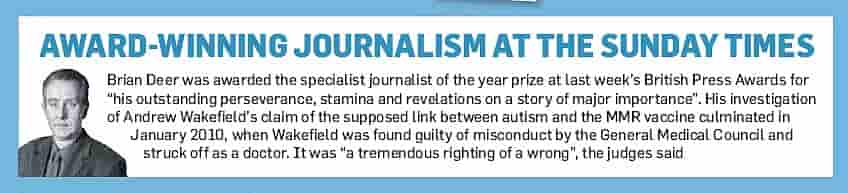
Judged against a criminal standard of sureness, he was found guilty on four counts of dishonesty and 12 counts involving the abuse of autistic children. Proven dishonesty charges related to Wakefield’s Lancet MMR paper, which was also found to be the product of unethical research on uniquely vulnerable children.
The five-member panel sat for 217 days, after which, on 24 May 2010, Wakefield was ordered to be erased from the medical register, ending his career as a doctor. Two clinicians were acquitted over their involvement, one by the panel, the other on appeal.
Get Deer’s book: The Doctor Who Fooled the World
RELATED:
Vexatious Wakefield lawsuits fail
Brian Deer’s 2004 Dispatches film
Selected MMR-Wakefield resources