>> TIMESAVER: MAIN POINTS
OF THE INVESTIGATION <<
 |
|
The
MMR-autism fraud
- our story so far
An investigation by Brian
Deer |
"It has been proposed that my role in
this matter should be investigated by
the General Medical Council (GMC). I not only
welcome this, I insist on it"
Andrew Wakefield - February 2004
|
IN 2010, immense human suffering risks
being exported across the world, caused by claims,
born in Britain, linking the triple measles, mumps
and rubella vaccine (MMR) with autism. Measles
outbreaks - linked by doctors to these claims - are
being reported across Europe, the United States,
Canada, Australia, Japan and South Africa, as well as
in the UK, where in June 2008 a 17-year-old West
Yorkshire boy died, and the government's Health
Protection Agency declared measles to be once again
"endemic".
"Most people
have forgotten, but measles was once an uncontrolled
scourge that infected three million to four million
Americans annually," noted the New York Times in
an editorial titled "Measles returns" on 24
August 2008. "In bad epidemic years, some 48,000
Americans were hospitalized, 1,000 more were
chronically disabled, and 400 to 500 died."
Meanwhile - and no
less seriously - countless mothers and fathers of
autistic children are being tormented with
unwarranted guilt, after being led to think that they
made a catastrophic mistake in agreeing to
vaccination, and that - in a blame-game reminiscent
of defunct "refrigerator
mother"
theories of autism - they may be responsible for
their own childs disability. Young parents, in
their millions, now agonize about risks whenever a
son or daughter falls due for shots.
Since the early 1970s
in the United States, and 1988 in the United Kingdom,
the three-in-one live virus MMR vaccine has been
routinely administered to almost all children, soon
after they're one year old. Along with other
immunisations - such as that against polio, and the
combined diphtheria, tetanus and pertussis shot - MMR
has become a mainstay of public health,
all-but-eradicating once-killer diseases.
But, now more than a
decade ago, the UKs leading medical journal,
the Lancet, unleashed a devastating assault on
confidence in childhood vaccines: suggesting that
independent researchers had discovered a possible
link between MMR and the development of a new
sudden-onset "syndrome", combining both an
inflammatory bowel disease and what was described as
regressive autism.
This frightening
allegation came in a five-page scientific research paper [pdf version], dated 28 February 1998,
written by a laboratory researcher, Dr Andrew
Wakefield, then 41, and co-authored by Professor John
Walker-Smith, 61, Dr Simon Murch, 41, and ten other
doctors, based at a university medical school
attached to the 1,000-bed Royal Free hospital, in the
Hampstead district of north London.
Media reaction at the
time to these claims was swift. "A medical study
suggests today that there could be a link between the
measles, mumps and rubella vaccine (MMR) given to
children in their second year of life and
inflammatory bowel disease and autism,"
reported, for example, The Guardian, on page 1 of its
issue of 27 February 1998. "They also found that
the behavioural changes in the children which are
typical of autism, such as forgetting the basic
language they had just learned, began within days of
their MMR vaccination."
In just over 4,000
words, the Lancet paper reported on 12 anonymous and
allegedly "previously normal" children,
said to be aged between 3 and 10, who had been
diagnosed at other medical centres with developmental
disorders, and who the paper said had symptoms of a
variety of bowel complaints. These dozen kids were
admitted for gruelling, five-day, batteries of
invasive and distressing tests in the hospital's
paediatric gastroenterology unit, between July 1996
and February 1997.
Although in January
2010 a UK General
Medical Council [GMC] panel concluded a mammoth,
multi-part hearing with findings that Wakefield's conduct and
research was both "dishonest" and
"unethical", the published study's
principal "finding" was an alleged
association between MMR vaccination and what the
Wakefield group claimed to be the sudden onset of
developmental disorders in eight - two-in-three - of
the 12 children.
This
"finding", and massive publicity that the
Royal Free hospital and medical school encouraged for
it [through a press
release, video news
release
and a televised press conference] launched a
worldwide scare over the vaccine's safety, triggering
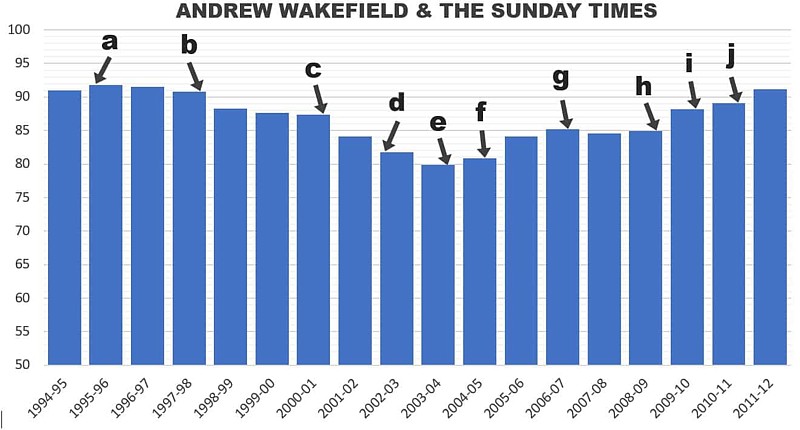
falls in immunisation rates [for
year-on-year stats see the foot of this webpage], outbreaks of potentially fatal or
disabling diseases, and an epidemic of self-recrimination among parents of autistic
children.
"Any mother who
has a child wants it to be normal," said, for
example, Karen Prosser of Kent, who featured with her
autistic son Ryan in the hospital's video, voicing
sentiments heard many times over the years. "To
then find out your child might be genetically
autistic, is tragic. To find out that it was caused
by a vaccine that you agreed to have done is just
devastating."
"In a way,
making the connection was worse for us," said
Rochelle Poulter of West Sussex, who enrolled her son
in Wakefields Lancet research. "We'd
convinced ourselves it was nothing we had done. Now
we knew it was our fault."
Such emotions quickly
took hold in the United States, where
Wakefields scare took off and was transformed.
After an announcement in July 1999 that a
mercury-based preservative, thimerosal, would be
removed from most vaccines, Wakefield appeared in
November the following year on the CBS network's 60
Minutes programme, speaking of an "epidemic of
autism". Soon a small, but ferocious campaign
gathered strength, claiming that all vaccines cause
the disorder: either due to their content, or because
of an increase in their numbers.
"In 1983 the
shot schedule was 10. That's when autism was 1 in
10,000. Now there's 36, and autism is one in
150," explained American actress Jenny McCarthy,
who blamed MMR for her own childs autism, and
was to take the most high-profile role in this
campaign. "All arrows point to one
direction"
Fixing
a link between MMR and autism
But, as journalists
queued to report on parents' fears, The Sunday Times
of London assigned Brian Deer [pictures] [British
Press Award] [Press
Gazette interview] to investigate the crisis. In
inquiries spread over a period of some five years, he
sought to crack the riddle of the MMR scare. Why was
it that, despite a huge investment of resources, no
other scientist or research centre, independent of
Wakefield, could confirm the paper's key finding?
Some had used statistics to see if autism took off in
1988, when MMR was introduced to the UK. It
didnt. Others used virology to see if MMR
caused bowel disease: a core suggestion in the
Lancet. It didnt. Yet more
replicated Wakefield's tests. They showed
nothing like what he claimed.
As the American
Academy of Pediatrics would summarise the scientific
consensus in an August 2009 statement to the NBC News Dateline
programme,
featuring both Wakefield and Deer:
While it
is likely that there are many environmental
factors that influence the development of autism,
vaccines are not the cause of autism. We know
this because many careful and repeated studies
show no link between vaccines and autism.
Specifically, numerous studies have refuted
Andrew Wakefields theory that MMR vaccine
is linked to bowel disorders and autism. Every
aspect of Dr. Wakefields theory has been
disproven.
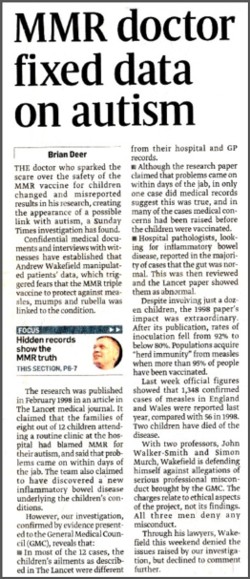
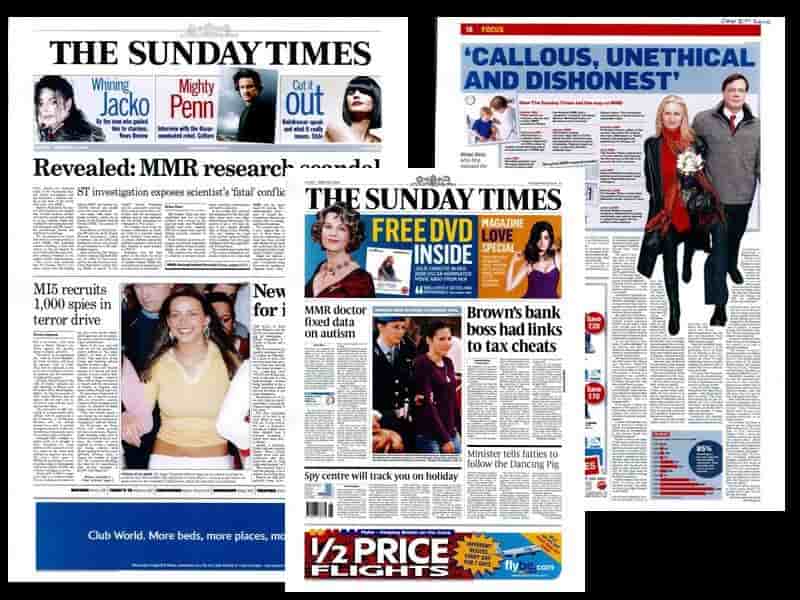
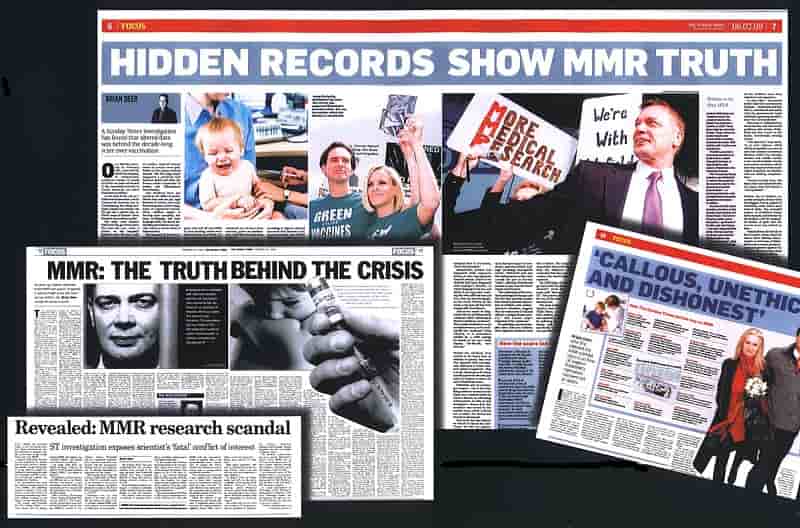
The solution for the
anomaly emerged in February 2009 - 11 years after the
research was first published. In a page 1
Sunday Times report, backed by two full pages inside, Deer
unveiled the first account of an exercise never
before accomplished by a journalist with regard to
published medical research. With co-operation from
parents and witnesses, access to confidential
documents, detailed evidence presented at the GMC
hearing, and review by internationally-recognised
experts, he succeeded in getting behind the face of
the Lancet report to analyse patients' histories and
diagnoses.
This exercise
revealed the most extraordinary mismatches between
what the Lancet claimed and documented facts. Some of
the children were not "normal" before
vaccination, despite it being stated in the paper
that they were. Others, who Wakefield claimed
suddenly developed behavioural problems following
MMR, did not do so until months afterwards. Others,
who were reported in the paper as having
"regressive autism" did not have this
condition. And yet more were claimed to have
inflammatory bowel disease, despite the hospital
pathology service, performing routine tests on gut
biopsies, reporting that they were normal.
"In summary, not
one of the 12 children is free of serious doubt as to
the manner in which their case has been reported by
you," Deer wrote to Wakefield, putting these
allegations, on 6 February 2009. "Indeed, there
is no real evidence that any of the children were as
you reported in the Lancet. When lack of evidence of
previous normality, lack of evidence of regression,
lack of evidence of inflammatory bowel disease, and
lack of any temporal link as you describe, are taken
into account, there was no basis in the records for
your claim to have discovered any new syndrome at
all."
Although Wakefield
later complained to the UK's Press Complaints
Commission - in a complaint rejected by the paper -
at the time of publication he did not respond,
leaving his lawyers to deny what Deer put to him.
"Publication of your allegations and account at
this time will give rise to serious risk that the GMC
process will be prejudiced and the fairness of the
hearing compromised," said solicitors Radcliffes
LeBrasseur.
"You also know that, at this juncture in the GMC
process, it would be inappropriate for Dr Wakefield
to give a detailed response to you. He has denied the
allegations and gave a detailed response over many
days to the GMC Panel. It follows that the assertions
made in your e-mail are denied."
But the implications
of Deer's findings of February 2009 - which had been
prefigured at this website with evidence of substantial
alterations between versions of the Lancet paper -
killed at its roots any credible basis for what has
become a global crisis over the vaccine. Examination
of the children's records reveals that, in
circumstances of the most profound financial
conflicts of interest, what Wakefield had done in his
1998 paper was to carve out his "syndrome"
with changes and misreportings, when he plainly had
found no such syndrome. The Lancet made it look like
he had discovered something consistent, when the
children had little in common.
"From the
information you provided me on our son, who I was
shocked to hear had been included in their published
study," the father of a boy from northern
California, who was admitted, at age 5, to
Wakefields research, told Deer, "the data
clearly appeared to be distorted."
The
1998 Lancet paper
That it took so long
for Deer's information to emerge says much about the
impenetrability of anonymised medical research, and
its vulnerability to abuse by researchers. Unlike
newspapers and other open media - where purported
facts and sources can usually be checked by rivals -
medical journals publish behind a veil of secrecy:
the confidentiality of patient information. This
leaves them uniquely vulnerable to fraud and
misconduct: as many high profile past examples have
revealed. Deers investigation of Professor Michael
Briggs,
and the later exposure of Dr Jon Sudbo, for examples, reveal that
patient data can be simply made up.
But, despite the 1998
Lancet paper's extraordinary impact - particularly on
parents of autistic children - even superficial
examination of it revealed a catalogue of crude
errors, inconsistencies and omissions. These might
properly have been caught in the
peer-review process, or challenged by the
journal's editor, Dr Richard
Horton, a
former Royal Free colleague of Wakefield's. But, in
the face of criticism, Horton had vehemently
supported the paper, and shrugged
off
mounting concerns. "Progress in medicine depends
on the free expression of new ideas," he wrote
in 2003, in reply to his critics. "In science,
it was only this commitment to free expression that
shook free the tight grip of religion on the way
human beings understood their world."
In addition to
errors, inconsistencies and omissions, moreover, the
paper was also marred by a striking departure from
journal conventions over the "inflammatory bowel
disease" Wakefield claimed to have discovered.
This was diagnosed by two alleged features:
Firstly, the
presence of small bumps in the small bowel -
technically named ileal-lymphoid nodular
hyperplasia - which represent local immune
tissue activation, frequently seen in
normal children.
Secondly, what
Wakefield claimed to be "non-specific
colitis", which is a clinically-significant
inflammation, causing damage in the large bowel,
pending allocation to a specific disease.
But, although the
Lancet report was titled "Ileal-lymphoid-nodular
hyperplasia, nonspecific colitis, and pervasive
developmental disorder in children," nowhere did
it discuss, or even cite previous literature on, the
key phrase: "ileal-lymphoid-nodular
hyperplasia". Nor did it offer any images of
the colitis, or clearly explain how the diagnosis was
reached.
Such shortcomings -
and a principal finding concerning the sudden onset
of disorders which appeared, at face value, to be
unbelievable - caused widespread concern among those
who understood the paper, and alerted Brian Deer to
the need for an investigation. This followed his
experience of 20 years of similar Sunday Times public
interest probes, including inquiries into contraceptive
pills
from the Schering AG and Wyeth drug companies, antibiotics from Wellcome and Roche, sex drugs from Pfizer, and painkillers from Merck.
The first point of
inquiry was the paper itself, where its text, tables
and references were thick with references to the
three-in-one vaccine. At the start of the most
important passage in any scientific paper - the
"findings" - it stated:
"Findings.
Onset of behavioural symptoms was associated by
the parents with measles, mumps, and rubella
vaccination in eight of the 12 children...
In the
no-less-critical results section, the
paper elaborated on the findings, alleging an
extraordinary 14-day timeframe:
In these
eight children the average interval from exposure
to first behavioural symptoms was 6.3 days (range
1-14).
It was this purported
"finding" and "result" -
suggesting that the Wakefield group may have stumbled
upon evidence of a potential health disaster - that
set off the worldwide MMR scare, which has caused
parents anxiety ever since. Although the research
involved only a few children, and its results were
never replicated, many medical breakthroughs have
begun with such small-scale observations, and, if
true, Wakefield's might have been the first snapshot
of a hidden epidemic of devastating injuries.
"It's a moral
issue for me," he said at the February 1998
press conference, where he called for a boycott of
MMR in favour of single shots to be given at yearly
intervals. "I can't support the continued use of
these three vaccines, given in combination, until
this issue has been resolved.
Further examination
of the paper raised additional questions, which would
move centre-stage as Deer's investigation unfolded.
With medical research increasingly dominated by the
agendas of drug companies and other commercial
interests, the reported study drew particular
strength from its apparently independent support.
Under a customary section for such papers headed
acknowledgements, it said:
"This
study was supported by the Special Trustees of
Royal Free Hampstead NHS Trust and the
Childrens Medical Charity.
No other source of
money was cited, although the charity, which had been
set up to fund experiments with vitamin B12 at
another London hospital, had ceased operations in
1995 due to an ethics and publication controversy.
Also in the paper was
a statement on ethical supervision, which the GMC
would later declare false.. Research on patients is
governed by agreements, particularly the Helsinki
declaration, and Wakefield had reported in the
Lancet that a gruelling five-day battery of invasive
and distressing procedures performed on the kids -
including anaesthesia, ileocolonoscopies, lumbar
punctures, brain scans, EEGs, radioactive drinks and
x-rays - was approved by the Royal Free's ethics
committee. Under the heading Ethical approval
and consent, the paper said:
Investigations
were approved by the Ethical Practices Committee
of the Royal Free Hospital NHS Trust, and parents
gave informed consent.
Authoritative
biomedical journals will not accept for publication
research involving human subjects without statements
of such a nature.
Finally, in the
paper's pivotal conclusions section [known in the
Lancet and many other biomedical journals as the
"interpretation"], the authors summarised
their purported findings:
Interpretation.
We identified associated gastrointestinal disease
and developmental regression in a group of
previously normal children, which was generally
associated in time with possible environmental
triggers.
Brian
Deers 2004 Sunday Times findings
Before his 2009
revelations about the changed and misreported
information, Deer had published a string of earlier
reports, unravelling the basis of the scare. [See The Sunday
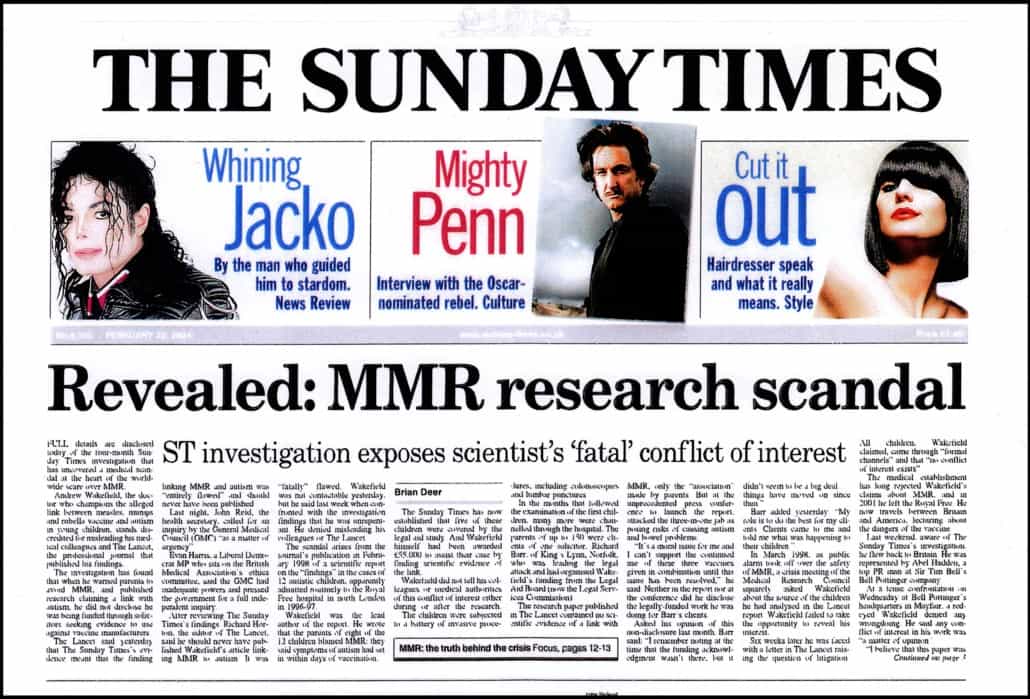
Times MMR reports listed] The first appeared on 22 February 2004, and at the time caused
public uproar. As Newsweek, in its issue of 2 March
2009, would recount:
"The
first cracks in the vaccine theories of autism
appeared in early 2004. An investigation by
British journalist Brian Deer in The Sunday Times
of London revealed that the children Wakefield
described in the Lancet study had not simply
arrived on the doorstep of the Royal Free."
Indeed, they had not.
But nobody would have known this from the manner in
which the 1998 paper had been crafted. The text -
drafted and redrafted by Wakefield with little input
from the co-authors - suggested that the eight
children whose parents were reported in it as blaming
MMR were merely routine referrals from general
practitioners and hospital doctors to the Royal
Free's paediatric bowel unit. Under a heading in the
1998 paper, "patients and methods",
the text stated:
12
children, consecutively referred to the
department of paediatric gastroenterology with a
history of a pervasive developmental disorder
with loss of acquired skills and intestinal
symptoms (diarrhoea, abdominal pain, bloating and
food intolerance), were investigated.
But even at this
early stage of The Sunday Times investigation, a
different story was unearthed. Long before
publication, almost all of these children [through
their parents] were actually clients and contacts
of a small-time UK solicitor, Richard Barr, based in the small
east-of-England town of King's Lynn, who for years
had been attempting to raise a speculative lawsuit
- financed through the British government's
legal aid fund - against drug companies which
manufactured MMR.
Although doomed from
the outset to fail [as all previous such actions in
the UK against drug companies have failed], this
lawsuit was the origin and engine of the MMR scare:
both in Britain and throughout the world. First spun
from publicity surrounding the UK government's
withdrawal in September 1992 of an early version of
MMR - due to the mumps component being
linked with rare cases of viral meningitis [which
Wakefield would later concoct into a bizarre conspiracy theory] - it quickly evolved into a
fishing expedition for any allegation critical of the
vaccine.
National vaccination
rates were unaffected by the 1992 withdrawal, and
there was no wider public alarm. But, soon after, a
campaign was started by a Wigan housewife, Jackie
Fletcher, alleging a link with developmental
disorders. At the time there was no suggestion that
MMR caused autism, and suspect cases were mostly like
her son, Robert Fletcher: a boy with epilepsy and
severe learning difficulties, which, in his case came
on about 10 days after the shot.
With brain disorders
still poorly understood, and with problems typically
manifesting at around the age of routine vaccination,
this was fertile territory for a class action
lawsuit, and soon alarmist media suggestions,
initially placed by Fletcher and Barr, of a link with
MMR were amplified like pyramid selling. Barr's name
got around as the "MMR lawyer", and some of
his clients began a campaign to deploy frightening,
but generally unverified, "mother and
child" vignettes: winning new converts to the
litigation. Eventually this would register some 1,600
claimants, all of whom have since discontinued.
In the early shape of
the UK scare, history was repeating itself. And the
lawyer learnt from an earlier controversy. His first
efforts ran along similar lines to failed legal
claims, mounted in Britain during the 1980s, over the
triple diphtheria, tetanus and
pertussis
[DTP] vaccine. Those claims involved [subsequently
discounted] allegations that DTP sometimes caused
permanent brain damage to children - and specifically
[albeit rather arbitrarily] within 14 days
of vaccination.
This 14-day
time-frame - the same as in the Lancet paper - was
also tabulated in a landmark 1981 British
epidemiological survey, the National Childhood
Encephalopathy Study, which not only included data
concerning events after DTP, but also after single measles
vaccine.
All this was
encouraging, but Barr - working with assistant and
future wife Kirsten Limb - had no
medical or scientific experts to mount a similar
attack on MMR. The mumps meningitis cases appeared to
resolve without long-term problems for sufferers, and
[although drug industry lawyers would later express
amazement that no serious legal challenge was raised
in respect of vaccine products withdrawn on
government orders] any serious side-effects were
evidently so rare that they couldn't offset the
advantage of vaccination. The risk-benefit profile of
the triple shot seemed clear, and Barr's lawsuit
hopes looked set to founder.
In 1995, however, the
position changed, with the emergence of Andrew Jeremy
Wakefield, a former trainee gut surgeon, doing
research at the Royal Free medical school into the
causes of bowel disease. The son of a prosperous
neurologist father and general practitioner mother,
from the west of England town of Bath, Wakefield was
ambitious and, although employed full-time at the
school since November 1988, had already developed a
taste for business ventures, registering private
companies from external addresses, and filing patents
on work done at the school.
The most bizarre was
"Wakefield's box": an "apparatus and
process for performing a chemical reaction",
filed with the London patent office in December 1993.
This was a cabinet, fitted with microwave heater and
fan system, to heat and cool materials for
experiments. The idea - which resembled a well-known
kitchen appliance - did not appear too novel, and
went nowhere.
Target
was Crohn's disease
But Wakefield
nurtured a more ambitious Big Idea: that he had
discovered the cause of Crohn's disease. This
terrible, and sometimes even fatal, inflammatory
bowel disorder, is a major medical mystery, with
numerous theories about why some people get it. The
former surgeon's speculation was that it was caused
by measles virus, and in March 1995, he
patented this claim, from his home address, without
the knowledge of his medical school employer. So if
this virus - which is found as a normal component of
MMR - caused Crohn's, hed every prospect of
both fame and wealth.
Speculations abound
about diseases of unknown cause being the result of
common infectious agents. Almost always they are
wrong, but in October 1992 - just two weeks after the
mumps meningitis problem had triggered the withdrawal
of two brands of MMR - Wakefield began phoning and
writing to officials at the government's department
of health in an extraordinary, almost menacing, tone.
Although the brand withdrawals were over mumps,
not measles virus in the vaccine, and he was
only a junior academic at a north London medical
school, he demanded top-level meetings, and for his
work to be funded, with veiled suggestions about
media involvement.
"My concern is
that although measles, and in particular the vaccine
may have no association with Crohn's disease
whatsoever, what will be picked up by the press is
the apparent association between the increasing
incidence of disease and the vaccine," he wrote
to Dr David Salisbury, chief of the UK immunisation
programme.
Two-and-a-half years
later, Wakefield made good on this warning when in
April 1995, one month after filing his Crohn's
patent, he held a press conference at the Royal Free.
This event announced the publication - also in the
Lancet - of a low-grade, much-challenged statistical paper, seeking to
mine some kind of epidemiological association between
vaccine use and the incidence of Crohn's. He appeared
on television and in newspaper reports. In King's
Lynn, these caught the eye of the lawyer.
"Children who
have been vaccinated against measles are three times
more at risk of developing serious bowel disease in
later life, a study suggests," reported Daily
Mail journalist Jenny Hope, in publicity from the
Crohn's press conference. "Dr Andrew Wakefield,
of the Royal Free Hospital School of Medicine in
North London, said the increased risk could be due to
the use of live virus."
It was this 1995
publicity which first
caused the
public to become concerned about MMRs safety.
And, although Wakefield would later repudiate his
bowel disease theory, his first forays into autistic
children were a bid to prove the cause of Crohn's.
Despite his later reputation as a campaigner over
autism, evidence later presented to a five-member GMC
disciplinary panel suggests that this was initially
far from the case. He simply needed to get into the
guts of children - almost any children might
do it - to prove that measles virus persisted.
But such research on
healthy kids would never be permitted: it would be
unethical to expose them to the risks. Through Barr,
however, he found an unparalleled opportunity: to
perform the tests on those with brain disorders.
These uniquely vulnerable children of the
lawyers desperately worried clients might thus
allow the research to go ahead. As the
Australian-born Prof John Walker-Smith, formerly the
Royal Frees professor of paediatric
gastroenterolgy, would later tell the GMC panel,
before which he was arraigned with Wakefield on
misconduct charges:
"The
heart of the matter - this all began with Dr
Wakefield's idea that Crohn's disease was
triggered by MMR, and measles was the important
factor."
Wakefield's theories
on Crohn's, however, proved a road to nowhere: even criticised by the Royal Free medical
school. But, evidently on the principle that "my
enemy's enemy is my friend", Barr and Wakefield
made common cause against MMR: bolting together a
novel, elaborate, and now refuted speculation that
measles virus in the vaccine caused
inflammation in the gut, which let "opioid
peptides" from food into the bloodstream, which
got into the brain and caused autism.
Although the 1998
paper remained silent on numerous other, pivotal,
matters, this so-called "opioid excess
theory" of autism - which has since been
rebutted in all material respects - was set out at
surprising length. In a customary section for
biomedical texts headed "Discussion", for
example, Wakefield recounted how a number of sources
argued that autism could arise from digestive
problems:
"The
'opioid excess' theory of autism, put forward
first by Panksepp and colleagues, and later by
Reichelt and colleagues and Shattock and
colleagues proposes that autistic disorders
result from the incomplete breakdown and
excessive absorption of gut-derived peptides from
foods, including barley, rye, oats, and casein
from milk and dairy produce."
As an explanation for
autism, however, this theory would prove absurd: an
almost Christmas cracker level of science. Although
not taken seriously enough to be publicly nailed by authoritative
research
in March 2008, it had first been suggested in July
1979 in a fringe "point of view" opinion.
Written by a medically-unqualified psychologist, Jaak
Panksepp, and published in an obscure monthly
journal, it relied on no clinical evidence
whatsoever, but was based purely on speculation, and
watching rats:
"We have
approached the possible neurochemical causes of
autism by assuming that the fundamental problem
of the autistic child is emotional. Some of the
earliest observed symptoms of autism include a
lack of crying during infancy, a failure to cling
to parents, and a generally low desire for social
companionship, which, we believe, shows that the
autistic child is constitutionally unable to feel
properly the emotions arising from social
relationships. Injections of low doses of
morphine can generate such behaviour patterns in
animals..."
There was more in
this vein, which by the 1990s should properly have
attracted dry humour:
"Contrary
to most prevailing professional opinions, we have
sided with the idea that the primary disorder of
autism is an emotional rather than a cognitive
one. We feel that the language difficulties of an
autistic child do not reflect a primary cognitive
disorder. Unless the child has a normal desire
for social interaction, the resulting failure of
early language development may abort the
construction of more mature linguistic
skills."
Although, on cold
consideration, such a theory sounds off-the-wall,
other possible mechanisms by which the vaccine might
cause neurodevelopmental disorders were shunted to
one side by this notion. And as hundreds of parents
of autistic and disabled children joined the lawsuit
- with all the uncertainty and stress that litigation
brings to people's lives - this would be presented as
a vital link in the purported chain of causality to
be set out in the legal claims. Here's a typical
paragraph, for example, from documents later
submitted to the High Court by Barrs law firm:
"In
susceptible children, the presence of measles
vaccine viral material in the tissues of the gut
causes immune dysregulation and/or immune
reactions and/or autoimmune reactions which cause
or materially contribute to the development of an
inflammatory bowel disorder, which in turn
initiates a biochemical cascade and in turn leads
to the egress of products of digestion and
neuroactive/neurotoxic agents (including an
excess of opioid peptides) into the circulation
damaging the brain so as to cause autism/an
autistic spectrum disorder."
But the key to the
strategy was to find concrete examples: test cases to
be tried in court. Since any vaccine-damaged
individuals have no known distinctive physical or
behavioural features, it was essential to Barr's
lawsuit [Sayers & Ors v SmithKline Beecham &
Ors] to propose a "fingerprint" of MMR
damage. So, in February and June 1996, Barr wrote to [possibly
hundreds of] his clients and contacts -
overwhelmingly people who'd got in touch following
publicity - and advised them that those whose
children had any of a list of possible symptoms of
Crohn's disease [such as bouts of diaorrhea, gut pain
or even mouth ulcers] should contact him for possible
referral to Wakefield.
It was a means of
finding subjects for Wakefield's research, but, by
selection, created a false impression. Using
recruitment methods never publicly disclosed before
Brian Deer's investigation, the appearance of a
potential link between [1] MMR vaccination, [2] bowel
problems, and [3] autism, was artificially created by
soliciting and sorting from a larger group of
children, recruited from publicity, a small number in
whom all three issues coincided.
Logically, it was
like selecting vaccinated kids with developmental
disorders and rotten teeth, and sending them to a
dentist who offers the opinion that vaccination
causes caries, leading to autism.
Legal
aid contract
The risk of creating
a spurious connection was obvious. But Barr had made
up his mind. "Needless to say both Kirsten and I
are satisfied that the link between vaccines and the
injury to our individual clients is not a fanciful
one, but one of direct causation," he wrote in
June 1996. "Unfortunately the experience of many
of our clients is that even in the face of quite an
obvious link between the vaccine and the injury,
doctors are dismissive and say that the cause is
anything but the vaccine."
While Barr appealed
to his clients for symptoms of this "obvious
link", he helped Wakefield draft a proposal to the British government's
Legal Aid Board to pay for the researcher to prove
the measles theory. Attaching a copy of a Royal Free
research protocol - later filed with the hospital's
ethics committee - the two men submitted to the board
detailed costings for procedures, and a statement of
Wakefield's intentions. In terms devastating to any
possible claim that Wakefield was employed to be an
independent scientist pursuing objective research,
before any of the children were admitted for his
project, and 21 months before the Lancet paper was
published, they wrote:
"It is
hoped that using the testing protocol attached it
will be possible to establish the causal link
between the administration of the vaccines and
the conditions outlined in this proposed protocol
and costing proposals. The standard of proof
aimed for will be at least the balance of
probabilities but it is hoped that in many
respects the level of proof will reach certainty
or near certainty."
Referring to
inflammatory bowel disease (IBD) and what they called
"disintegrative disorder", the two men's
proposal also suggested that, before any of the
children were admitted to hospital for the project, a
"new syndrome" had already been identified:
"In
contrast with the IBD cases, which have a prima
face [sic] gastrointestinal pathology, children
with enteritis/disintegrative disorder form part
of a new syndrome. Nonetheless the evidence is
undeniably in favour of a specific vaccine
induced pathology."
So seriously did
these preparations impact the 1998 Lancet study that,
even before the last of the 12 children was admitted
to the hospital for Wakefield's research, the parents
of six had already been issued with legal aid
numbers
through Barr's then-law firm, Dawbarns of Norfolk.
Moreover, even before the last child in the series
was admitted to the Royal Free, [one year before the
paper was published], Walker-Smith
knew that
the study was contaminated. On 20 February 1997, he
wrote to Wakefield, in a letter marked as copied to
Murch:
"It is
clear that the legal involvement by nearly all
the parents will have an effect on the study as
they have a vested interest... I would have been
less concerned by legal involvement if our work
were complete and we had a firm view. Never
before in my career have I been confronted by
litigant parents of research work in progress. I
think this makes our work difficult, especially
publication and presentation."
In the event, prior
to the childrens referrals, parents of at least
five of the 12 were clients and contacts of
Barrs. At the time of publication, ten
had full legal aid certificates to sue vaccine
manufacturers. One further child was from the United
States, and therefore not entitled to sue in the UK.
And the mother of the twelfth eventually changed her
mind - four years after going to the hospital - and
blamed MMR for her child's neurological problems,
after she was visited at home by a lawyer.
Wakefield and Barr
were working together. But third parties were also
key. In addition to being lawyer's clients and
contacts, parents arriving at the Royal Free to
vocally accuse the vaccine of causing developmental
disorders were members or contacts of the British
campaigning organisations JABS and Allergy-Induced
Autism: both run by Barr clients [respectively Jackie
Fletcher
and Rosemary
Kessick],
who were collaborating with Wakefield behind the
scenes. No wonder that, eventually, the parents of
all 12 - an incredible 100% - of the Lancet children,
who Wakefield held out to the world as being nothing
more than routine clinical referrals to the
paediatric bowel unit of the hospital [which had no
department or reputation, and almost no expertise, as
a centre for developmental disorders], were on the
record as blaming MMR.
None of this
underbelly was revealed in the paper, or reported in
surrounding publicity. Although the Lancet text
opaquely referred to possible "selection bias in
a self-referred group", this possibility was
dismissed in the same sentence, and nowhere was the
children's extraordinary status and manner of
recruitment disclosed. Rather, Wakefield laundered
into the medical literature, as apparently scientific
findings and results, what were, in reality,
highly-motivated recollections and assertions from a
group of parents who had an overpowering emotional
and economic need to believe that MMR was at fault.
The apparent parental
allegations, moreover, were written up in terms that
misled. Where Wakefield spoke in the paper of
behavioural symptoms within 14 days of MMR, the true
position was that the parents [usually after advice
from lawyers or activists, and always after being
advised on the phone by Wakefield] had generally
reported [if anything] common, benign, consequences
of vaccination, such as crying, fever, rash,
irritability, and even sometimes [also benign]
febrile convulsions. No competent doctor, acting
professionally, could describe these as
"behavioural symptoms", in the context of
autism, much less use them as evidence of regression.
In fact, Wakefield's
tabulated finding - linking MMR with the sudden onset
of regressive autism in two thirds of a consecutive
series of 12, seen routinely at a children's bowel
unit within the space of a few months - was both
biologically implausible and statistically
impossible. It simply could not happen.
No paper or article
has ever subsequently been published proposing
anything like this scenario. Indeed, faced by
urgently-commissioned research, and a review of cases
by the Committee
on Safety of Medicines, which showed no such temporal
association, the lawsuit-driven anti-MMR campaign
moved off in a different direction. The argument
quickly changed to allege that the emergence of
autistic disorders after MMR wasn't sudden at all,
but was delayed and insidious.
By August 2001, other
retained experts, working for Barr, led by Canadian
epidemiologist Walter Spitzer and British
psychologist Kenneth Aitken, published a paper
reporting, among other things, that they'd found only
two out of 493 [0.4%] children then enrolled for
Barr's lawsuit [who were vaccinated between January
1988 and November 1998, and thus including
Wakefield's series] where MMR had been given less
than 30 days before the appearance of
behavioural symptoms. In striking contrast, however,
Wakefield had claimed in the Lancet paper that eight
out of 12 [66.6%] had received MMR within 14 days
of symptoms. Moreover, Spitzer and Aitken reported
that the median time to the onset of symptoms among
Barr's clients was 1.1 years, while
Wakefield had claimed a median time of only 6.3
days.
Wakefield's
"finding" and "result" were thus
abandoned by history, with only the sting of his
attack remaining. In due course, he would up the
stakes, issuing a string of false claims, including
baseless comparisons between California and London
autism data, published with a Royal Free sidekick Scott
Montgomery
Ph.D in November 1999, again in the Lancet, claiming
evidence that MMR was responsible for an epidemic of
autism. Then, in January 2001, the pair published, in
the journal Adverse Drug Reactions and Toxicological
Reviews, what was little more than a sham review of
vaccine research. Analysis of these texts reveals
Wakefield's motive: to attack MMR, with little heed
for truth or consequence. But, with regard to the
February 1998 Lancet paper, his claims were a
charade: by a former surgeon with insufficient
training in general medicine and paediatrics to
realize that what he'd claimed was impossible.
It was a similar kind
of story with the "inflammatory bowel
disease" Wakefield claimed to have discovered.
Later, he would dub this "autistic
enterocolitis", as if it were something
distinctive to these children. Even the British
Medical Journal, attending the launch of the Lancet
paper in 1998, took this to be a pivotal insight.
"The study is the first of five new papers to be
published on the new syndrome, which the team have
named ileal
lymphoid nodular hyperplasia," the journal reported
on 7 March 1998.
But within weeks of
the Lancet paper's publication, the clinicians
admitted that they'd seen something else: very common both to children with
developmental disorders, and to those with learning
difficulties. "Plain radiography confirms severe
constipation with acquired megarectum [solid
blockage] in almost all affected children,"
Walker-Smith and Murch wrote in a letter to the
journal, published on 21 March 1998. "Most
parents note a honeymoon period of behavioural
improvement after the bowel preparation for
colonoscopy and this is maintained if recurrent
constipation can be prevented."
Years later, Murch, a
consultant gastroenterologist, who would also face
GMC charges alongside Wakefield, published eloquently
on constipation
in autistic children. But - though it was also repeatedly
referred to by parents - it was nowhere mentioned in
the paper. Was it related to the ileal-lymphoid
hyperplasia? This expression [meaning swelling of
lymph glands near the end of the small intestine,
close to the appendix] didn't refer to an
"inflammatory bowel disease" at all, but to
a common gut feature, often seen in children,
regarded by specialists as usually benign. Although,
oddly, the Lancet paper contained no explanation,
discussion or literature citations whatsoever about
this feature, even a panel of 20 specialists,
including Wakefield and his supporters, convened in
October 2006 by a US group, Autism Speaks, concluded:
"The
clinical significance of LNH in children with
autism is unclear given that similar findings
have also been reported in children with typical
development as well as children with food
allergies and immune deficiencies."
Besides lymphoid
hyperplasia being a frequent, benign finding in all
kinds of children seen at hospitals - and not a new
disease linked to autism - Walker-Smith would later
admit in confidential papers that most children who
he claimed had "autistic enterocolitis"
didn't have enterocolitis [meaning inflammation of
both the large and small intestines] at all. And
experts also found "unremarkable" signs in
the children's colons. "These colonoscopic
findings of increased vascularity and granularity are
entirely subjective," wrote one experienced
gastroenterologist in a report. "These are
appearances that can occur following bowel
preparation for colonoscopy and they are of no
diagnostic significance."
Even by November
2003, Murch, the paper's second author had come clean
over this question of inflammation. "That any
reports that characterise gut inflammation in
autistic children are reported in the media as
supporting the idea that MMR is causative is deeply
frustrating, since it simply is not so," wrote
Murch in a letter to the Lancet. "I and my
colleagues have seen similar intestinal changes in
children with no history of regression, in
unvaccinated children, and in children whose first
autistic symptoms clearly predated MMR
administration."
These issues were
debated after the paper's publication, but it was not
until Deers February 2009 revelations that they
assumed the sharpest and most shocking focus.
According to official reports, issued by the Royal
Free hospital's pathology service, bowel biopsies
from the children were repeatedly judged normal, with
no evidence of inflammatory bowel disease. The Lancet
paper, however, had described 11 of the 12 as
suffering from what Wakefield called
non-specific colitis.
Wakefield had not
only reached this unsupported diagnosis, but claimed
that the colitis was so clinically serious that it
led to brain damage, triggered by MMR. "These
findings are consistent with autistic
enterocolitis," he would assert, for example,
with regard to five litigant children, in a report
for Barr dated August 2003, and submitted to the
court in the lawsuit. "It is my opinion that, on
the balance of probability, the disease was caused by
or at least contributed to by, MMR vaccine."
But in face of the
evidence, in September 2003, Barr's lawsuit collapsed, when public funding was
stopped. This followed the exchange of expert reports, including
Wakefield's, revealing that the game was up. Although
Fletcher's JABS group would blame the government, the
Legal Services Commission, the judiciary, and even
Brian Deer [who at the time had never published
anything about MMR] for the failure, it was the
children's own lawyers - the QCs Jeremy Stuart-Smith,
Simeon Maskrey and Augustus Ullstein - who had
advised the commission that, notwithstanding the vast
investment of public money in trying to undermine
MMR, the attack based on Wakefield's theories was
unlikely to succeed. As Lord Justice May summarised
the events, in a February 2006 appeal court judgment:
"The
actions proceeded and expert evidence was
exchanged. At this stage, three leading counsel
for the claimants in the group action produced a
lengthy advice. They advised that, as the
evidence stood, there was no reasonable prospect
of establishing that the MMR vaccine could cause
ASD."
Ten years had been
wasted on Wakefield's claims. Parents had gained
nothing but heartache.
He
who paid the piper...
To understand
Wakefield's conduct, it's hard to overlook his hidden
financial interests. To the later declared surprise
of his colleagues [mp3 audio], two years before the Lancet
paper was published, his research on the children had
begun, not just with a desire to collaborate with
Barr, but with a lucrative financial contract,
discovered by Deer, to join the team preparing the
lawsuit. In February 1996, Wakefield agreed to work
for Barr at a rate of £150 an hour - a great deal of
money for a retained expert at that time - in
addition to his Royal Free salary. And as the Sunday
Times investigation revealed in February 2004, the
proposal submitted to the Legal Aid Board [now the
Legal Services Commission] in June 1996 meant money
to support Wakefield's work.
Shunning competing
explanations for how MMR might cause injuries, and
without any medical or scientific review, Barr was
authorised to pay Wakefield a maximum of £55,000
from public funds - on top of his hourly rate - to
perform the research in the June 1996
proposal.
This was to provide for "clinical and
scientific" tests on ten client children in the
hunt for evidence for the lawsuit. Interviewed by
Deer in 2004, Barr - by now working for the larger
law firm Alexander Harris - confirmed that he'd
arranged finance [mp3 audio] for the study published in
the Lancet of February 1998. But then, after public
uproar followed the first Sunday Times reports, he
avoided any further comment.
Even some of
Wakefield's closest collaborators voiced concern over
this new information. "We were shocked by the
revelations in the Sunday Times," said Professor
John O'Leary, a controversial Dublin-based Wakefield
associate, and former business partner, in a statement issued through his lawyer.
"We were not made aware, nor were we aware, of
any liaison between Dr Wakefield and Mr Richard Barr
of Alexander Harris Solicitors that apparently
existed since 1996. In addition, we had never been
informed that the LSC had funded Dr Wakefield."
Walker-Smith also
denied all knowledge, despite being the study's
senior clinical investigator. In an email, circulated
at the Royal Free on 27 February 2004, in response to
The Sunday Times investigation, he said:
"No
financial details of Andy's work was ever
discussed with me by anyone and I was totally
unaware of the grant of £55,000 that had been
paid to him in an NHS Trust Fund, until Deer told
me to my astonishment in December 2003."
The explosive
revelation about Wakefield's £55,000, however, only
scratched the surface of his pecuniary advantage.
Wakefield denied that he had been paid by the
solicitor, but, on the legal front, in December 2006
[only five months after Wakefield's supporters also
issued a press
release
denying that he was ever paid] the Legal Services
Commission answered a Freedom of Information Act
request from Brian Deer with a spreadsheet of fees to paid
witnesses
in the MMR lawsuit, stating that, since joining Barr
ten years previously, Wakefield had been paid
£435,643 [about $780,000], plus expenses, for his
role in backing the generic case against MMR. This
money - which is believed to have been augmented by
yet more, still undisclosed, for work on individual
children's records - was drawn against the
cash-limited UK legal aid fund, intended to help poor
people gain access to justice. During this period,
Wakefield and his wife built a house on land purchased adjacent to
their home, which was offered for sale in March 2007
priced £2,950,000 [$5,677,550].
Like many biomedical
journals, the Lancet had strict rules [including uniform
requirements for manuscripts] requiring authors to
report even potential conflicts of interest. But
neither the nature of the collaboration with Barr,
the money Wakefield received, nor the manner of the
children's recruitment, were disclosed to the journal
and its readers. Nor did Wakefield reveal the true
situation when repeatedly offered the chance. In
March 1998, for instance, at a meeting convened by
the UK Medical
Research Council, he was asked where he got the
children. The minutes of the exchange accurately
reflect a full transcript, in Brian Deer's
confidential possession:
"Members
were interested in how the children had come to
be referred to the RFHMS team, as this had a
bearing on the issue of bias in the generation of
the case series. Mr Wakefield explained that
originally the parents of the children had come
to the group without any connection through any
other organisation. Latterly, following media
attention, parents had heard of the RFHMS group's
work either directly or through other
organisations. All patients who had been reviewed
to date had been referred by their general
practitioner or paediatrician by the standard
route."
In May 1998, two
months after this meeting, the Lancet published a
reader's letter speculating that lawyers were involved [pdf
version].
Then, in April 2000, Wakefield was asked at a US congressional
committee,
with reference to material he'd presented, which
included the Lancet 12:
"Who
funded your study?"
And, in March 2001,
he was asked again at an Irish parliamentary
committee
to identify the source of his finance. When Wakefield
dodged the question, a deputy pressed him:
"I
genuinely wanted to know who is funding the
research."
On any of these
occasions, Wakefield might have made the position
clear: that a lawyer employed him to produce evidence
against the vaccine. But the truth would prove
devastating: revealing the grossest possible conflict
of interest that its possible for a scientist
to have. Payrolled as he was by Barr, if he had
failed to report the existence of his new
syndrome, or, if asked, failed to call for
parents to shun MMR, as he did, then his
£150-an-hour contract would have been in jeopardy.
Barr planned to raise his lawsuit under the strict
liability of consumer protection legislation, and
thus, of necessity, his principle medical and
scientific expert - Wakefield - must not only find
fault with the three-in-one vaccine, he must deem it
unfit for marketing.
Any other stance
would cause the legal case to collapse, either for
lack of funding, or at any eventual trial. Thus, when
Wakefield published his claims in the Lancet and
called for MMR to be suspended, he knew - but the
British public didnt - that he would be writing
himself some handsome cheques.
Ethical
issues
The Sunday Times
investigation also revealed anomalies over the
project's institutional review. Under the terms of
the Declaration
of Helsinki of June 1964 [with later revisions],
and other rules, such review is an essential
prerequisite to research on humans: aiming to protect
the rights of subjects, to prevent exploitation of
the vulnerable - especially children and the mentally
incapacitated - and to ensure that the true facts
[including sources of funding and subjects] are
independently approved as ethical. The spur to the
declaration were abuses by Nazi doctors, exposed
after the World War II. Other 20th century atrocities
included the Tuskegee
syphilis experiment, which saw infected black men left
untreated.
But after the Lancet
report was published, its claim that
investigations were approved by the Ethical
Practices Committee was questioned by a senior British doctor,
and denied both by the chair of the
Royal Free's ethics committee, and by the dean of its
medical school. In fact, the committee had challenged
Wakefield and Walker-Smith in 1996 over the purpose
of their investigations, which included a battery of hazardous, invasive
procedures of questionable clinical justification.
These procedures were set out in two protocol
documents describing the clinical and scientific
research to be undertaken, titled "A new
paediatric syndrome: enteritis and disintegrative
disorder following measles/rubella vaccination".
One of these documents was a 20 page narrative, outlining the
proposed project. The other was an ethics committee
question-and-answer pro-forma of 11 pages, completed and signed by the
researchers.
After written and
verbal questions to Wakefield and Walker-Smith, the
ethics committee was led to believe that the
procedures to be undertaken - including general
anaesthesia, ileocolonoscopies, MRI brain scans,
EEGs, and even lumbar punctures - were merely routine
clinical evaluations, which would have been carried
out even if there had been no study. But, in fact,
they were part of the regime specified
in the deal that Wakefield had reached with Barr.
Having been set out in a research protocol and
proforma [which, oddly, spoke of an alleged "new
syndrome" in advance of any research], moreover,
the procedures were determined before children were
even seen at the hospital, much less had their
individual histories, symptoms and signs evaluated by
appropriate doctors.
Years later, at the
GMC hearing, between 2007 and 2010, Wakefield,
Walker-Smith and Murch would claim under oath that
the investigations were all clinically-indicated,
with decisions to perform them taken after the
children were examined at the hospital. But on 5
February 2004, prior to the GMC's charges being laid,
Brian Deer had interviewed Murch, who, despite
becoming abusive during the interview, clearly
recalled the decisions to perform the procedures
being taken before, as part of a research exercise.
By agreement, the interview was recorded.
BRIAN DEER:
So up front somebody had a rubber stamp
that said theyll all have MRIs...
colonoscopies... et cetera.
SIMON MURCH:
Exactly.
Murch added:
We had
meetings, and in our research planning meetings
we had all these referrals, and we felt that they
- having seen the few we had taken
histories from - they had had no
investigations. The doctors label
applied. One or two had been investigated
at the time, but this was, Okay, how are we
going to do this properly? And so
that was a prospectively-planned research to do a
defined number of children, just in terms of
assessing the limits of what we were
having.
He was in no doubt,
moreover, that the study was ethically approved. Deer
read him the ethical statement in the Lancet - "Investigations
were approved by the Ethical Practices Committee of
the Royal Free Hospital NHS Trust, and parents gave
informed consent - and then continued.
BRIAN DEER:
Do you believe that to be true?
SIMON MURCH:
Yes.
BRIAN DEER:
You believe its true?
SIMON MURCH:
I do.
BRIAN DEER:
You believed it then, and you believe it
now?
SIMON MURCH:
Yes.
BRIAN DEER:
Investigations?
SIMON MURCH:
Yes. The ethical thing, that was approved
for those 12 children. We did not go on doing
lumbar punctures, and we havent done that
since. That was for that initial assessment
study. Yes, absolutely."
Weeks after this
interview, Simon Murch, on behalf of the Lancet
authors, Prof
Humphrey Hodgson, on behalf of the Royal Free and
University College medical school, and Dr Richard
Horton,
on behalf of the Lancet, all took the same stance,
and issued formal statements insisting that ethical
approval was given for the work published in the
journal, according to the protocol documents
submitted in 1996, and extensively discussed
in 1997.
Wakefield made the same claim in a letter to The Sunday Times. But,
despite all these considered written assertions,
after the disciplinary charges were laid by the GMC,
Wakefield, Walker-Smith and Murch changed their
story, repudiated their claims of 2004, and said that
no research study was ever carried out on the
children, and hence no approval was required.
In fact, as documents
obtained during Deer's inquiries revealed, the
committee never approved any study as described in
the Lancet of February 1998. A comparison between the project submitted
to the committee - involving proposed research on 25
patients diagnosed with a very rare and serious
condition called childhood
disintegrative disorder [and with what Walker-Smith told the
committee was a "hopeless
prognosis"]
- was quite different to the eventual report on 12
children afflicted by vastly more common and
disparate developmental disorders, which couldn't
responsibly be described as "hopeless".
These disorders not only included autism, but
[although not revealed as such in the paper] also the
"high-functioning", non-regressive,
Asperger's syndrome, and even pathological
demand avoidance.
Moreover, in a
stipulation commonly laid down by ethics committees,
the Royal Free's ruled that any children enrolled
into Wakefield's research prior to the completion of
ethical consideration in December 1996 [which was 7
of the 12 reported in the paper] must be excluded from the study. Had this
ruling been heeded [which it wasn't], the apparent
results of the research would have been substantially
different to what was published:
embracing many children where a vaccine link was
implausible, or where there was manifestly no claim
of anything like the sudden onset of regressive
autism. Compliance with the rules would have
torpedoed the 14-day temporal link, and the health
scare would have been scuppered.
Dr Michael Pegg,
chair of the Royal Free's ethics committee, was
interviewed by Brian Deer in 2003. If somebody
tells me something, I have to believe them, he
said of the submissions made to him regarding the
Wakefield project. If what I am told is
not correct, that is a problem for others, the
General Medical Council and so on.
The unreliability of
the Lancet data was emphasised in 2005, when Deer
obtained a draft of the paper, showing that Wakefield
had sexed-up his findings. Side-by-side, the two
texts report dramatically different
results
from the same records of the same 12 subjects. One
child's bowel, for instance, moves from normal to
abnormal in a simple, manual alteration. The most
striking change, however, concerns the 14-day
time-frame between vaccination and the alleged onset
of behavioural symptoms. This morphs from
one version to the next. In a version circulated at the Royal Free
in August 1997, 14 days is cited as the average
time to the onset of "behavioural
symptoms", with the maximum time [the
range] stated to be 56 days. In a second
version,
eventually published, however, the 14-day time-frame
survives, but now as the maximum, with the reported
average just 6.3 days.
Parents - desperate
for answers, and understandably hoping for financial
help to care for their children - consented to
Wakefield's project. But, in some cases, their
children underwent distressing, painful tests, or
were even injured during futile procedures. For
instance, the mother of one of the Lancet 12 - a
7-year-old boy - said that her son was rushed by
emergency ambulance from his home to the Royal
Berkshire hospital after lumbar puncture under
general anaesthetic at the Royal Free.
Later, during an
extension of the project into a larger number, a
second child, aged 5, was obliged to undergo
emergency transfer from the Royal Free to Great
Ormond Street hospital after his bowel was punctured
in 12 different places during a colonoscopy. In
December 2007, this boy was awarded £482,300 after
the High Court was told that he'd suffered multiple
organ failure, including kidney and liver problems,
and neurological injuries. In allegations denied by
the hospital, the boy's parents are reported to have
claimed that the colonoscopy - not involving
Wakefield - was "not clinically indicated or
justified", that they were not given proper
informed consent, and that the procedure was an
"assault" on their son.
Dispatches: MMR
- What they didn't tell you
After the initial
Sunday Times reports, the UK's Channel 4 Television
network asked Brian Deer to continue his inquiries.
These resulted in further revelations in a prime-time
Dispatches documentary MMR: What
they didn't tell you, broadcast on 18 November 2004, and
described in the British
Medical Journal as "one of the most exciting
examples of investigative television journalism you
will ever see".
The programme's
findings took The Sunday Times investigation into new
areas of inquiry. Instead of focusing on the
litigation background and Wakefields conflicts
of interest, Deer probed other aspects of the
doctors agenda, and dug into the basis of his
science. Although Wakefield's associates, business
partners and collaborating parents uniformly declined
to co-operate with the programme-makers, in no
instance was any evidence unearthed suggesting that
his claims had merit.
Although Wakefield
had performed no clinical research upon which to
credibly call on parents to boycott the vaccine, as
he did at the press conference in February 1998, his
attack on MMR had been orchestrated through a
20-minute video news
release,
prepared weeks in advance and issued to journalists
by the Royal Free's press office. In this video,
which doctors knew was likely to cause public
alarm, and damage to immunisation rates, Wakefield
four times claimed that single shots were likely to
be safer than MMR, which he said should be withdrawn
by the government.
In the videotape,
which the Royal Free refused to release to Channel 4,
but which Deer's team obtained nevertheless,
Wakefield said:
"There is
sufficient anxiety in my own mind of the safety,
the long term safety of the polyvalent - that is
the MMR vaccination in combination - that I think
that it should be suspended in favour of the
single vaccines, that is continued use of the
individual measles, mumps and rubella
components."
In a patent
application [GB2325856], filed less than four months
later, and also revealed by Deer, Wakefield spelt out
his claim that MMR caused autism, which he named
"regressive behavioural disease" [RBD]:
"It has
now also been shown that use of the MMR vaccine
(which is taken to include live attenuated
measles vaccine virus, measles virus, mumps
vaccine virus and rubella vaccine virus, and wild
strains of the aforementioned viruses) results in
ileal lymphoid hyperplasia, chronic colitis and
pervasive developmental disorder including autism
(RBD), in some infants. Before vaccination the
infants were shown to have a normal development
pattern but often within days of receiving the
vaccination some infants can begin to noticeably
regress over time leading to a clinical diagnosis
of autism."
But his call and this
claim [maintained and restated by Wakefield in
identical terms in an issued United
States patent dated March 2003] had no scientific
basis. And as he would later admit during an
interview for an online presentation by London's Science
Museum,
he didn't know himself how to justify them. In a
text, submitted for his approval before being posted
on the web in June 2003, museum staff asked about his
call for single vaccines. "What's his
reasoning?" they asked.
He said:
"It's
purely empirical - we have no idea. It's the
public health people's job to look into
that."
Wakefield's call in
1998, however, had created the false impression that
it was backed by the "findings" in The
Lancet paper. And it fitted Barr's strategy for
pursuing the litigation - which was rooted in UK
consumer legislation, focused specifically on
combined vaccine products. As a confidential Barr newsletter, sent to the lawyer's
clients, explained in May 1997:
"If the
MMR vaccines are withdrawn, then that of course
will be a great leap forward for the cases."
Wakefield worked for
Barr, but there was an even greater self-interest
than the enormous fees he claimed from the lawsuit.
Unknown to the public prior to the Dispatches
investigation, nearly nine months before the press
conference, Wakefield and the Royal Free medical
school had filed the first in a string of patent
applications for extraordinary products which could
only have stood any chance of success if MMR's
reputation was damaged. These included, firstly, a
single vaccine against measles - a potential
competitor to MMR - and, secondly, purported
remedies, perhaps even what Wakefield bizarrely
called a "complete
cure",
for both inflammatory bowel disease and autism.
One example of
Wakefield's claims was found in a document filed with the London patent
office on 6 June 1997, but not known about prior to
Deer's programme:
"I have
now discovered a combined vaccine/therapeutic
agent which is not only most probably safer to
administer to neonates and others by way of
vaccination, but which also can be used to treat
IBD whether as a complete cure or to alleviate
symptoms."
In the issued United
States patent of 2003 [US 6,534,259 B1], Wakefield
went further, claiming not only the vaccine and a
product for treating bowel disease, but also that the
product would treat autism, which he called
"regressive behavioural disease" or
"disorder":
"I have
now discovered a combined vaccine/therapeutic
agent which is not only most probably safer to
administer to children and others by way of
vaccination/immunisation, but which also can be
used to treat IBD and RBD whether as a complete
cure or to alleviate symptoms."
These commercial
interests - which Wakefield privately bragged would
make millions - were based on a fringe
technology,
devised by a disgraced American doctor, Hugh
Fudenberg,
who made bizarre claims when interviewed by Brian
Deer in Spartanburg, South Carolina. Fudenberg said
that he treated autistic children using a powdered
"transfer factor" remedy, which he
explained that he rolled out in a sheet, three
molecules deep, "like pasta", on his
kitchen table. The broadcast portions of the
interview were strange enough, as the following
exchange reveals:
BRIAN DEER:
"Now using this technology, do you believe
that autism can be cured?"
HUGH
FUDENBERG: "Yes."
BRIAN DEER:
"Cured?"
HUGH
FUDENBERG: "Yes... It's cheap, it's oral. No
injections. One pill a day, every other day for
three, six, months."
BRIAN DEER:
"And where does that come from?"
HUGH
FUDENBERG: "From my bone marrow."
BRIAN DEER:
"From your own personal bone marrow?"
HUGH
FUDENBERG: "Yeah."
Despite such oddities
in Wakefield's scientific collaborations - including
joint patents with Fudenberg for rights over possible
miracle cures for autism - the former gut surgeon
started his own private company, Immunospecifics Ltd
[intended to be a subsidiary of another company, to
be called Carmel Ltd, after his wife, Dr Carmel
O'Donovan], involving collaborators John
O'Leary,
Robert Sleat, and Roy Pounder. This was intended to make a
fortune from "diagnostic kits" to be sold
off the back of the self-same litigation that he was
promoting. Had these fantastic ambitions been known
about before Deer's programme, Wakefield's then
six-year-old crusade against MMR would surely have
been interpreted differently.
And what of the
integrity of Wakefield's scientific discoveries?
These, too, were investigated for Channel 4. His
theory, invoked to justify what would become a
sustained worldwide campaign against the vaccine, was
based on an unsubstantiated claim that the ultimate
culprit - both for inflammatory bowel disease and the
children's autism - was measles virus in MMR.
Wakefield led parents to believe that it was this
virus, purported to persist in the gut, which caused
the damage that could lead to autism. He then joined
fringe US-based businesses, such as the International
Child Development Resource Center & Good News
Doctor Foundation, in Florida, which sold expensive,
unproven products, and unusual medical services,
purporting to offer children relief.
Yet, as he'd sat at
the London press conference in 1998 and triggered the
public panic, Wakefield knew that his own laboratory
at the Royal Free had used sophisticated molecular
technologies [RT-PCR and NASBA] to test the children
whose cases he presented in the Lancet as evidence of
his claims. Those tests, which were executed under
his personal supervision, but, yet again, never
reported before Brian Deer's investigation, found no
trace of measles virus [or mumps and rubella viruses]
in any of the children involved.
This information was
confirmed by Dr Nicholas Chadwick, who was
Wakefield's personal research assistant, and who
tested samples taken from the children. Chadwick
would later give evidence in US court
hearings,
but spoke for the first time publicly on the subject
to Deer.
BRIAN DEER:
"And are these children the same children
that went on to be published in the Lancet,
leading to the MMR scare?"
NICHOLAS
CHADWICK: "Yes, that's right."
BRIAN DEER:
"Did you find measles virus in those
children?"
NICHOLAS
CHADWICK: "No. No single case did I find any
measles virus in those children."
BRIAN DEER:
"You looked at some cerebro-spinal
fluid."
NICHOLAS
CHADWICK: "That's right."
BRIAN DEER:
"By lumbar puncture. Did you find any
measles virus in those?"
NICHOLAS
CHADWICK: "No."
BRIAN DEER:
"So you found no measles virus in the
children who were presented to the public at the
very foundation of the MMR scare, where Dr
Wakefield's theory was that it was measles virus
itself that was responsible for a bowel disease,
and then leading on to some kinds of autism, and
you found no measles virus."
NICHOLAS
CHADWICK: "That's correct."
Andrew
Wakefield's responses
Wakefield was fired
from his employment at the medical school in late
2001, and, until February 2010, earnt a reported
$280,000 a year running a Texas-based colonoscopy
business called Thoughtful
House -
employing, among others, endoscopist Arthur
Krigsman
and assistant Carol Stott. He has also spent much of
his time travelling the United States, enjoying a
luxury lifestyle and drawing new customers to that
business, suggesting a vaccine-caused epidemic of
autism.
From the outset of
Brian Deer's inquiries, Wakefield refused to
co-operate, declining through his UK publicist Abel Hadden multiple requests for
interviews. He ignored, or rejected through lawyers,
written invitations to address the matters to be
raised in the television documentary. And when
approached by Deer and a film crew at an autism
conference in Indianapolis, in October 2004,
Wakefield attacked the camera and fled.
Nevertheless, either
directly or through lawyers, Wakefield has denied
misconduct, and claimed to have acted properly at all
times. His wife, Carmel O'Donovan, has given
supportive interviews to British newspapers involved
in backing his campaign, while litigant-parents and
anti-MMR campaigners working with him have issued press
notices
denying that he was ever paid by Barr for research.
American fringe anti-vaccine autism organisations,
such as the Autism
Research Institute [which for many years has published
evidence that almost
anything
will be accepted as a remedy for autism] and Generation
Rescue,
meanwhile, have continued to claim that the 1998
Lancet paper is pivotal evidence of a risk from MMR
to children. The latter organisation claimed in a
2009 report aimed at parents and others:
"This study demonstrates
that the MMR vaccine triggered autistic behaviors
and inflammatory bowel disease in autistic
children."
In April 2004,
Wakefield, with others, claimed that he had properly declared
his legal funding in a 1998 letter to the Lancet: a claim rejected by the Lancet. Wakefield said
that he had donated his income from the
litigation to charity, but gave conflicting accounts
as to which. More statements by Wakefield, and other
material concerning his responses, can be found
through an index page at this website.
"There was no
legal aid funding for this... nor were any of the 12
children in receipt of legal aid certificates,"
he said in one response to The Sunday Times,
referring to the Lancet research. "Subsequent to
the start of the investigation of the relevant
children, I was separately commissioned through
Richard Barr to undertake quite separate virological
studies on 10 children."
In response to Brian
Deer's first Sunday Times reports, Wakefield claimed in formal statements in 2004
that the legal contract and payments were for a
scientific study "quite separate" to the
research published in the Lancet, although no such
study was ever produced, and the documents submitted
to the Legal Aid Board identify a single project. In
response to the Dispatches programme, Wakefield,
again in a formal statement, denied that he ever planned a
vaccine, which he said was only included in patent
applications as "an afterthought". But
following these claims - taken up worldwide by his
supporters in attacks on Deer's integrity - fresh
documents came to light on both the contract and the vaccine.
In December 2005,
Wakefield's lawyers said in a letter that, contrary to popular
opinion, he was not the cause of the MMR scare, but
that his hypothesis of a possible link between
MMR and autism was but one episode in a much longer
public health debate about vaccine safety. His
participation in this debate, they said, was
conscientious, reasonable and responsible for a
research doctor in his position.
The letter said that
his work on MMR, and his connections with the lawyers
Dawbarns and the Legal Aid Board [now the Legal
Services Commission], were well known both in
the general media and amongst his colleagues from an
early stage.
In an "open
letter" by Wakefield and others, published in
June 2006 by a tiny rightwing US fringe group called
the Association of American Physicians and Surgeons,
he claimed that:
"Every
aspect of the original 1998 report of the first
12 children with this disorder has been endorsed
by independent research."
One of the
signatories to this letter was a London GP, Richard
Halvorsen.
He was also hired by Barr, and was one of a small
number of undistinguished doctors who cashed-in on
the alarm Wakefield created. Halvorsen - now running
his business out of Harley Street - sold parents
single vaccines, of no established worth over the
free MMR, with prices given by his business in 2007
as £335 for a course of three shots, without any
consultation. In December 2004, another such GP, David Pugh, was jailed for forging test
results suggesting that children were protected.
Particularly through
his campaigning in the United States, Wakefield has
also won new supporters, including, for example, one
epidemiologist who in November 2007 wrote of the
Lancet research:
"The
paper is actually excellent - a superb case study
that will join the ranks of other famous case
studies, such as the link between rubella
infection and congenital rubella syndrome (Gregg
1941) and between exposure to thalidomide and
embryopathy (McBride 1956)... The paper, once
understood in this light, as case series
analysis, is truly remarkable, well written and
brilliantly documented."
In statements issued
in February 2004, Walker-Smith and Murch also denied misconduct: a
stance they have subsequently restated.
Following Deer's
February 2009 revelations about the Lancet paper,
Wakefield issued a lengthy statement, accusing Deer of
"ignoring any information contradictory of his
premise," and again denying every aspect of the
investigation. "The notion that any researcher
can cook such data in any fashion that can be slipped
past the medical community for his personal benefit
is patent nonsense," he said. "Scientific
rigor requires repeatability for verification of any
research and Mr Deer's implications of fraud against
me are claims that a trained physician and researcher
of good standing had suddenly decided he was going to
fake data for his own enrichment."
Andrew
Wakefield v Channel 4, Twenty Twenty Productions
& Brian Deer
Brian Deer wasn't the
first to try to get to the bottom of Wakefield's
extraordinary activities. But, as doctors, including
those at the UK's department of health, challenged
him to substantiate his allegations, he threatened
his critics with complaints. In March 2002, for
instance, he formally complained to the GMC, alleging
serious professional misconduct, over a senior Royal
Free consultant who in December 1997 had told a
paediatrician:
"There is
a zealot surgeon in our adult gastroenterology
department who thinks that MMR is the cause of
all the problems of the Western world".
Wakefield even
threatened to report the government's chief medical
officer, Sir Liam Donaldson, to the GMC for having
sought from the hospital, in February 2002, a file of
ethics committee papers [that Brian Deer eventually
obtained]. Wakefield wrote:
"It has
come to my attention that you have sought details
of our studies from the ethical practices
committee of the Royal Free NHS trust. I infer
from this that faced with an increasingly
compelling scientific case against the MMR
vaccine you are seeking to discredit the
scientists involved. Your attempts to interfere
in the scientific process are unacceptable. Not
only do you have no right whatsoever to this
information without permission, but also your
action has had an indirect but nonetheless
profound effect upon our ability to help these
desperately ill children. I am seeking advice
prior to taking this issue up with the General
Medical Council."
These kind of
harrying attacks weren't only aimed at doctors.
Wakefield also mounted onslaughts against
journalists. Brian Deer, of course, was repeatedly
targeted, beginning with a typically-worded threat.
"If you decide to publish, in spite of our
conversations and all of the written material I have
let you have over the last two days," Wakefield
blustered to the legal manager of Times Newspapers
Ltd, on 14 February 2004, "you will leave me no
recourse other than to pursue you through the courts,
in order to protect my reputation."
The most striking
early incident, however, was a purported grievance
lodged with the [former] Broadcasting Standards
Commission over an ITV-1 "Big Story" programme, titled
"A difficult decision". This was
transmitted on 3 October 1996 - more than a year
before the Lancet paper - and offered balanced
coverage of Wakefield's claims at that time that
vaccines against measles caused Crohn's disease.
However, not only was Wakefield's complaint rejected
by the commission [which described the programme as
"a responsible investigation into a matter of
considerable public interest"], but only six
months after a hearing which adjudicated on the
matter, Wakefield admitted at a private meeting that
his own data on Crohn's disease suggested that it
wasn't caused by measles at all.
Wakefield also
revealed a penchant for threatening to sue others who
challenged his conduct. Following Brian Deer's first
Sunday Times reports - and before the extraordinary
sums Wakefield pocketed from the MMR scare were
unearthed - Wakefield instructed libel lawyers Peter
Carter Ruck & Partners [on a contingency fee
arrangement] to threaten both The Sunday Times and the
Lancet, falsely suggesting that he'd properly
disclosed his relationship with Barr's lawsuit. Both
publications, however, rejected his complaint, and
Carter-Ruck wasn't heard from again.
Later, in June 2005,
Wakefield's then-solicitor, Simon Dinnick of the
Medical Protection Society's lawyers Radcliffes
LeBrasseur, was instructed to threaten the Cambridge
Evening News, an English regional newspaper, which
had reported on an aspect of the dispute. Among other
things, Dinnick said that the newspaper's report
alleged that the purpose of the research money from
Barr "was to establish a positive link"
between MMR and autism "thus suggesting a
predetermined outcome and a lack of
objectivity". Demanding an apology and a payment
[which he successfully extracted from the
poorly-advised little newspaper], Dinnick concluded
on his client's behalf:
"There
could hardly be a more serious allegation against
a research gastroenterologist."
Ironically, the paper
was too timid: Barr had hired Wakefield for precisely
this purpose. But in this threat
- and others circulated at the time - Wakefield
blustered that he was suing for libel The Sunday
Times, Channel 4 and Brian Deer, publisher of this
website. He even went as far as having claim forms
issued at the High Court office in London. But this,
he'd later realize, was a big mistake, that some
observers think sealed his fate. Channel 4 -
Britain's independent public service network - had
the resources to defend itself, and was determined to
stand up to his threats. Within weeks, Wakefield's
lawyers were trying to freeze the action, pleading
for "protection from the Court" in the face
of the mounting costs of his ploy. But, despite
fielding a QC, Desmond Browne, and a full supporting
team, Wakefield lost at every hearing. And in
December 2005, he was ordered by a senior judge, Mr Justice
Eady, to serve the necessary papers on the
defendants: to "put up or shut up," as
Channel 4's leading counsel, Adrienne
Page QC,
[supported by Matthew
Nicklin]
expressed it.
Endorsing Channel 4's
position, the judge handed down comments on
Wakefield's behaviour that must surely have proved
unwelcome. Bluntly accusing him of using legal moves
"as a weapon in his attempts to close down
discussion and debate over an important public
issue," Eady said, in the first of three
judgments on the case - [1] [2] [3] - that he was satisfied
"that the claimant wished to extract whatever
advantage he could from the existence of the
proceedings while not wishing to progress them or to
give the defendants an opportunity of meeting the
claims."
Many documents were
exchanged during this heavy litigation, as is
required by the UK's civil procedure rules. But the
defendants were surprised by Wakefield's paltry
disclosures, which were backed by signed statements
of truth. If these statements were correct, then
Wakefield - architect, with Barr, of a worldwide
crisis over the safety of a children's vaccine -
possessed almost no data to support his allegations,
and had destroyed vital records of purported
findings. Despite the earlier claim by Wakefield that
the legal money went into a "quite
separate" study to that published in the Lancet,
moreover, no such study was ever produced, despite
two years of litigation. Indeed, the relevant
materials Wakefield appeared to have accumulated
during his campaign were, by reference to his legal
submissions, less extensive than Brian Deer's
journalism. So striking were the omissions -
particularly regarding alleged virological studies -
that the defendants were prepared to apply to the
court, challenging Wakefield's statements of truth.
What Brian Deer's
Dispatches programme had said was agreed by both sides in
the libel litigation to have been very serious
indeed. They went to "the heart" of
Wakefield's "honesty and professional
integrity", as Eady put it in the first of his
judgments. Among the many serious charges the
defendants admitted Deer's investigation levelled
against Wakefield was that he:
"knew or
ought to have known that there was absolutely no
scientific basis at all for his belief that MMR
should be broken up into single vaccines."
And that he:
"acted
dishonestly and irresponsibly, by repeatedly
failing to disclose conflicts of interest and/or
material information, including his association
with contemplated litigation against the
manufacturers of MMR and his application for a
patent for a vaccine."
And that he:
"caused
medical colleagues serious unease by carrying out
research tests on vulnerable children outside the
terms or in breach of the permission given by an
ethics committee, in particular by subjecting
those children to highly invasive and sometimes
distressing clinical procedures and thereby
abusing them."
Indeed, Channel 4 and
its co-defendants went further, confirming in court
papers that they accused the former surgeon of having
been:
"unremittingly
evasive and dishonest in an effort to cover up
his wrong-doing."
On 2 January 2007,
however, following court orders compelling Wakefield
to turn over to the defendants a mass of documents
supplied to him by the GMC - and just two days after
the £435,643, plus expenses, the Legal
Services Commission says he pocketed from his attack
on MMR was exposed by Deer in The Sunday Times - he
abruptly abandoned his libel claim, and, as
reported by the Press
Association, agreed to pay the broadcaster's
costs, estimated at about £500,000 [$1,000,000].
Three weeks later, he
abandoned a second, near-identical, action
against this website, and a third, against Times Newspapers
Ltd. He would argue, through his lawyers, that this
was to allow him to concentrate on preparing for the
then-upcoming hearing of the GMC, to begin the
following July. But there was considerable overlap
between the issues, and Sunday Times lawsuit, for
example, had already been stayed by the court, and was
inactive until after that hearing.
Finally, in what must
have felt like a humiliating climbdown, in February
2007, Wakefield, through Radcliffes LeBrasseur, paid compensation to Brian Deer for the costs
of defending this website.
General
Medical Council hearing
The trigger to the
GMC's investigation was the outcome of a five-hour
meeting between Brian Deer and Richard
Horton,
editor of the Lancet, on 18 February 2004, at the
journal's London offices. Horton was accompanied by
five of his senior editors, and also attending was Dr
Evan Harris, Lib Dem MP for Oxford West and Abingdon,
a specialist in medical ethics. At this meeting, Deer
reported on the findings of his investigation, as it
stood at that time, including the involvement of
anti-MMR groups and lawyers in the research, and
Wakefield's funding by Barr. Deer also produced
evidence that the ethical statement in the paper of
February 1998 was false, and presented baffling
tables
which suggested that the case series reported by
Wakefield had in some way been rigged.
Only two days after
this meeting - and prior to Brian Deer's first Sunday
Times reports on the subject, published on 22
February - the Lancet issued a press-released statement [read full-text pdf of statements
issued by the Lancet], denying much of what Deer had told
Horton, but accepting that Wakefield's receipt of
money through Barr was an undeclared conflict of
interest. In its statement, the Lancet summarised
what it said were Deer's allegations as follows:
1. That,
contrary to a statement in the Lancet paper,
ethics approval for the investigations conducted
on the children reported in the study, some of
them highly invasive (eg, lumbar puncture), had
not been given.
2. That the
study reported in The Lancet was completed under
the cover of ethics approval for an entirely
different study of 25 children with "A new
paediatric syndrome: enteritis and disintegrative
disorder following measles/rubella
vaccination".
3. That,
contrary to the statement in the Lancet paper
that children were "consecutively referred
to the department of paediatric
gastroenterology" at the Royal Free Hospital
and School of Medicine, children were invited to
participate in the study by Dr Andrew Wakefield
and Professor John Walker-Smith, thus biasing the
selection of children in favour of families
reporting an association between their child's
illness and the MMR vaccine.
4. That the
children who were reported in the Lancet study
were also part of a Legal Aid Board funded pilot
project, led by Dr Wakefield - a pilot project
with the aim of investigating the grounds for
pursuing a multi-party legal action on behalf of
parents of allegedly vaccine-damaged children,
the existence of which was not disclosed to the
editors of The Lancet.
5. That the
results eventually reported in the 1998 Lancet
paper were passed to lawyers and used to justify
the multi-party legal action prior to
publication, a fact that was not disclosed to the
editors of The Lancet.
6. That Dr
Wakefield received £55 000 from the Legal Aid
Board to conduct this pilot project and that,
since there was a substantial overlap of children
in both the Legal Aid Board funded pilot project
and the Lancet paper, this was a financial
conflict of interest that should have been
declared to the editors and his co-authors and
was not.
That Friday evening,
after defending, and even glorifying, Wakefield's work for six
years, the Lancet now declared the 1998 paper it had
published to be "fatally flawed". The
editor, Richard Horton, told the
BBC:
"In my
view, if we had known the conflict of interest Dr
Wakefield had in this work I think that would
have strongly affected the peer reviewers about
the credibility of this work and in my judgment
it would have been rejected."
On Sunday and Monday, The Independent newspaper
summarised events, and, as uproar greeted Deer's revelations, Tony Blair, the prime minister, called
for renewed support for the vaccine. "There's
absolutely no evidence to support this link between
MMR and autism," he said. "I hope, now that
people see that the situation is somewhat different
to what they were led to believe, they will have the
triple jab because it is important to do it."
Less than two weeks
later, by a majority of 10 to 3, the Lancet paper's
authors, including Walker-Smith and Murch, further
vindicated the public interest in Deer's
investigation, by retracting the finding of a possible
MMR-autism link, set out in the paper's conclusions,
or "interpretation", section. They wrote to
the Lancet, in a statement published on 6 March 2004 [pdf of
retraction]:
"We wish
to make it clear that in this paper no causal
link was established between MMR vaccine and
autism as the data were insufficient. However,
the possibility of such a link was raised and
consequent events have had major implications for
public health. In view of this, we consider now
is the appropriate time that we should together
formally retract the interpretation placed upon
these findings in the paper, according to
precedent."
[For the
retracted "interpretation" text, check
the opening abstract of the Lancet
paper]
[Wakefield's reply to the retraction is here]
Five days after the
meeting between Brian Deer and Richard Horton, and
immediately upon publication of Deer's first report,
the GMC announced its own inquiry into the affair. On the day
after Horton's statement of Friday 20 February 2004,
the government's then-health secretary, John Reid, called for a GMC
investigation, and on Monday 23 February, the GMC
approached Deer and asked if, in the public interest,
he would pass them the full findings behind his
Sunday Times reports. In an email dated 25 February,
he summarised his findings as of that date.
Later, the GMC's retained lawyers at the London firm
of Field Fisher Waterhouse [FFW] requested Deer to
supply his research materials - including pivotal
documents.
Deer, however, was not the
complainant in what would become the longest-ever
UK medical disciplinary inquiry, which was brought on
the council's own initiative, following its
satisfaction that his submissions were accurate. His
information, moreover, would be compounded with
submissions, including complaints, from dozens of
other sources, including parents.
Although Wakefield
and his wife would later claim that the GMC's case
against him was merely based on allegations by a
journalist, at Wakefield's disciplinary hearing,
Sally Smith QC, for the GMC, explained that the case
against the doctor was the regulator's and not
Deer's, and told the panel how it came about.
"And that, you heard, was through an
investigative journalist, Mr Deer, who made
allegations in 2004 to Dr Horton, the editor of the
Lancet, and in addition he wrote a lengthy article in
The Sunday Times," she said on 16 March 2009.
"Subsequently, the General Medical Council
investigated what you also know is the complex
background to the case. And I should remind you that
the prosecution has been brought solely on the
instructions of the General Medical Council. Mr Deer
is not the complainant."
The position was
further clarified in May 2009, when Dr Rita Pal, a
doctor interested in GMC matters, unconnected with
Deer, published details she had obtained under the
freedom of information act. "I can confirm that,
in response to widespread public interest in the MMR
issue, we instructed our solicitors to investigate
further," a GMC official explained, stating
that, since 1993, 575 inquiries had been opened in
reaction to press reports. "This in turn led to
action under our fitness to practise procedures. It
has always been the case that the GMC has been able
to act on information that raises a fitness to
practise issue. This has not been restricted to the
receipt of a complaint from an individual."
Ironically, before
the GMC even announced its intention to investigate -
and, indeed before Deer's first report - Wakefield,
who had huddled with Horton shortly after the meeting
with Deer, declared that he supported such a
development. It has been proposed that my role
in this matter be investigated by the General Medical
Council, he said in a statement, responding to health
secretary Reid's call. I not only welcome this,
I insist on it, and I will be making contact with the
GMC personally, in the forthcoming week." But
despite his insistence, when his bluff was called, he
offered the UK medical profession's regulatory body
little cooperation: a stance he retained for the next
three years as FFW acceded to his public demand, and
collected statements and documents from doctors,
parents, scientists and other sources, sometimes
relying on the GMC's statutory powers laid down in
1983 legislation.
In December 2006,
following an examination of only some aspects of
Wakefield's conduct [excluding, in particular, his
activities with regard to Crohn's disease and his
alleged identification of measles virus, which were
matters judged to be disproportionately
time-consuming to prove to the required standard], a
raft of charges were laid. In doing so, the
GMC accepted the truth of Deer's journalism, and
framed what were now it's own allegations: to be put
to a fitness to practise panel to determine whether
the doctors were guilty of serious professional
misconduct. The GMC's case embraced allegations of
research and financial misconduct; of exploiting
autistic children with high-risk medical procedures
without clinical necessity, ethical approval or
contractual permissions; of buying
blood
from children at a birthday party [hear
Wakefield audio mp3]; of misleading a panel of the Medical
Research Council; and of failing to disclose
financial and commercial conflicts of interest,
notably his contract with Barr and his patent for a
single vaccine.
Despite false
stories, placed by Wakefield's by-now dramatically
shrunken band of supporters, suggesting that the GMC
was uncertain over whether the case would proceed,
the scheduled disciplinary
hearing
began in London on 16 July 2007, before a two-lay and
three-medical member panel, chaired by Dr Surendra
Kumar, a general practitioner and president of the
British International Doctors Association. Other
panelists were Sylvia Dean, a member of the
Employment Tribunal, Wendy Golding, chair of the
London borough of Southwark Housing Tribunal, Dr
Parimala Moodley, a member of the council of the
Royal College of Psychiatrists, and Dr Stephen
Webster, a retired consultant geriatrician.
As the hearing
progressed, the panel was presented with an
unprecedented analysis, not only of what Wakefield,
Walker-Smith and Murch did at the Royal Free between
1996 and 1998, but also the extraordinary manner of
the children's treatment. The prosecution case
amounted to allegations that uniquely vulnerable,
developmentally disordered children - most of whom,
the GMC said, had no reason to be brought to London
and admitted to the hospital's paediatric bowel unit
at all - were systematically exploited in a
speculative and unethical fishing expedition,
masterminded by Wakefield. Pursuant to his theories
over Crohn's disease, this venture was intended to
find measles virus in their guts and spines, and
other symptoms or signs which could be invoked in
Barr's litigation.
Although, amazingly,
Wakefield had never [and has never] had legal
care of a patient at any time in his career - and his
Royal Free contract explicitly prohibited any
clinical responsibilities - it was heard in evidence
that he would telephone parents at their homes and,
speaking with the apparent authority of a hospital
consultant, lead them to think that their children -
who he'd never seen - may suffer from a serious
inflammatory bowel disease. Understandably, these
parents were wracked with worry by these calls, and
became anxious for their children to undergo
Wakefield's investigations. One mother's GP was even
advised that one of her sons might have a fatal
degenerative brain disease, on the grounds that the
boy had headaches.
"Parents may be
so overcome by the nature of their child's disorder
that it's difficult for them to retain some
objectivity," Professor Ian Booth, a consultant
paediatric gastroenterologist and dean of the
Birmingham university medical school, said in
evidence for the GMC, during a staggering 143 days of
evidence and submissions, which would be spread over
nearly two years. "They had clearly not been
able to satisfy themselves about the cause of their
child's symptoms previously. And they'd, I think,
been put in a very vulnerable position."
Also giving evidence
for the GMC, the mother of one child enrolled in
Wakefield's Lancet project - who supplied the GMC
with documents critical to the prosecution - told the
hearing that she had first been persuaded of a
possible link between the vaccine and autism "in
hindsight" by another of the parents. She had
then contacted Wakefield directly, and at the same
time - again on the parent's advice - registered as a
client of Barr's. "It was like a jigsaw puzzle
that seemed to fit into place," she explained,
adding that she understood Wakefield's activities to
have been "a research programme" and that
Barr was "trying to really put a stop to the MMR
vaccine being used".
Curiosities at the
mammoth hearing included a decision by Wakefield
during the first session to put no questions to Dr
David Salisbury, a GMC witness from the government's
department of health, and at the second session - in
April 2008 - to produce no witnesses to corroborate
his own account. Later, former litigant parents, such
as a woman called Rosemary Kessick, from
Cambridgshire, and another called Isabella Thomas,
from West Sussex - whose children's medical records
couldn't be reconciled with claims made by Wakefield
in the Lancet paper - publicly identified themselves
and complained that they were not allowed to
participate in the proceedings. However, the GMC's
lawyers had invited parents to assist, writing to
them individually, and it was Wakefield himself who
chose not to call them as witnesses, or to expose
them to cross-examination.
During 22 days of
examination and cross-examination, Wakefield rejected
all of the GMC's charges. Among other points, he
denied dishonesty, and said that all of his work was
executed in good faith. He said that children
admitted for the research published in the Lancet
were seen purely by clinical need, and claimed that
the "pilot study" he carried out for Barr
was begun after the Lancet research was completed. He
presented evidence that, he said, suggested that the
editor of the Lancet should have been aware of a
connection with Barr before the journal published the
paper. He also said that others at both the Royal
Free hospital and medical school were aware of his
relationship with the lawyer. With regard to an
allegation that he had bought blood from children at
a birthday party, Wakefield said that his videotaped recollection of this event, in which he
publicly joked about the children crying, fainting
and vomiting, was largely made-up, for which he
expressed regret.
Wakefield said that
he'd failed to notify the ethics committee of his
contract with Barr because he'd filled-in his
application to the committee before the legal money
was authorised, signed the document afterwards, but
failed to re-read it and make the necessary
amendment. He denied that he had any further
responsibility in this respect, or that he'd a
"duty to ensure" that the committee was
given accurate information. Asked about the conflict
of interest between his employment by Barr and his
publicly-adopted role as an apparent independent
researcher, Wakefield said: "I didn't realize
that it would cause the concern it did, because I
didn't understand the basis of the concerns."
Under
cross-examination, Wakefield praised the lawyer who,
two years before the Lancet paper was published - we
now know - had hired him to attack the vaccine.
"What struck me when I met Richard Barr and
Kirsten Limb was that they had a deep knowledge of
the subject, and they were motivated very much by
their genuine concern for the children," he
said. "They were not in any shape, manner or
form ambulance chasers."
Second to give
defence evidence was Prof John Walker-Smith, who in
almost five weeks of testimony in July and August
2008 also denied misconduct. He argued that he only
saw children by clinical need, and defended all tests
and investigations as having been performed on
clinical, not research, grounds. He said that he
didn't know that Wakefield's employment contract
forbade clinical involvement, and that he didn't know
about either Wakefield's private company
Immunospecifics Ltd or Wakefield's measles vaccine
patent. He also denied knowing that parents were
litigants: either when they came to the hospital or
when the Lancet paper was published. Shown documents
in which litigation matters were raised with him at
the time - such as a letter from Wakefield telling
him that Legal Aid Board money was available to pay
for a child's admission to the hospital - he said he
didn't then recognise the significance. "I had
no real knowledge of what the Legal Aid Board
was," he told the hearing. "I did have some
anecdotal knowledge of lawyers being involved with
particular children, but no more than that."
Walker-Smith was
asked by his counsel, Stephen Miller QC, when he was
first aware of the sums of money involved. "I
had a late evening telephone call from the
investigative journalist Brian Deer at my home - a
rather disturbing telephone call," he replied,
referring to a conversation in December 2003.
"And in the course of that telephone call I
think he mentioned the sum of £55,000 being
allocated to Andy Wakefield. I was quite unaware of
that, and I was quite shocked to hear that."
He said the Lancet
paper provided no evidence that MMR caused autism,
and blamed the Royal Free's press conference and what
he called "the media" for leading people to
think it did. All of his grandchildren had been
vaccinated with the triple shot, he said.
Notwithstanding the formal statements by himself and
his co-defendants in 2004 to the contrary, he now
denied that the 12 children reported in the paper
were investigated under the ethics committee
application, and claimed that the research project
for which approval was sought in 1996 was never
carried out. He denied that he'd a "duty to
ensure" that the paper was "true and
accurate", and said that he had
"trusted" Wakefield to ensure that it was
correct. He told the hearing: "I don't know what
the term 'senior author' means", and with regard
to the statement in the Lancet saying that
investigations had been approved by the Royal Free's
ethics committee, he said that he had no
"input" to that statement. Questioned by
Miller, he confirmed his support for the retraction
of March 2004, which he said was brought about by the
"new information" which had come to light.
Walker-Smith's
evidence, as Wakefield's had done before him,
provoked a number of sharp exchanges. "I'm
afraid I have to suggest to you that you are making
it up as you go along," said Sally Smith QC,
cross-examining for the GMC, on 5 August, with regard
to the retired professor's account of the ethical
issues.
He replied:
"That is completely untrue, Ms Smith."
During questions from
the panel, Walker-Smith was also challenged over the
wholesale changing of pathology reports for publication in the
journal. The most striking exchange was sparked by Ms
Wendy Golding, one of the two lay members hearing the
evidence:
WENDY
GOLDING: What I wondered about was whether
or not it seemed strange that 11 children would
have the same diagnosis. Theyve come in
with different issues, but theyve got the
same diagnosis.
JOHN
WALKER-SMITH: That, of course, is the heart
of the matter. This is why we published in the
Lancet, because there was this remarkable
homogeneity between the findings. There was a
remarkable similarity, as you are rightly
saying.
WENDY
GOLDING: But youve changed what was
actually diagnosed to what you wanted it to
be.
JOHN
WALKER-SMITH: Ive certainly not
changed it to what I wanted them to be, in any
way. I mean there are changes, but Ive
suggested that these changes are not dramatic.
Its just a way of looking at it. There were
changes, but not dramatic.
In his evidence,
given in January 2009, Murch also denied misconduct,
arguing that, despite a mass of documentation, and
the recorded interview with Deer, referring to
research, the children were seen purely on clinical
grounds. Shown his formal
statement
of February 2004, published by the Lancet and taken
up by anti-vaccine campaigners, in which he claimed
that the children were seen under a protocol approved
by the ethics committee, he now repudiated that
statement as "incorrect in most respects",
and said that none of the children were seen under
this protocol. The ethical statement in the Lancet
was thus confirmed as inaccurate, as Deer had alleged
to Horton in February 2004. During the hearing, Murch
became insulting towards Deer, as he had when
interviewed by the journalist.
The final evidence
was taken in March 2009, by which time it became
clear how isolated were the three doctors' positions.
They called no witnesses of fact as to what had
happened at the Royal Free. No parent, former medical
colleague, nurse or other staff member was summoned
to confirm the defence's claims. And although
Wakefield, Walker-Smith and Murch all said that they
had been working on an unwritten "clinical
study" - quite separate from the research
project set out in the documents Deer obtained - not
one document or person was brought forward to confirm
that any such study took place.
Meanwhile, summing
up, the prosecution made clear that their case wasn't
an attack on the children's families. "No one
doubts, or has questioned, the tragedy of these
children's disorders," said Smith, in her
closing submissions for the doctors' regulator.
"Nor, of course, the love of their parents, nor
their parents' desire to do the very best they could
for them. But this case is about the nature of the
doctors' duties towards the patients. And, of course,
it is the child who is the patient in every
case."
With regard to the
Lancet paper, Smith said that it was "profoundly
misleading", and told the panel: "The whole
of science is based on the reporting of findings by
groups of researchers, and therefore, we say, the
whole of science is based on the accuracy of that
reporting, and indeed the integrity of those doing
the reporting." Identifying Wakefield and
Walker-Smith, she said that they had failed to pay
regard to "the accuracy and the honesty and the
transparency" that was expected in such
publications. "They were both, as a result, in
breach of the trust that the scientific community and
the public at large have to place, and do place, in
the integrity of medical practitioners."
Specifically with
regard to Wakefield, she said that he had failed to
disclose "his deep involvement" in the MMR
litigation, and his receipt of Legal Aid Board money
to fund his research. "And by that failure, we
say, he deprived the Lancet, peer reviewers and
potentially readers of the journal, and the public at
large, of information that they should have had.
Because, we say, he had lost any kind of objectivity
about the nature of his involvement in the
litigation. He had become a champion of a cause
rather than any kind of objective scientist."
Although the GMC's
lawyers sourced or re-sourced their evidence
independently of Brian Deer's investigations, all of
the charges were developed from his reports and
supporting submissions, and followed similar lines to
material published at this website. Due to
protections afforded uniquely to doctors, however,
the hearing proved tough - and expensive - going.
Although the rules have recently changed, not only
was this GMC case required to be proven to the
standard of criminal trials, rather than to the civil
standard in disciplinary hearings in all other
occupations, but, under the governing 1983 medical
act, the GMC had no powers to compel those facing
charges to volunteer information, or even to supply a
statement of their case. This contrasted with civil
court hearings [as Wakefield's disastrous libel
adventure demonstrated] where parties are ordered to
save time and money by sharing information, and by
narrowing the areas of dispute. And while, in
tackling crime, the police might kick down a
suspect's front door, seize their records and warn
them that it may harm their defence if they fail to
mention something which they later rely on in court,
in GMC cases the accused can stand mute behind a wall
of non-cooperation: vastly increasing the mountain of
effort the prosecution is forced to scale. Thus, the
doctors were able to drag the case out: withholding
their evidence - including documents and responses -
for years after the GMC's approach.
While the defendants
were thus able to increase the costs and time
involved, there were also issues of legal privilege
and medical confidentiality erected around
Wakefield's activities for Barr. The lawyer himself
declined to appear before the panel, and meanwhile, a
handful of former litigants, and crank hangers-on, ran a campaign of
hatred and abuse that denigrated those who told the
truth. This even included fabricating
smears,
insinuating that Brian Deer - whose journalism also
nailed plagiarist Dr Raj Persaud [PA News, BBC radio] before the GMC in June 2008
- was working with the drug industry.
Meanwhile, Wakefield
supporters paraded outside the hearing with
photographs of children with bowel disease who had
nothing to do with the research, while some pretended
to be parents of kids involved. Others launched a
website causing more unwarranted distress by
publishing a fabricated account of the proceedings.
This account - in which charges, evidence and
submissions were invented, root and branch - was
compiled into self-published books and essays,
skimming profit from those it misled. The author,
working with Wakefield and paid by anti-vaccine
campaigners, was a fantasist with a history of
latching onto vulnerable people, and was heard
bragging outside a GMC session that he could pocket
80% on sales of such books.
So unsavoury was this
character's behaviour that, on 3 November 2008,
even Wakefield, Walker-Smith and Murch joined with
the GMC in condemning an attempt by him to smear the
panel's chairman, Dr Kumar, with false allegations of
a conflict of interest through an alleged
shareholding in a drug firm. Counsel for the
defendants unanimously agreed that there was no such
conflict. "Unfortunately this is not a court of
law and does not have the benefit of contempt
jurisdiction, otherwise I might be giving a lot
firmer advice to the panel," Nigel Seed QC, the
hearing's independent legal assessor, said. "If
anybody was misguided enough to think they were
helping any of the parties, they were not."
Concluding for
Wakefield, Kieran Coonan QC denied all of the
charges, and submitted that the length of, and delays
in, the proceedings had jeopardised his client's
rights to a fair hearing. "Dr Wakefield had a
profound interest in, and concern for these
children," he told the panel.
Outside, Wakefield
and his supporters persistently denied that the
Lancet paper was ever about MMR, and that, since it
had made no such connection, in the partial
retraction of March 2004 nothing had been retracted.
But this was not the tack taken by his defence, as
they made his case to the GMC panel. Inside the
hearing room, Wakefield's leading counsel repeatedly
declared it to be what he called "a fact"
that the paper had caused a decline in vaccination
levels. "The fact of the linkage of the paper,
and the press briefing, and the downturn, is a fact.
And that fact, it is not difficult to imagine, in
some quarters would be heavily criticised,"
Coonan said. "Publication of the paper, together
with a commentary, and the observations that he made,
have led, on the evidence you have heard, led to a
downturn in vaccination with the MMR vaccine. That is
a fact."
On 28 January 2010,
after a staggering 197 days of evidence, submissions
and deliberation, the panel handed down its rulings on Wakefield's conduct. Amid
rowdy scenes at the GMC's offices, the panel found
against Wakefield on all material issues, and branded
him "dishonest", "unethical",
"irresponsible" and "callous".
His 1998 Lancet research was found to be dishonestly
described and performed on developmentally-disordered
children without ethical approval.
Some three dozen
serious charges were found proven, including four
counts of dishonesty and 12 counts involving the
abuse of children with develomental disorders. Eleven
counts related to causing invasive, "high
risk" research to be carried out on the children
without ethical approval; nine counts of causing such
research to be carried out contrary to the children's
clinical interests; three counts of causing a child
to undergo lumbar puncture which was not clinically
indicated; and three counts of ordering medical tests
without the necessary qualifications and in breach of
his non-clinical employment contract.
Wakefield was found
to have shown a "callous disregard for the
distress and pain" of children during the
incident when he paid kids, said to have been as
young as four years old, £5 each for blood samples
taken at a birthday party.
Among the most
serious charges found proven related to Wakefield's
1998 Lancet research. The panel concluded that the
published paper contained a false statement that the
study had been approved by the Royal Free hospital's
ethics committee (an institutional review board), and
that the paper contained a "dishonest"
description of the reported study's purpose and
admissions criteria.
"In reaching its
decision, the panel notes that the project reported
in the Lancet paper was established with the purpose
to investigate a postulated new syndrome and yet the
Lancet paper did not describe this fact at all.
Because you drafted and wrote the final version of
the paper, and omitted correct information about the
purpose of the study or the patient population, the
panel is satisfied that your conduct was
irresponsible and dishonest."
The panel ruled that
Wakefield's failure to notify the editor of the
Lancet of his involvement in MMR litigation, his
receipt of legal aid funding for the study, and his
filing of a patent for a single measles vaccine,
"constituted a disclosable interest which
included matters which could legitimately give rise
to a perception of a conflict of interest."
With regard to the
funding of his research from the legal aid fund, the
panel found Wakefield to have failed to notify the
Legal Aid Board that clinical investigations on the
children would be paid for under the National Health
Service, and hence not all of the money requested and
received was needed for the purposes specified. The
panel found this financial misconduct both
"misleading" and "dishonest".
Concerning instances
in 1998, after the Lancet paper's publication, when
Wakefield was challenged by other doctors over his
possible involvement in litigation and the source of
children enrolled in his research, the GMC found his
responses to have been "dishonest". These
incidents included dishonesty during a special
meeting called by the UK Medical Research Council to
consider his research claims.
In yet more proven
charges, Wakefield was found to have inappropriately
administered a substance - transfer factor - to a
child for experimental reasons, without recording
this in the child's records, notifying his family
doctor, or holding the requisite paediatric
qualifications.
Most of the
substantive charges laid against the accomplices
Walker-Smith and Murch were found proven - although
neither man was found to have acted dishonestly.
Wakefield declined to
appear before the panel as its findings were handed
down. However, he arrived outside the GMC's offices
in Euston Road, London and, in a short speech,
rejected its findings."The allegations against
me and my colleagues are both unfounded and
unjust," he declared. "I repeat, unfounded
and unjust."
Five days after the
panel's findings, the Lancet retracted Wakefield's
1998 paper. Twelve years to the month after it was
published, and six years to the month after Deer
explained to the journal's editors what Wakefield had
done, they said in a short statement issued on the
morning of 2 February 2010:
"Following
the judgment of the UK General Medical Council's
Fitness to Practise Panel on Jan 28, 2010, it has
become clear that several elements of the 1998
paper by Wakefield et al are incorrect, contrary
to the findings of an earlier investigation. In
particular, the claims in the original paper that
children were 'consecutively referred' and that
investigations were 'approved' by the local
ethics committee have been proven to be false.
Therefore we fully retract this paper from the
published record."
Under the headline
"Lancet retracts Wakefield's 'utterly false' MMR
paper", The Guardian newspaper reported:
The
medical journal's editor, Richard Horton, told
the Guardian today that he realised as soon as he
read the GMC findings that the paper, published
in February 1998, had to be retracted. It
was utterly clear, without any ambiguity at all,
that the statements in the paper were utterly
false, he said. I feel I was
deceived.
On 17 February,
following the withdrawal of another Wakefield paper,
in the journal Neurotoxicology, and a revolt among
board members and colleagues, he was ousted from his
post at the Thoughtful House business. The following
statement was issued in the name of Jane Johnson,
director of the controversial Defeat Autism Now
network of alternative practitioners:
"The
needs of the children we serve must always come
first. All of us at Thoughtful House are grateful
to Dr Wakefield for the valuable work he has done
here. We fully support his decision to leave
Thoughtful House in order to make sure that the
controversy surrounding the recent findings of
the General Medical Council does not interfere
with the important work that our dedicated team
of clinicians and researchers is doing on behalf
of children with autism and their families. All
of us at Thoughtful House continue to fight every
day for the recovery of children with
developmental disorders. We will continue to do
our very best to accomplish our mission by
combining the most up-to-date treatments and
important clinical research that will help to
shape the understanding of these conditions that
are affecting an ever-increasing number of
children worldwide."
Days later, Max Clifford, a leading British publicist,
claimed that he'd withdrawn from a planned
collaboration with Wakefield, whose case resumed at
the GMC on 7 April. In fact, he hadn't. On that day,
Smith for the doctors' regulator urged the panel to
strike Wakefield and Walker-Smith off the medical
register and to suspend Murch. In reply, Coonan, for
Wakefield, allocated three days to present evidence
and submissions (including testimonials and character
references), offered none. Thus, throughout the
two-and-a-half-year case, Wakefield would never call
any person to speak in his defence.
"Sir, in the
light of the specific, extensive findings that the
panel has made at Stage 1, and since we are unable on
Dr Wakefield's behalf, in these proceedings, to go
behind those findings, we call no evidence and we
make no substantive submissions on behalf of Dr
Wakefield at this stage," Coonan told Kumar, the
panel's chair. "Sir, I am instructed to make no
further observations in this case."
On 24 May 2010, the
panel reconvened after deliberations in private, on
day 217 of the hearing, with the final, sentencing,
stage. In statements read by Kumar, Wakefield and Walker-Smith were found guilty of serious
professional misconduct and ordered to be erased from
the medical register. Murch was found to have acted irresponsibly,
but not to an extent that the panel felt constituted
serious professional misconduct, and was acquitted.
In a 35-minute
statement, Kumar summarised the panel's findings with
regard to Wakefield, and explained why they had
concluded that he was guilty. Specifically with
regard to the Lancet research, which was the focus of
Deer's investigation, the chair said: "The
children described in the Lancet paper were admitted
for research purposes under a programme of
investigations for Project 172-96 and the purpose of
the project was to investigate the postulated new
syndrome following vaccination. In the paper, Dr
Wakefield failed to state that this was the case and
the panel concluded that this was dishonest, in that
his failure was intentional and that it was
irresponsible. His conduct resulted in a misleading
description of the patient population. This was a
matter which was fundamental to the understanding of
the study and the terms under which it was
conducted."
Kumar continued:
"In addition to the failure to state that the
children were part of a project to investigate the
new syndrome, the Lancet paper also stated that the
children had been consecutively referred to the
department of paediatric gastroenterology with a
history of pervasive developmental disorder and
intestinal symptoms. This description implied that
the children had been referred to the
gastroenterology department with gastrointestinal
symptoms and that the investigators had played no
active part in that referral process. In fact, the
panel has found that some of the children were not
routine referrals to the gastroenterology department
in that either they lacked a reported history of
gastrointestinal symptoms and/or that Dr Wakefield
had been actively involved in the process of
referral. In those circumstances the panel concluded
that the description of the referral process was
irresponsible, misleading and in breach of Dr
Wakefield's duty as a senior author.
"The statement
in the Lancet that investigations reported in it were
approved by the Royal Free Hospital ethics committee
when they were not, was irresponsible."
Kumar said that,
subsequent to the Lancet paper's publication,
Wakefield had two occasions when he could have put
the record straight, "yet both times he
compounded his misconduct". The first was in
response to Lancet correspondents who "suggested
that there had been biased selection" of
children. The second was at a meeting called by the
Medical Research Council to discuss his findings.
Wakefield's conduct on both occasions, the panel
concluded, was "dishonest and
irresponsible".
Kumar said with
regard to Wakefield and Walker-Smith, in language
almost identical for the panel's statements on both
men: "The panel concluded that, in all the
circumstances and taking into account the standard
which might be expected of a doctor practising in the
same field of medicine in similar circumstances in or
around 1996-1998, the findings are not only
collectively such as to amount to serious
professional misconduct, but also when considered
individually, constitute multiple separate instances
of serious professional misconduct."
Specifically
regarding Walker-Smith, Kumar said, among other
things: "Professor Walker-Smith was involved in
research on young, vulnerable children, without the
appropriate ethical approval; he caused them to
undergo in the pursuit of that research, invasive
procedures that were not in their best clinical
interests; he was irresponsible in his reporting in a
scientific journal of a study which he knew, or ought
to have known, had major public health
implications."
Deer's investigation
was thus vindicated in all respects, after the most
thoroughgoing public inquiry.
The
story goes on...
In 2010, measles
remains a threat, and more parents than ever are
being misled into blaming themselves for autism. But
the tide is turning, as the truth about Wakefield's
campaign surfaces. Not only have Brian Deer's
revelations become so widely known in the UK that
they have even become incorporated into a schools exam
question,
but deeply-involved "MMR" parents and
anti-vaccine campaigners have begun to consider
"a life after Andy". Although before Deer's
first reports, Wakefield had already stated that his
reputation was such that he would never work again in
Britain, lawyers running vaccine litigation in the
United States have dropped him from lucrative expert
witness panels, and his papers have been excluded
from lists of scientific research upon which American
claimants have relied. In May 2010, following the
Lancet's retraction, the American Journal of
Gastroenterology also retracted one of his papers.
On the research front
- where no publication has ever replicated
Wakefield's 1998 Lancet claims - in September 2008, a
uniquely-authoritative virological
study,
co-authored by O'Leary [whose lab had evidently been
brought up to a better standard since facing earlier
criticisms
and a withdrawn
collaboration] repudiated Wakefield's core
allegation. This study's published paper concluded:
"The work
reported here eliminates the remaining support
for the hypothesis that ASD with GI complaints is
related to MMR exposure."
This study was
ethically reviewed by four institutional bodies, and
only drew on data from children who, unlike
Wakefield's subjects, were admitted to hospital for
ileocolonoscopies which were purely for clinical
reasons. One collaborator in the project - who in his
authorship also now publicly repudiated Wakefield's
claims - was Dr Timothy Buie, of Harvard university:
America's leading paediatric gastroenterologist with
a special interest in autism.
Nine months later,
further research, which compared the bowel habits of
young children with autistic spectrum disorders with
those of other children, also contradicted
Wakefield's claims. The paper, published in the Archives of
Disease in Childhood, concluded:
"There
were no symptoms to support the hypothesis that
ASD children had enterocolitis."
On the legal front,
in February 2009 - just four days after Deer's
revelations about the Lancet paper being stuffed with
changes and misrepresentations - another bomb dropped
on Wakefield. Three special masters who had heard
test cases in US federal court, handed down scathing
judgments
on his theories and campaign, often emphasising many
of the same alarming matters that were first revealed
by Deer. Indeed, the US Department of Justice had
made extensive reliance on Deer's research -
confirming his findings to its own satisfaction -
particularly those regarding Wakefield; the work of pathologist John
O'Leary
and his repudiation of the MMR-autism connection;
the whistleblowing of molecular biologist Nick
Chadwick,
who made a statement; the curious background of
endoscopist Arthur
Krigsman;
and the payments made to witnesses in the UK
litigation. In the light of such information, a
late-stage application was made in the London High
Court by the US department of health and human
services. And pages from briandeer.com were even
shown in court during the Washington hearings.
Although, in the
light of Deer's earlier findings about the payments
to Wakefield and the involvement of lawyers in his
research, none of Wakefield's papers were
listed by the petitioners, and he was not called to
give evidence, the man himself was never far from
view. "It's at best speculation, idle
speculation," said, for example, Vincent
Matanoski, lead attorney for the Department of
Justice, regarding the theory that MMR can cause
autism. "Now, at worst - at worst - it's a
contrivance. It's a contrivance that's been developed
and articulated and promoted by its chief proponent,
and that's Andrew Wakefield. He promoted it for
financial gain."
The first of the
American test cases involved a severely retarded and
autistic girl, Michelle Cedillo, who is a patient at
Wakefield's Thoughtful House business. Her family's
lawyers claimed that she was the boutique example of
a child injured by MMR, hence she headed the list of
some 5,000 claims. The judge in the case, Special
Master George Hastings, however, rejected the claim,
stating that the evidence was
"overwhelmingly" against it. He said:
"Unfortunately,
the Cedillos have been misled by physicians who
are guilty, in my view, of gross medical
misjudgment."
Echoing Deer's
findings about children in the Lancet paper, Hastings
said:
"The
evidence strongly indicates that Michelle was
already showing evidence of brain abnormality and
of autism prior to her MMR vaccination.
[his emphasis]"
In a second judgment
on whether MMR can cause autism, published on the
same day, from special master Denise Vowell, the
court said:
"Sadly,
the petitioners in this litigation have been the
victims of bad science, conducted to support
litigation rather than to advance medical and
scientific understanding."
And in a third test
case, special master Patricia Campbell-Smith, was
forthright in highlighting questions about
Wakefield's integrity.
"At the
time that Dr Wakefield authored the 1998
Wakefield article, he did not disclose in the
article that he had been contacted by lawyers for
the Legal Services Commission to participate in
the United Kingdom autism litigation against
three MMR vaccine manufacturers. Dr Wakefield was
one of the three top recipients of payment in the
claimants action in the United Kingdom."
In the wake of these
judgments, Wakefield intensified his campaign, making
a string of allegations against Deer, and demanding
that the journalist be taken off his investigation.
"Mr Deer betrays a profound bias that ought to
prompt any reasonable editor to remove him from an
assignment reporting on my case," he said in a
baseless complaint, published online in March 2009
and later submitted to the UK's Press Complaints
Commission.
His supporters have
endorsed this, with many bombarding Deer with hatred:
"FUCK
YOU. YOU ARE THE SCUM OF THE EARTH. YOU ARE JUST
TRASHING PEOPLE THAT ARE TOTALLY DEDICATED TO
FIND CURES FOR A HORRIBLE DISEASE. PROTECTING
YOUR SELFCENTERED ASS, TRASHING OTHERS FOR
SELFGAIN, OR PROTECTING YOUR BUDDIES AT A
CORRUPTED PHARMACEUTICAL INDUSTRY. WELL, NOW I'M
TRASHING YOU RIGHT BACK. YOU ARE TRASH. WE'RE
EVEN."
Other viewpoints,
however, have outweighed such attitudes, with strong
support for the continuing investigation. As one US
visitor to this site commented:
"Thank
you for standing up to Wakefield. I admire the
hell out of you for taking a stand for a free
press and the public health. You're dealing with
the worst kind of human slime, but remember this:
long after you and Wakefield are gone, there will
be children in this world who owe their life and
health to you. I can't imagine a better legacy.
Hang in there and fight those bastards."
Meanwhile, in
Britain, pennies have begun to drop. In February
2010, the publicist Max Clifford abandoned plans to represent
Wakefield, and among those most preyed upon - the MMR
lawsuit claimants - many voices have turned against
the doctor. Parents, who one might think could be
aggrieved by Deer's inquiries, have written to voice encouragement. With
regard to the events at the Royal Free, one mother
wrote in an email:
"You'll
never get a thank you for stopping the bad things
happening to the kids because sadly they aren't
capable of saying it, which is the reason they
became victims in the first place."
Another parent,
incensed by ex-litigants and disturbing rallies of
cranks outside the GMC, wrote to Deer saying that she
was the mother of two severely autistic children, and
had been bullied into silence by anti-vaccine
activists. "Now they are calling on members to
attend a rally at the GMC in support of Dr
Wakefield," she wrote. "Unfortunately I
will be away or I would be there with my own banner!
Do you know if I and other parents like me can send
our own message to the GMC pointing out that not all
parents of autistic children regard this man as a
hero?"
Meanwhile, a father
from one of the many families only now recovering
from the strain of Barr's futile litigation wrote:
"Personally
I think 'shot by our own side' just about sums it
up. I still find it shocking what Wakefield did,
and we never blame you for exposing it."
 |
Richard Barr:
UK lawyer who, from 1992, spent 12
years and £15m of public money
trying to find fault with the
vaccine. Before giving up in 2004, he
said he'd always sought to represent
what his clients told him.
|
|
 |
Jackie
Fletcher:
The mother of a brain-disordered boy
used until 1996 as the model of
alleged MMR damage. Runs a UK
campaign group, JABS, and was the
main public face of the attack on the
vaccine. Barr client.
|
|
 |
Kirsten Limb:
After consulting Barr on another
matter, she became his firm's
researcher, spending hundreds of
hours pulling scraps from medical
journals to supply to Wakefield
(right) and Barr, who she later
married. |
|
 |
Rosemary
Kessick:
In 1996, her autistic son
was substituted for Fletcher's child
as the model of MMR damage. Principal
litigant in vaccine lawsuit. Supplied
Wakefield with parts of his autism
theory. Also a Barr client. |
|
 |
Andrew Wakefield:
An ex-surgeon, embittered after his
theory that measles virus caused
Crohn's disease was scorned.
Published a string of false and
misleading reports, seeking to
discredit MMR. Financed via Barr. |
|
| How
they shattered parents' confidence.
MMR vaccination rates for England and Wales,
by second birthday in year: | 91-92 = 90% |
92-93 = 92% | 93-94 = 91% | 94-95 = 91% |
95-96 = 92% | 96-7 = 92% | 97-8 = 91% |
98-9 = 88% | 99-00 = 88% | 00-01 = 87% |
01-02 = 84% | 02-03 = 82% | 03-04 = 80% |
04-05 = 81% | 05-06 = 84% | 06-07 = 85% |
07-08 = 85% | 08-09 = 85% | Source: Health
Protection Agency. See graphs. See another graph. |
This page is frequently
updated and revised to reflect new
information, or to improve its clarity.
Please tell us if you spot an error, and we
will fix it
|
Copyright,
2004-2010, Brian Deer. All rights are
reserved. No portion of this article on MMR
and Andrew Wakefield may be copied,
retransmitted, reposted, duplicated, lifted
to pad blogs, or otherwise used without the
express written approval of the author.
Journalists, writers, academics or others who
plagiarise Brian Deer's research or insights
may face civil redress and/or public
criticism. Please read our copyright and
plagiarism statement. Feedback and other
information are much appreciated, via the
comment link above
|